
AI and ML companies don't just ship features — they ship capabilities. The API is often the product, which means documentation becomes the first sales call, onboarding flow, and support channel rolled into one. When developers are integrating complex models, managing authentication, and tuning parameters, clear and interactive documentation can determine whether adoption accelerates or stalls.
The best API documentation platforms for AI and ML teams go beyond static reference pages. They support versioning for rapidly evolving models, auto-generated SDKs, interactive playgrounds for testing endpoints, and seamless collaboration between engineering and product teams. This guide covers the leading platforms that help AI and ML companies turn powerful models into usable, trusted developer experiences.
TLDR:
- AI and ML APIs require documentation tools that support streaming protocols like Server-Sent Events and WebSocket connections for real-time model outputs, not just traditional REST endpoints.
- Fern provides native SSE and WebSocket support in the API playground, generates type-safe SDKs in 9+ languages, and auto-generates
llms.txtso AI coding assistants can accurately answer questions about your API. - Automated CI/CD integration keeps documentation and SDKs synchronized as ML models evolve through retraining and tuning, eliminating manual maintenance overhead.
- Interactive API explorers with OAuth 2.0 authentication let developers test streaming endpoints directly in-browser, reducing time-to-first-integration for complex AI capabilities.
- Compare platforms based on streaming protocol support, SDK generation, AI agent compatibility, and CI/CD integration to find the right fit for your AI/ML API needs.
What is API documentation for AI and ML companies?
API documentation for AI and ML companies covers the technical guides that explain how to interact with AI model endpoints. These resources help developers integrate machine learning capabilities into their applications.
AI and ML APIs require different approaches than traditional REST APIs. They handle streaming responses where model outputs arrive as real-time chunks rather than single payloads. Server-Sent Events and WebSocket connections deliver token-by-token text generation or continuous audio streams from models.
Documentation needs to account for complex data structures like embeddings, token configurations, and model-specific settings. Response types vary based on the operation, requiring proper type safety in client code. The documentation serves both human developers building integrations and AI agents that need machine-readable specifications.
Key capabilities required in API documentation tools for AI and ML companies
AI and ML APIs present distinct technical requirements that standard documentation tools often fail to address. Real-time model outputs, complex type structures, and machine-readable specifications demand purpose-built capabilities. The following features separate documentation platforms that serve AI companies from those designed for traditional REST APIs.
Streaming protocol support
Streaming protocol support stands as the primary requirement. AI model responses deliver output in real-time chunks through Server-Sent Events and WebSocket connections. Documentation tools need native support for these protocols in both interactive testing playgrounds and generated SDKs.
Complex type handling
Complex type handling supports ML-specific data structures. Tools must generate accurate type definitions for discriminated unions representing different model response types, embedding vector representations, and configuration objects containing multiple optional parameters. Type safety prevents integration errors during development.
AI agent compatibility
Machine-readable files like llms.txt give AI coding assistants structured context about your API, helping them generate accurate code and answer developer questions without hallucinating endpoint details or outdated parameters.
Multi-language SDK generation
Multi-language SDK generation addresses the diverse technology stacks used in ML development. Python serves data science teams, TypeScript powers web integrations, and Go handles backend infrastructure. Automated SDK generation across these languages eliminates manual maintenance and keeps client libraries synchronized with API changes.
CI/CD integration
CI/CD integration automates documentation maintenance. ML models evolve frequently through retraining and tuning. Automated documentation updates through GitHub Actions or similar pipelines keep API references and SDK versions synchronized with model changes without manual intervention.
Best overall API documentation tool for AI and ML companies: Fern
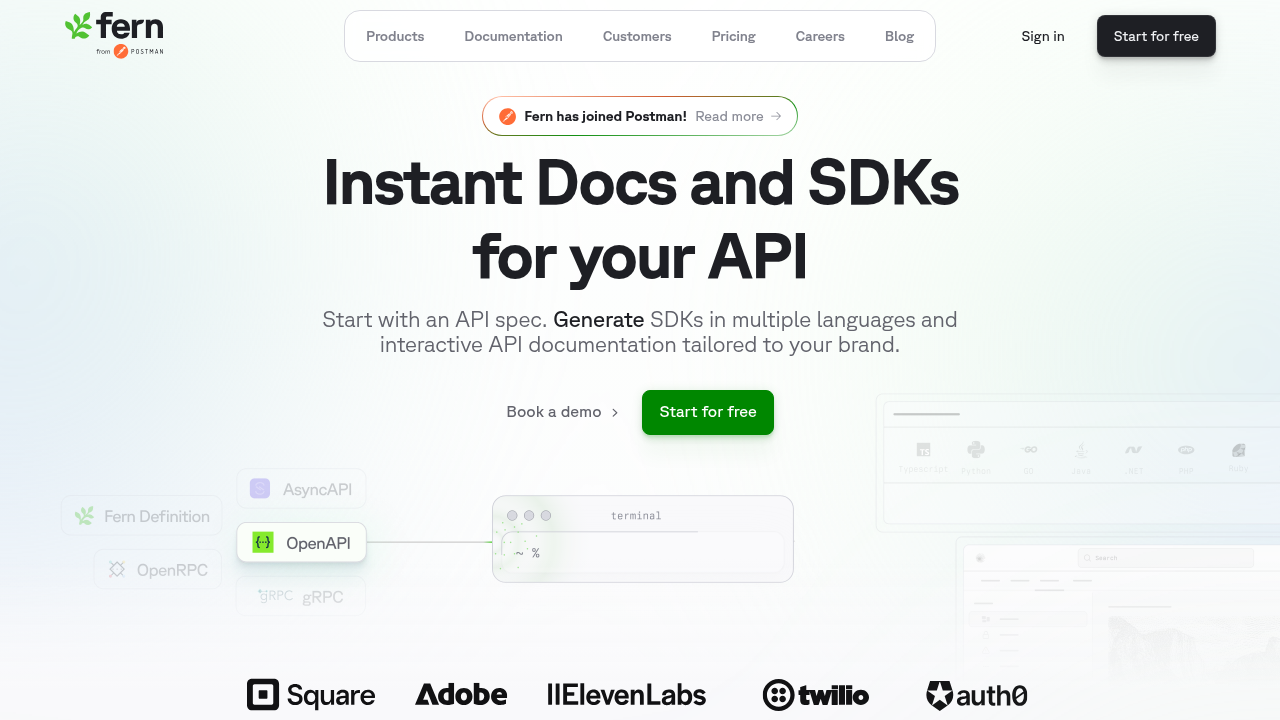
Fern combines documentation, strongly typed multi-language SDK generation, streaming protocol support (SSE/WebSockets), and CI-driven workflows into a single spec-based system.
The platform creates interactive API documentation with native support for Server-Sent Events and WebSocket protocols that handle real-time token streams from LLMs. The built-in API explorer allows developers to test streaming endpoints directly in-browser with OAuth 2.0 authentication and automatic credential injection.
Ask Fern answers technical questions using retrieval-augmented generation grounded in your documentation content. Automatic llms.txt generation makes APIs accessible to coding assistants like Cursor and Claude Desktop, while automatic code examples appear in multiple languages for every endpoint.
For companies exposing real-time model APIs with complex response types, Fern handles streaming protocols, type-safe SDK generation, and documentation maintenance from a single specification. It's best suited for AI platforms prioritizing correctness, automation, and SDK quality at scale.
Mintlify
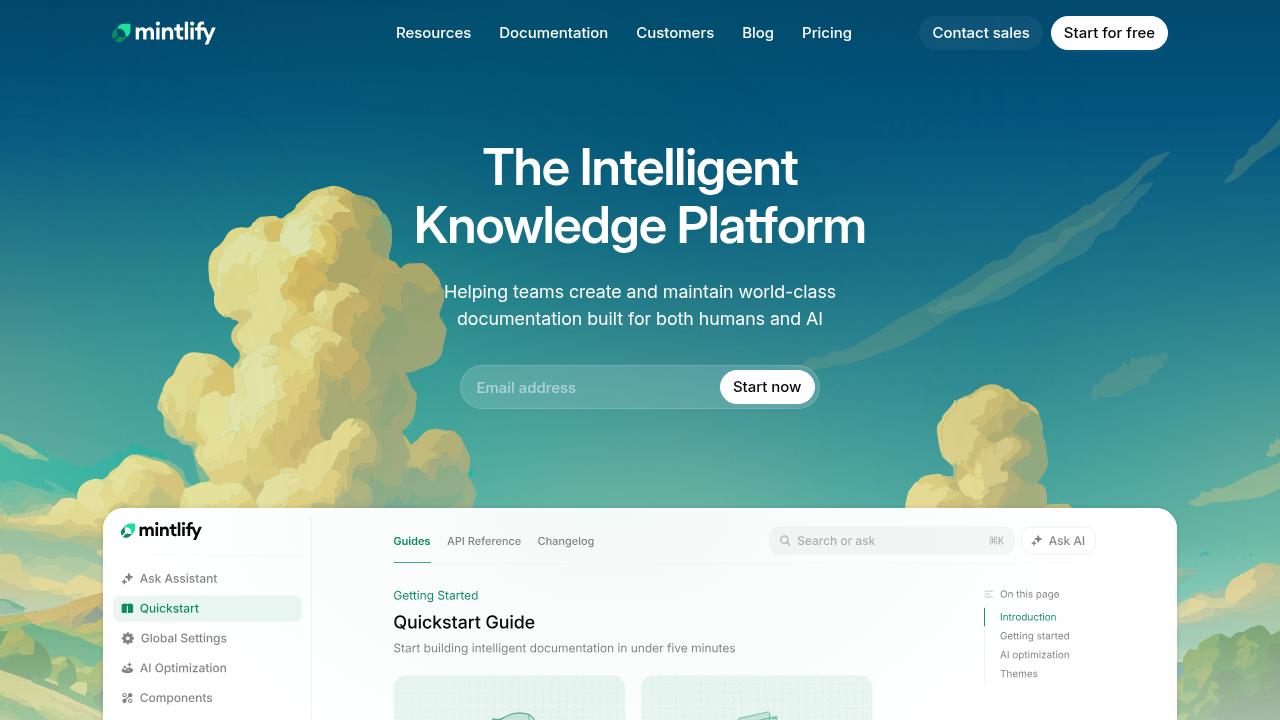
Mintlify is a documentation builder designed for startups seeking fast deployment with visual editing capabilities. The platform generates API reference pages from OpenAPI specifications and supports MDX-based content authoring with interactive components.The service provides API reference generation from OpenAPI specs, visual MDX editing with custom components, AI-powered chat search, and GitHub integration for version control workflows. Mintlify works well for early-stage companies that need to ship documentation quickly without extensive customization requirements.
While Mintlify provides modern documentation features, it lacks the deeper, integrated developer tooling ecosystem that engineering-heavy AI/ML teams often require. There is no native SDK generation capability, meaning teams must build and maintain client libraries separately. Code examples exist but are not generated from SDK source, creating potential drift between documented usage and actual client library behavior. Its interactive playground supports WebSocket connections but doesn't support Server-Sent Events — the protocol most commonly used for LLM token streaming — which is a meaningful gap for AI/ML API documentation.
Mintlify is a strong choice for startups that need fast, visually driven API documentation, but its lack of native SDK generation and limited support for streaming or complex ML APIs makes it less suited for engineering-heavy teams. Companies with advanced integration or typed-model requirements may need to pair it with other developer tooling to ensure accuracy and maintainability.
ReadMe
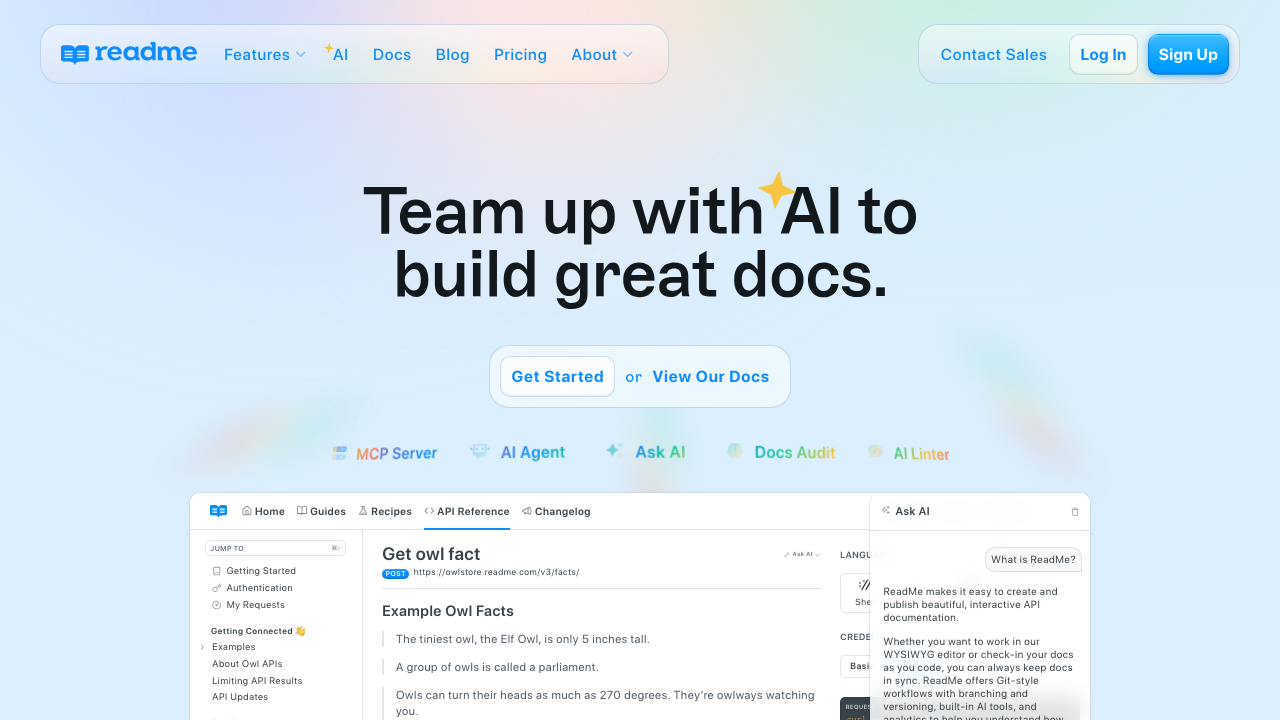
ReadMe provides hosted API documentation with interactive reference pages and full developer portal capabilities. The platform includes built-in “try it out” functionality, documentation analytics, changelog management, and customizable branding to support cohesive developer experiences.
The platform is well suited for organizations that prioritize documentation analytics, usage tracking, and a polished developer hub. It combines interactive API references with user metrics and portal features that help teams understand engagement and adoption patterns.
These strengths in interactive portals and analytics come with trade-offs. The interactive API testing environment does not natively support streaming protocols such as Server-Sent Events or WebSockets, which are critical for many AI and ML applications. In addition, its hybrid CMS and Git synchronization model can introduce merge conflicts and workflow complexity for larger teams, compared with fully docs-as-code approaches where the repository serves as the single source of truth.
For AI and ML APIs that rely on streaming responses and complex type systems, the absence of native SDK generation is a meaningful limitation. Teams must build and maintain their own client libraries to handle Server-Sent Events, WebSocket connections, and discriminated unions commonly used in ML model responses.
GitBook
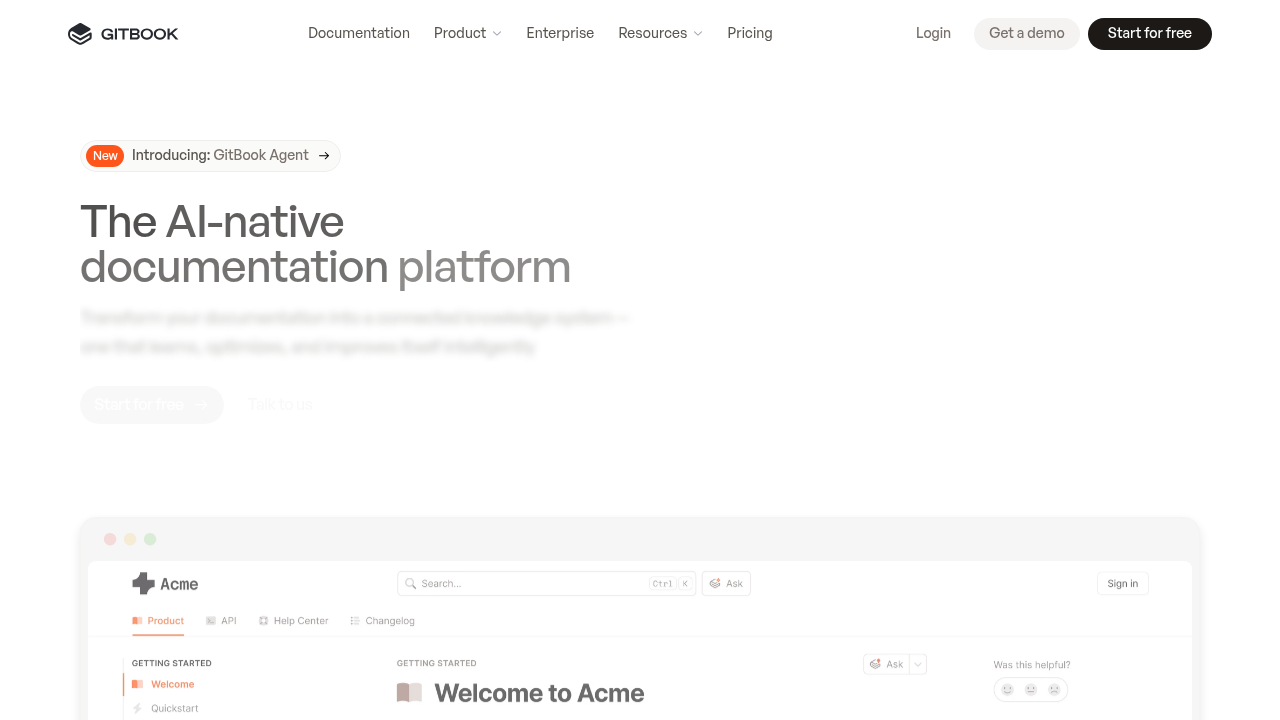
GitBook provides a web-based documentation and knowledge base platform built around a WYSIWYG editor. It supports Git integration with branch workflows, custom domains, and structured content organization through spaces and collections. This makes it well suited for cross-functional teams that need collaborative editing, review workflows, and centralized documentation management without requiring a fully code-first setup.
GitBook includes an OpenAPI-powered "Test it" playground for endpoint testing, auto-updating API reference generation from OpenAPI specs, CI/CD integration for keeping specs in sync, and AI search through its GitBook Assistant. It also auto-generates llms.txt and llms-full.txt for all published docs.
Where GitBook falls short for AI and ML teams is SDK generation and streaming protocol support. The platform does not generate SDKs or client libraries, meaning teams must build and maintain those separately. Its playground is built on standard REST testing via Scalar and doesn't support streaming protocols like Server-Sent Events or WebSockets, which are central to most LLM API implementations. Teams with complex, rapidly evolving model APIs may also find the WYSIWYG-first workflow less suited to spec-driven, automation-heavy documentation pipelines.
Feature comparison table of API documentation tools for AI and ML companies
The table below compares technical capabilities across API documentation tools for AI and ML companies.
| Feature | Fern | Mintlify | ReadMe | GitBook |
|---|---|---|---|---|
| Interactive API documentation | Yes | Yes | Yes | Yes |
| Streaming protocol support (SSE/WebSocket) | Yes | WebSocket only | No | No |
| AI search and assistant | Yes | Yes | Yes | Yes |
llms.txt generation | Yes | Yes | Yes | Yes |
| Self-hosted deployment | Yes | No | No | No |
| CI/CD native workflow | Yes | Yes | Yes | Yes |
| Auto-generated code examples | 9 languages | Yes | Yes | Yes |
| SDK generation | Yes | No | No | No |
Why Fern is the best API documentation solution for AI and ML companies
Fern provides interactive documentation with native streaming protocol support, handling the real-time responses that define AI and ML APIs. The built-in API explorer tests Server-Sent Events and WebSocket endpoints directly in the browser, letting developers see token-by-token LLM outputs or continuous audio streams without building test environments.
AI-native documentation features include retrieval-augmented search through Ask Fern, automatic llms.txt generation for AI coding assistants, and auto-generated code examples in multiple languages for every endpoint. These capabilities serve both human developers integrating your API and autonomous agents that need machine-readable specifications.
Teams working with evolving ML models benefit from CI/CD integration that regenerates documentation automatically when API definitions change. Fern also generates type-safe SDKs in 9+ programming languages from the same specification, keeping client libraries synchronized with documentation without requiring separate tools.
Final thoughts on documentation for AI-powered APIs
The right streaming API documentation makes the difference between developers successfully integrating AI models or abandoning the attempt. AI and ML companies need interactive documentation that handles real-time responses, AI-powered search that answers questions instantly, and automatic updates as models change. Fern provides comprehensive documentation capabilities with optional SDK generation from the same specification.
Teams looking to explore how this works for their API can book a demo to discuss specific requirements.
FAQ
Do you need streaming protocol support if your AI model doesn't stream responses?
Yes, if you plan to add streaming capabilities in the future. Most AI and ML companies eventually move to streaming outputs for better user experience, and migrating documentation tools mid-development creates significant overhead.
Can you generate SDKs without using a documentation platform?
You can build SDKs manually or use standalone generators, but maintaining consistency between documentation, SDKs, and API specifications requires separate tools and manual coordination. Integrated platforms like Fern handle both from a single source.
How do you test Server-Sent Events in API documentation?
Documentation platforms with native SSE support provide in-browser testing playgrounds that display real-time token streams without requiring developers to write test scripts. Tools without this feature require external testing environments.
When should you prioritize SDK generation over documentation alone?
Prioritize SDK generation when your API serves developers working in multiple programming languages or when your endpoints involve complex type structures that benefit from compile-time validation. Single-language teams with simple REST APIs may start with documentation only.
What makes AI agent compatibility different from traditional documentation?
Traditional documentation is designed for human readers — visual formatting, navigation menus, and prose explanations. AI coding assistants need a different format to accurately represent your API. llms.txt is a machine-readable index file that gives LLMs structured, plain-text context about your documentation, helping them answer developer questions accurately and generate correct integration code without hallucinating endpoint details or outdated parameters.