

Modern APIs change fast, and developers expect documentation and SDKs to keep pace. They also want interactive docs, accurate code samples, multi-language support, and AI-ready content. A growing class of API documentation platforms now generates both SDKs and documentation from the same underlying spec, guaranteeing consistency, reducing manual work, and improving the developer experience.
TLDR:
- API documentation platforms help teams create, publish, and maintain clear, accurate documentation for their APIs.
- The best platforms balance automation with quality by maintaining API reference documentation that stays accurate.
- Many tools handle either SDKs or docs separately, requiring multiple vendors and manual coordination.
- Fern is the all-in-one developer experience platform providing both SDK generation and API documentation in one integrated solution.
What are API documentation platforms?
API documentation platforms help teams create, publish, and maintain clear, accurate documentation for their APIs. They bridge the gap between how an API is built and how developers actually learn, understand, and integrate with it.
These platforms provide tools for writing developer content such as guides, tutorials, and onboarding documentation using Markdown or MDX. They allow teams to customize the look and feel of their docs and publish polished documentation.
Many platforms generate API reference documentation directly from an API definition. These references clearly present endpoints, parameters, and request and response schemas in a structured, easy-to-read format. By treating the API definition as a single source of truth, these platforms reduce documentation drift and minimize inconsistencies between the API's behavior and its documentation.
To improve usability, platforms often include interactive features such as "try it out" functionality and ready-to-use code samples, allowing developers to experiment with the API directly from the documentation.
Some platforms go further by supporting SDK generation, producing both client libraries and API reference documentation from the same API definition. Generated SDKs offer idiomatic methods, typed models, and common API functionality out of the box across multiple languages. This creates a more cohesive developer experience and makes APIs faster and easier to adopt.
What makes a great API documentation platform for generating SDKs and docs?
The best platforms balance automation with quality, maintaining API reference documentation that stays accurate as your API evolves. This matters more than ever: nearly 80% of technical teams report that API documentation has become more important in the last five years, with poor docs being an immediate disqualifier for tool adoption.
Six key factors separate production-ready solutions from basic doc generators:
Interactive references
Built-in API explorers and auto-populated code snippets that let developers test endpoints immediately.
CI/CD integration
Integration with workflows like GitHub Actions to handle packaging and publishing automatically.
Protocol support
Multi-protocol support including WebSockets, Server-Sent Events, gRPC, and AsyncAPI for real-time and asynchronous APIs.
Customization and extensibility
Options to inject custom code, filter endpoints, or tailor SDK behavior without losing the ability to regenerate.
Deployment flexibility
Hosting options including custom domains, self-hosting capabilities, and access control features for enterprise requirements.
Unified output
Producing documentation and SDKs from one definition file.
Fern
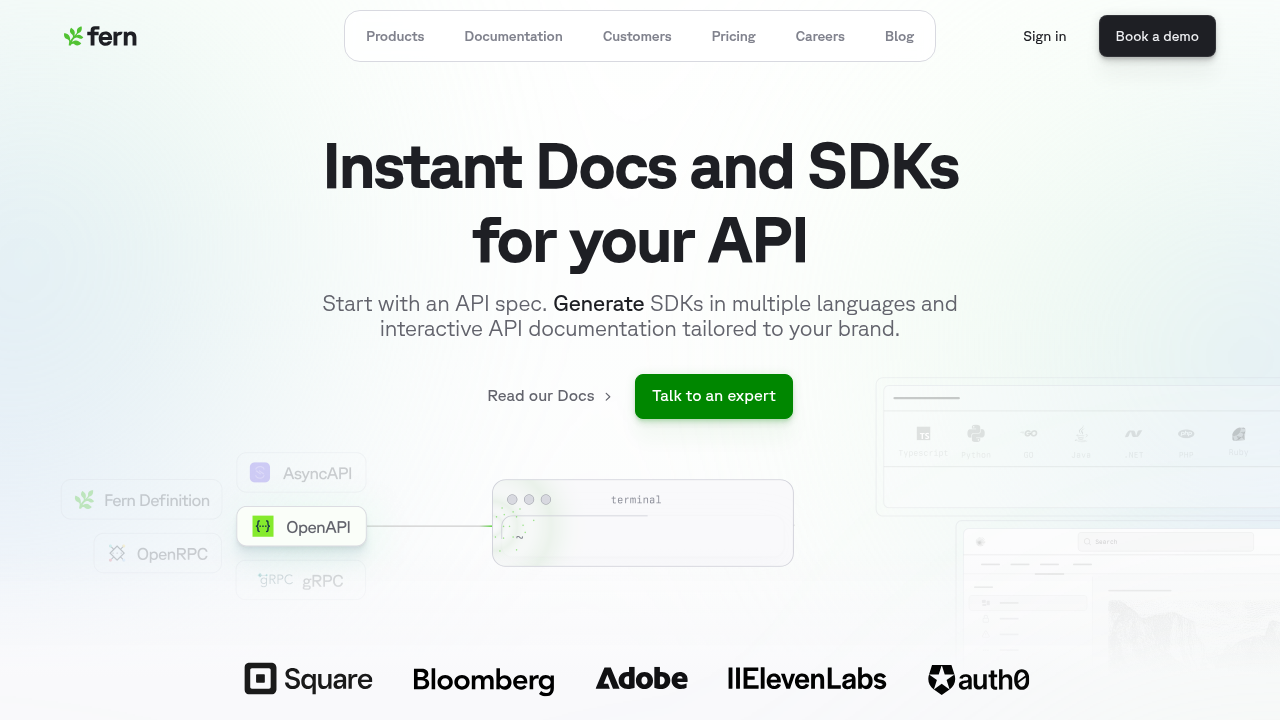
Fern is an API documentation platform that also generates SDKs, providing an end-to-end API workflow. Teams can generate SDKs in multiple languages alongside interactive API reference documentation directly from a single API definition.
Beyond reference docs and SDKs, Fern provides the structure and tooling teams need to create high-quality developer guides. Its documentation platform includes a built-in API explorer, support for MDX-based content, versioning, role-based access control (RBAC), custom branding, and enterprise SSO, allowing organizations to deliver a polished, scalable developer experience.
Key features
- Automated SDK generation in TypeScript, Python, Go, Java, C#, PHP, Ruby, Swift, and Rust with automatic publishing to package registries.
- With Fern, the API documentation and the SDKs are generated from the same source of truth, so they stay perfectly in sync.
- Multi-protocol support spanning REST (OpenAPI), WebSockets (AsyncAPI), Server-Sent Events, gRPC, and OpenRPC, making it well suited for real-time and asynchronous APIs.
- AI-native documentation features, including embedded AI Search, automatically generated MCP servers, and automatic
llms.txtgeneration. - Fern is built for developers, offering a CLI and config files that integrate easily with Git and CI pipelines.
Limitations
Fern requires adopting a spec-first workflow and committing to maintaining an API definition file. Teams without existing specs or those used to code-first approaches will need to adjust their development process.
The bottom line
Fern combines SDK generation, interactive API documentation, and AI-powered search in a single, unified solution. While many competitors focus on only one part of the developer experience, Fern brings everything together, eliminating the need for teams to stitch multiple tools into a fragmented workflow.
ReadMe
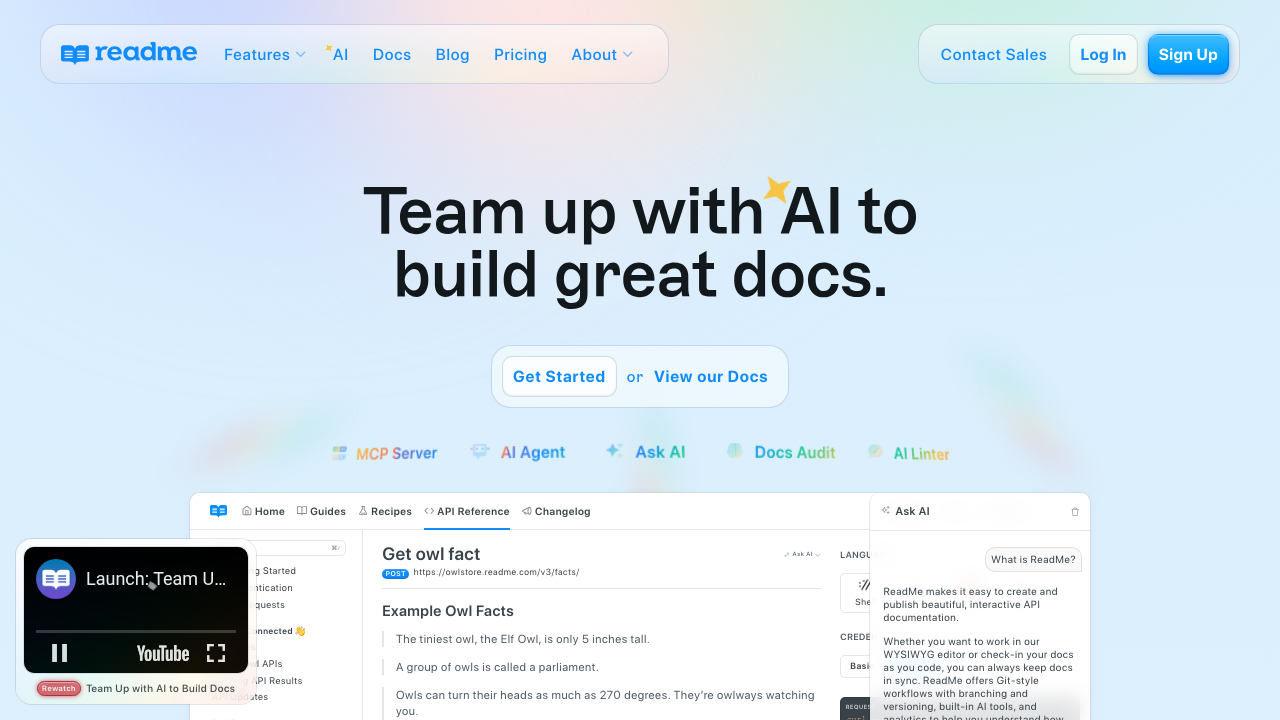
ReadMe is a developer documentation platform for creating interactive API docs and guides that help teams onboard and support developers. It combines API reference documentation, "try it out" functionality, and content with analytics to understand how developers use the docs.
Key features
- Interactive API reference with try-it-out functionality.
- Customizable developer portal with branding options.
- Metrics and analytics for documentation usage.
- Changelog and versioning capabilities.
Limitations
ReadMe does not generate SDKs. Teams must build and maintain client libraries separately or rely on developers to work directly with raw API endpoints.
The bottom line
ReadMe works well for teams seeking a straightforward documentation solution with strong metrics capabilities. It's best suited for those who primarily need reference documentation and don't require SDK generation. If you need both SDKs and docs, you'll need to adopt multiple tools and manage separate workflows.
GitBook
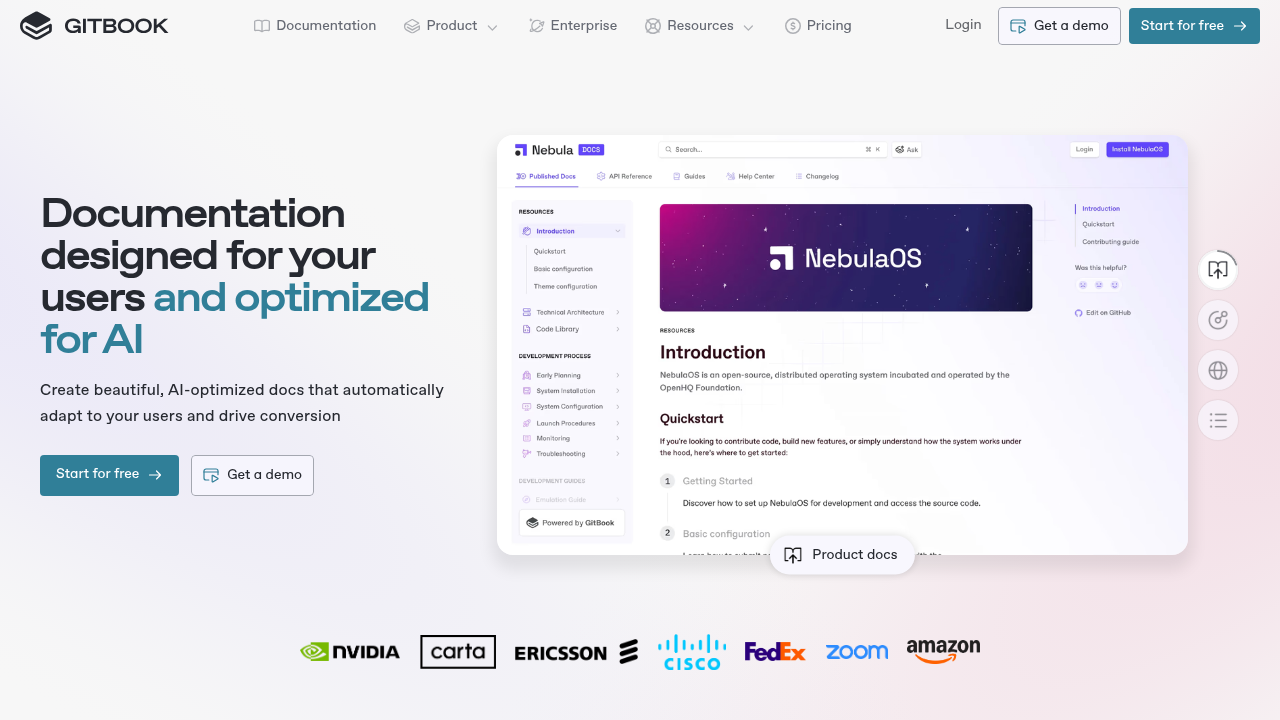
GitBook is a collaborative documentation platform used to create, manage, and publish product, internal, and developer documentation. It focuses on structured content, team collaboration, and integrations, making it well suited for knowledge bases and shared documentation at scale.
Key features
- Git-based documentation with branch and merge workflows for version control.
- Collaborative editing features including commenting and review capabilities.
- Custom domain support with branding customization options.
- Content organization through spaces and collections.
Limitations
GitBook auto-generates API references from OpenAPI specs and supports interactive "Test it" blocks, but it doesn't generate SDKs and doesn't extend beyond REST to protocols like WebSockets, SSE, gRPC, or OpenRPC. If your team relies on spec-first development with multi-protocol or SDK requirements, GitBook won't enforce or build on that.
The bottom line
GitBook is a solid choice for teams that need a general-purpose knowledge base with optional Git integration, especially when the API is small or stable enough that manual updates aren't burdensome. However, it becomes limiting for teams that need strict spec-to-doc alignment, low-maintenance automation, or support for multiple API versions.
Stainless
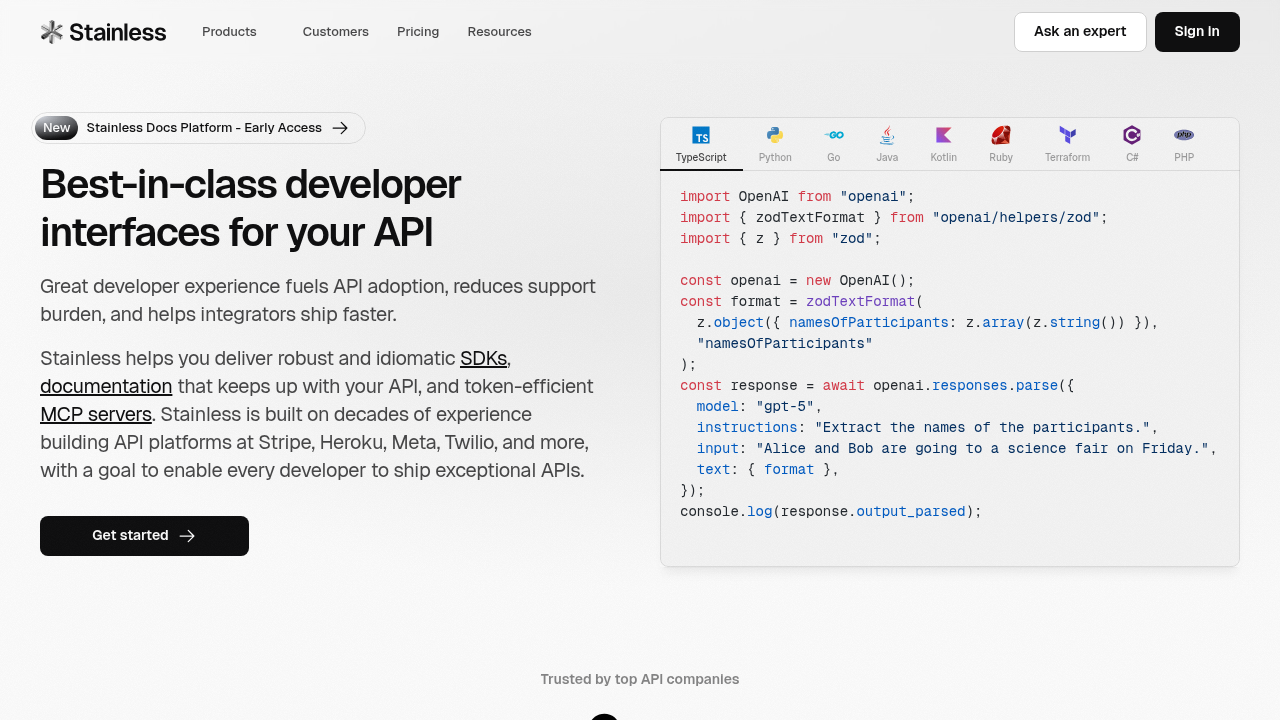
Stainless generates SDKs through a dashboard-centric interface. The tool covers several programming languages and handles basic REST API client library creation.
Key features
- SDK generation for TypeScript, Python, Go, Java, Kotlin, Ruby, C#, PHP, and Terraform with automated package publishing.
- Web dashboard for SDK configuration.
- OpenAPI specification support with validation and linting.
- Automated changelog generation tracking SDK updates across versions.
Limitations
Stainless does not support WebSockets, gRPC, or OpenRPC. Its documentation platform launched in 2025 and is newer than Fern's, with less accumulated track record for teams considering production-grade developer portals.
The bottom line
Stainless handles REST SDK generation well and has expanded its language support and feature set considerably in 2025. It fits teams that want high-quality REST SDK generation with a dashboard workflow, though teams needing broader protocol support or a more mature docs platform may find Fern a better fit.
Mintlify
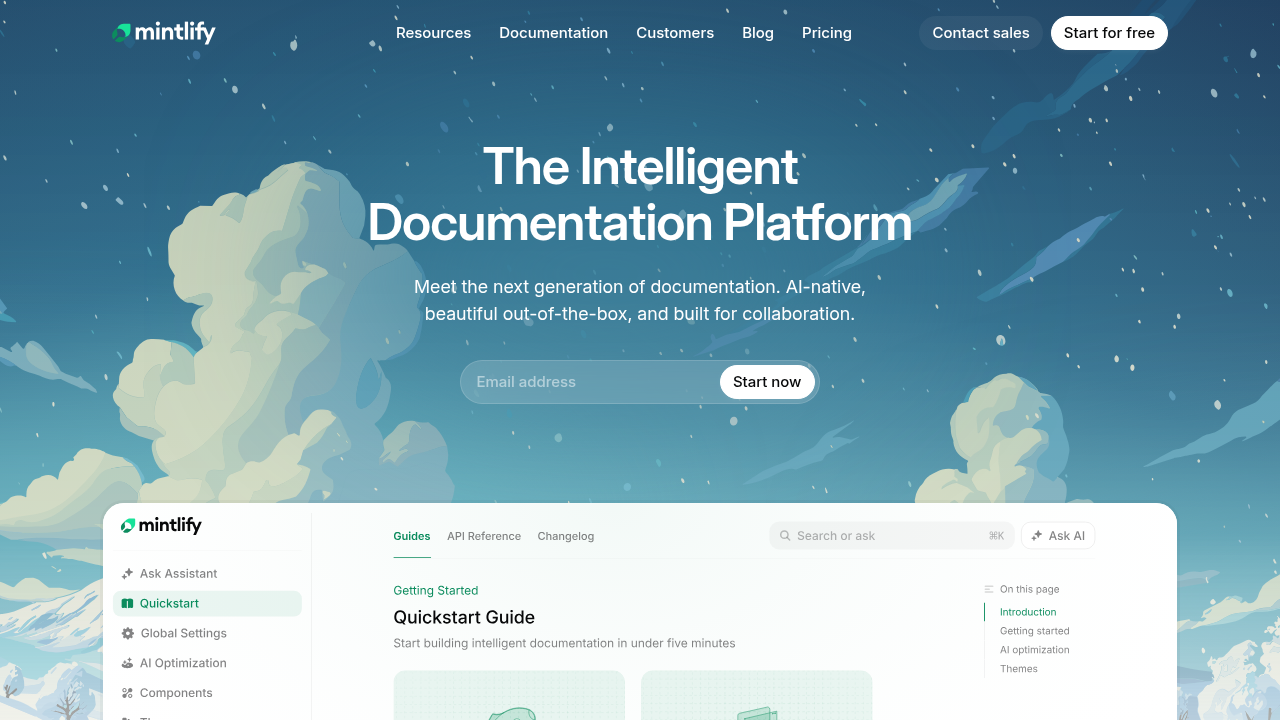
Mintlify is a modern documentation platform for APIs and developer tools that focuses on design, performance, and ease of authoring. It generates API references from OpenAPI specs and combines them with Markdown or MDX guides to create polished, product-quality developer documentation.
Key features
- API reference generation from OpenAPI specifications.
- MDX-based content authoring with components.
- Built-in search and AI chat features.
- Custom domains and theme customization.
Limitations
Mintlify does not provide SDK generation, so teams needing SDKs must combine multiple tools that may interpret the OpenAPI spec differently. This can lead to stale code snippets, inconsistent examples, and added workflow complexity. Mintlify also lacks self-hosting or on-prem deployment options and does not offer content-level RBAC for multi-tier documentation.
The bottom line
Mintlify serves documentation needs for smaller organizations but doesn't have the enterprise features and SDK generation capabilities that many growing API companies require.
Feature comparison table
The table below compares key capabilities across leading API documentation platforms.
| Feature | Fern | ReadMe | GitBook | Stainless | Mintlify |
|---|---|---|---|---|---|
| SDK generation | Yes | No | No | Yes | No |
| API reference docs | Auto-generated | Auto-generated | Auto-generated (OpenAPI) | Auto-generated | Auto-generated |
| Protocol support | REST, WebSocket, SSE, gRPC, OpenRPC | REST only | REST only | REST only | REST only |
| Self-hosting | Yes | No | No | No | No |
| Content-level RBAC | Yes | No | No | N/A | Dashboard only |
| AI Assistant | Yes | Limited | No | No | Yes (lightweight) |
Why choose an integrated platform like Fern
Fern is the all-in-one developer experience platform providing both SDK generation and API documentation in one integrated solution. With this unified approach, your team doesn't need to stitch together multiple tools to deliver a complete developer experience for your APIs.
Its broad spec and protocol support gives teams far more flexibility, making Fern a strong fit for organizations with diverse or evolving API architectures.
Fern also includes advanced platform-level capabilities such as RBAC, self-hosting options, and AI-powered developer assistance, offering more configurability than one-size-fits-all competitors.
It's designed for both fast-moving startups and mature API companies that need a premium developer experience, as well as larger enterprises that must maintain high-quality, multi-language SDKs and documentation without pulling engineering focus away from core product work.
Final thoughts on API documentation and SDK tooling
APIs power the modern internet, yet integration remains tedious and error-prone. Inconsistent and fragmented documentation is one of the biggest blockers for API teams, increasing friction throughout the development lifecycle. Platforms that generate both SDKs and documentation from a single API specification deliver a far smoother developer experience, making integration and long-term maintenance faster, more reliable, and far less manual.
Fern brings these capabilities together in one unified platform, using a single source of truth so SDKs and API reference docs stay perfectly aligned to the same API definition, eliminating drift and guaranteeing nothing lags behind the code.
With SDK generation in nine languages and documentation features like RBAC and AI-powered support, Fern supports the full developer workflow, while many alternatives focus on narrower slices of the problem. The right choice depends on whether you need an all-in-one platform or prefer stitching together specialized tools.
FAQ
How to keep SDKs and documentation synchronized when APIs change
Use a platform that generates both SDKs and docs from the same API specification. When you update your spec and run the generation process, both artifacts update together automatically, preventing drift between client libraries and documentation.
What's the main difference between platforms that only generate docs versus all-in-one solutions?
Documentation-only platforms require you to build and maintain SDKs separately, often leading to inconsistent code examples and manual coordination, while all-in-one platforms generate both from a single source of truth to keep everything aligned.
Is it possible to add custom logic to auto-generated SDKs without breaking future updates?
Yes, platforms like Fern allow you to inject custom utility functions or method overrides that persist across regenerations. Your additions won't be overwritten when you regenerate SDKs after API updates.
When to choose a spec-first approach over code-first API development
If you need to maintain multiple SDKs, extensive documentation, or serve both human developers and AI agents, a spec-first workflow provides a single source of truth that prevents documentation lag and guarantees all artifacts stay synchronized.
What protocols are needed to support real-time API features beyond REST?
For streaming data and real-time communication, look for platforms that support WebSockets and Server-Sent Events (SSE) in addition to REST. Many documentation tools only handle standard HTTP endpoints.