
As APIs become the primary interface for modern products, the quality of the developer experience—accurate reference documentation, up-to-date client SDKs, and disciplined version and lifecycle management—has emerged as a key differentiator. API-first development platforms address this by treating the API specification, typically OpenAPI, as the single source of truth that drives both SDK generation and reference documentation. When executed well, this model reduces manual overhead, enforces consistency across languages, and ensures documentation and client libraries evolve in lockstep with the API.
Implementation quality varies across platforms. Some tools still produce SDKs and documentation through loosely coupled workflows, increasing the risk of drift as APIs change. Others fully embrace an API-first approach, tightly integrating SDK and documentation generation with shared versioning, customization, and automated publishing pipelines. This article evaluates leading API-first development platforms through the lens of how effectively they support SDK and reference documentation generation, with a focus on multi-language support, version management, and sustained alignment between code and documentation in real-world API lifecycles.
TLDR:
- API-first development defines your API contract before implementation to prevent drift.
- Fern generates type-safe SDKs in 9+ languages and interactive docs from one API definition.
- Unified toolchains eliminate maintenance overhead from managing separate SDK and documentation tools.
- Fern automatically generates idiomatic client libraries with built-in OAuth, retries, and pagination.
- Fern generates SDKs and documentation from a single source of truth, used by 150+ companies.
What Is API-first development?
API-First development treats the API specification as the system’s single source of truth. Endpoints, request/response schemas, and authentication flows are defined before any implementation code is written. Establishing the API upfront provides a clear contract for how services, applications, and clients interact, promoting consistency, predictability, and scalability across the software ecosystem.
By emphasizing the design phase, API‑First ensures all stakeholders align on the API’s structure and behavior early in the process. This reduces rework and guarantees that downstream artifacts—such as SDKs, client libraries, and documentation—remain accurate and reliable. It also supports parallel development, allowing frontend and backend teams to work simultaneously against a stable API contract. Treating APIs as first-class products results in more consistent, reusable, and discoverable interfaces, enhancing efficiency, maintainability, and long-term scalability.
Evaluation criteria for API-first platforms
Choosing the right API-first solution requires looking beyond simple documentation hosting. With API strategy becoming AI strategy, the ability for tools to support both human developers and AI agents is critical. Solutions should handle the entire lifecycle, from design to consumption, ensuring the platform scales with evolving demands.
Evaluation focuses on the quality of automated outputs. Strong systems generate idiomatic, type-safe SDKs across multiple major languages without manual intervention. For documentation, tools are assessed on how effectively they convert OpenAPI specs into interactive, search-optimized references. The best options synchronize these artifacts directly from the source of truth to prevent drift.
Integration into existing engineering workflows is critical. Solutions are judged on how well they fit into CI/CD pipelines (GitHub Actions, GitLab CI) to automate publishing. Support for diverse standards, such as OpenAPI and AsyncAPI, is essential, as these remain widely used in complex architectures.
Developer experience features that reduce friction are also important. This includes testing utilities like local previews or integrated API explorers, versioning and changelog handling, and advanced capabilities such as automatic error documentation and support for authentication flows which are key elements for enterprise-grade API delivery.
Best overall API-first development tool: Fern
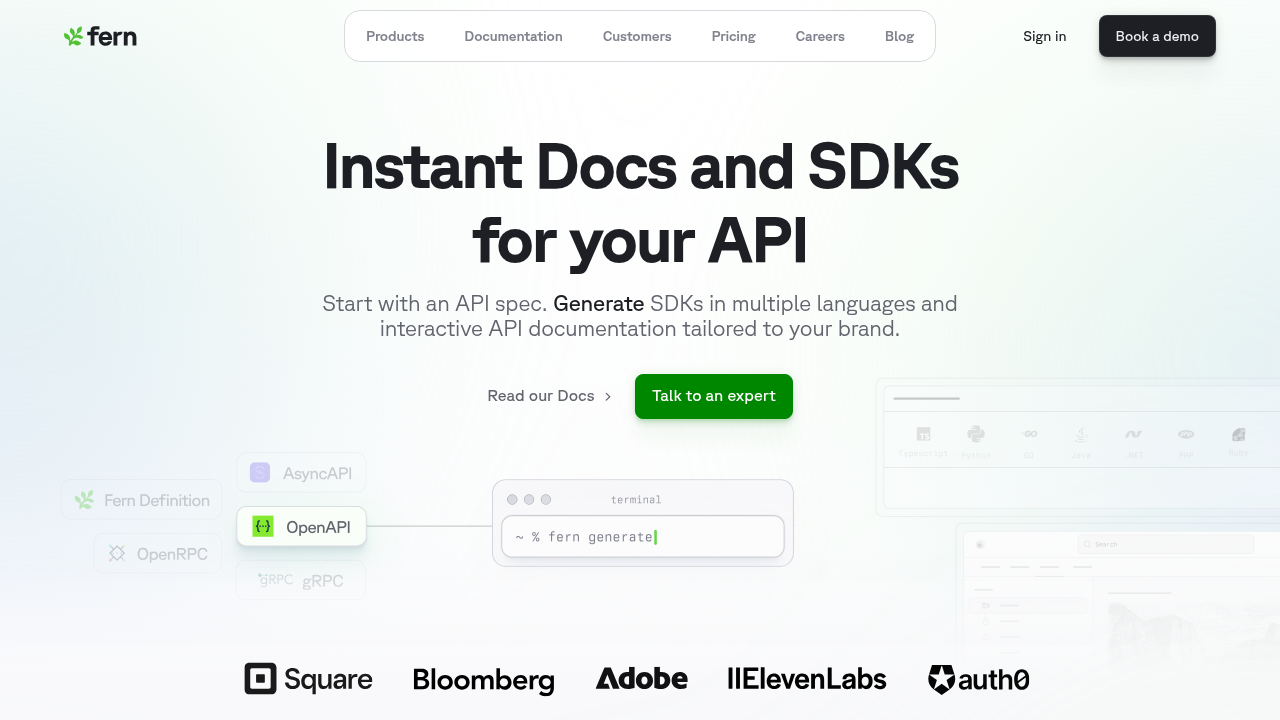
Fern unifies SDK generation and documentation into a single workflow, ensuring artifacts never drift from the definition. By treating your API specification—OpenAPI, AsyncAPI, or Fern Definition—as the source of truth, you automatically generate client libraries and reference sites synchronized with every commit. This eliminates the maintenance burden of stitching together separate tools.
Key capabilities:
- Generates both SDKs (9+ languages) and interactive API reference docs from a single API definition.
- Deploy interactive documentation featuring an API Explorer for testing endpoints directly, complete with auto-generated code snippets in every supported language.
- Enable Ask Fern, an AI assistant that indexes your documentation and SDK code to provide accurate, cited answers to developer questions.
- Integrate the Fern CLI into GitHub Actions or GitLab CI to publish packages to registries like npm, PyPI, and Maven Central automatically.
Bottom line:
Fern provides a complete developer experience with SDKs in multiple languages, synchronized documentation, and AI-powered support from one integrated toolchain. The key advantage of this unified approach is the level of control it provides. You can customize how SDK elements are presented in your API reference and document error responses with detailed schemas. Its AI-powered search accesses both SDK code and documentation, enabling more thorough and accurate query results. This combination of automation and flexibility sets Fern apart from platforms that produce rigid, one-size-fits-all references, giving you the benefits of spec-driven generation while tailoring the presentation layer to your specific needs.
Mintlify
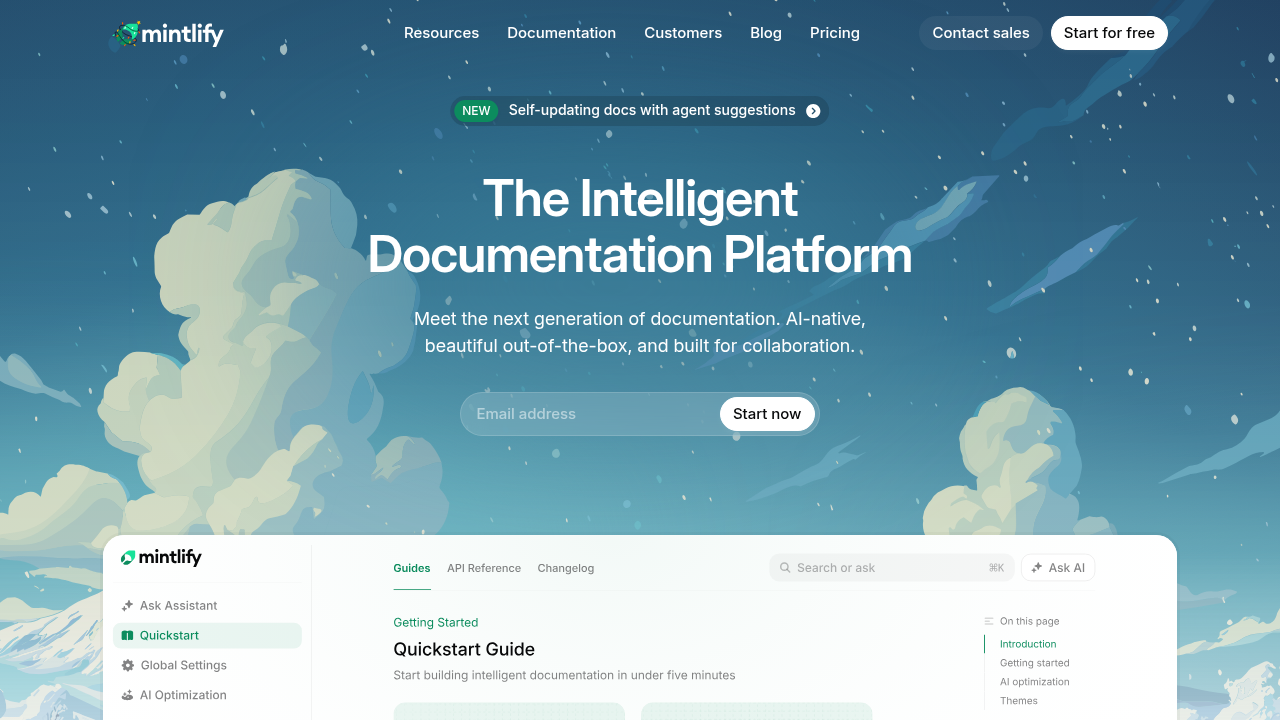
Mintlify builds search-optimized developer sites with minimal configuration. It converts OpenAPI files into interactive references and manages guides using Markdown, allowing teams to launch public-facing documentation quickly.
Key capabilities:
- Create documentation using Markdown, React components, and customizable themes.
- Generate API references from OpenAPI specifications with features for interactive exploration.
- Provide AI-powered search to help users locate information within the guides.
- Deploy updates automatically via a Git-based workflow on every commit.
Limitations:
Mintlify focuses exclusively on documentation generation. Teams must maintain SDKs separately and manually write code examples, which increases drift risk when APIs evolve. Access control is limited to dashboard permissions rather than specific page visibility, and multi-product support often requires duplicating content across folders.
Bottom line:
Mintlify handles documentation-only use cases well for teams comfortable managing SDKs through other means. However, the separation between documentation and client libraries creates maintenance overhead. When your API changes, you must update the OpenAPI spec, regenerate documentation, and separately update SDK code and examples.
Speakeasy
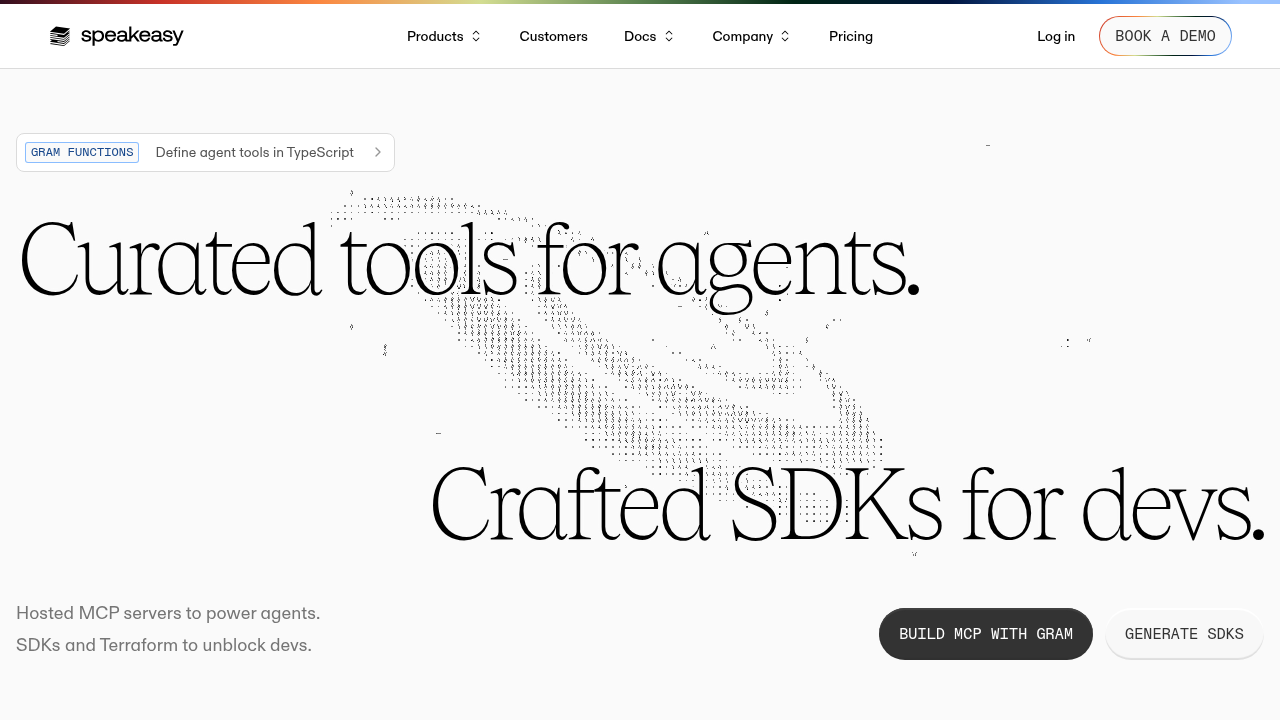
Speakeasy focuses strictly on generating client libraries from OpenAPI specifications. It targets engineering teams looking to automate the creation of SDKs and Terraform providers without maintaining the generation logic internally.
Key capabilities:
- Generate SDKs in TypeScript, Python, Go, Java, C#, and PHP.
- Manage configuration and generation settings through a web-based dashboard.
- Create Terraform providers to support infrastructure-as-code use cases.
- Automate updates via GitHub integration to publish packages when specs change.
Limitations:
Speakeasy does not provide documentation generation. Teams must integrate a separate documentation platform, which creates two distinct workflows and increases the risk of artifacts drifting from API specification. The code structure uses a flattened namespace approach rather than nested organization, which can make navigation difficult in APIs with large surfaces areas.
Bottom line:
Speakeasy handles SDK generation for teams comfortable managing documentation separately. For organizations that need both SDKs and documentation from a single source of truth, Fern provides an integrated toolchain that ensures consistency across all developer-facing artifacts.
Stainless
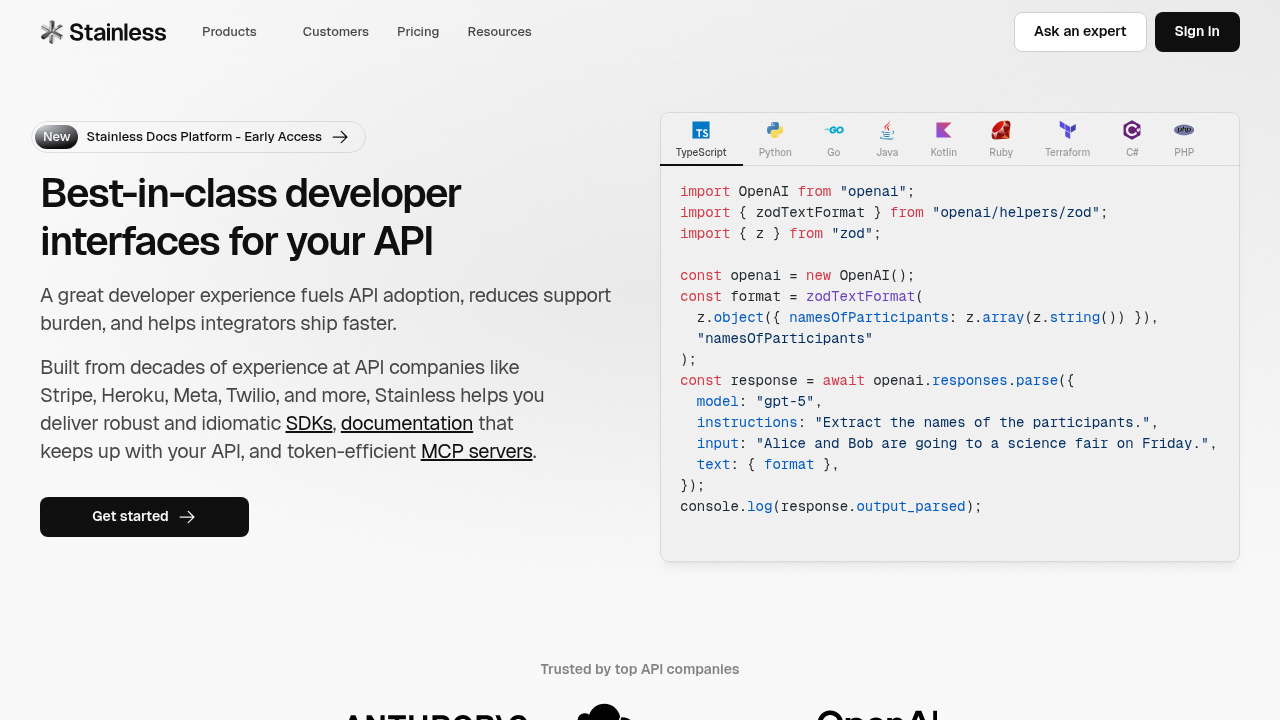
Stainless provides a dashboard-driven approach to generating client libraries. Teams connect their GitHub repositories to the service, which monitors OpenAPI files and triggers updates to downstream packages automatically.
Key capabilities:
- Generate SDKs in TypeScript, Python, Go, Java, Ruby, and Kotlin.
- Manage SDK configuration through a web-based dashboard.
- Automate versioning and publishing to package registries.
- Integrate with existing OpenAPI workflows through GitHub monitoring.
Limitations:
Stainless does not support real-time protocols like WebSockets or Server-Sent Events (SSE), nor does it fully support OpenAPI 3.1.1. The documentation product remains in beta, lacking the depth of established tools. There is also no option for on-premises deployment, which restricts usage for security-conscious enterprises.
Bottom line:
Stainless handles REST API SDK generation through a dashboard-driven workflow but lacks protocol breadth and unified artifact management. For teams requiring WebSockets, SSE, or gRPC support alongside REST, or those needing synchronized documentation and SDKs from a single source of truth, Fern provides comprehensive coverage with full OpenAPI 3.1.1 support and on-premises deployment options for enterprises with strict governance requirements.
Stoplight
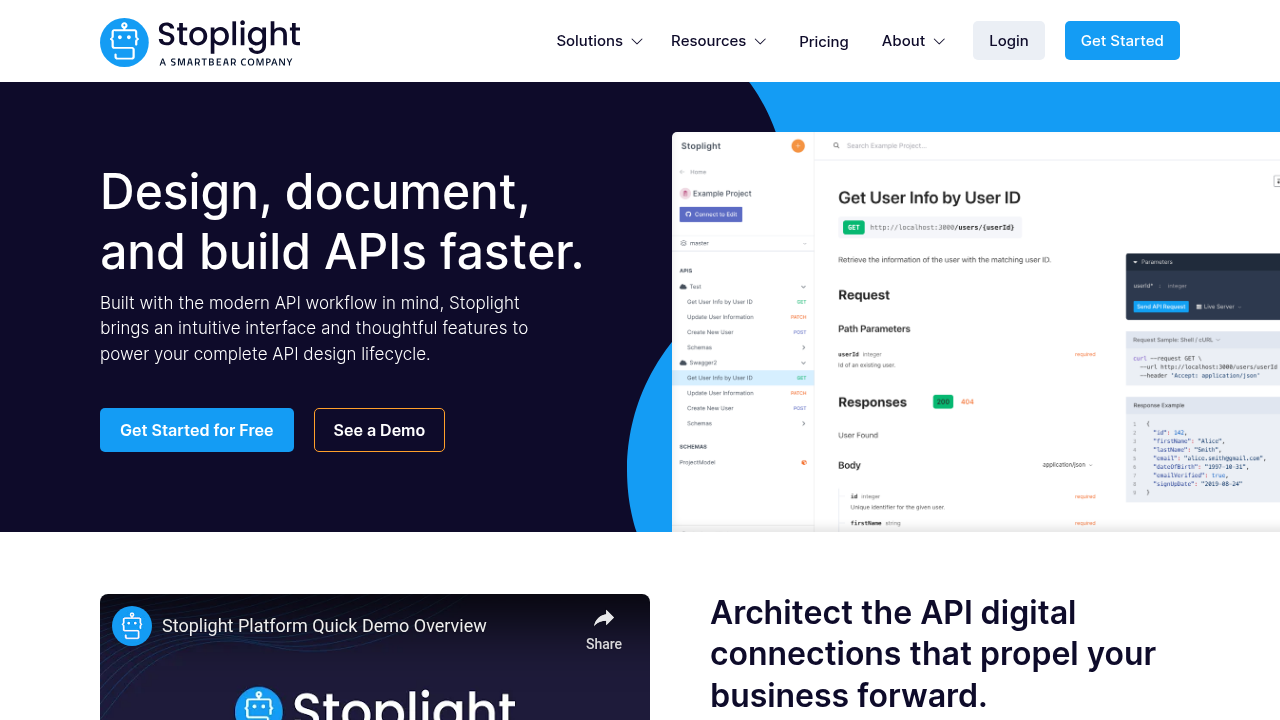
Stoplight provides API design and documentation tools centered around OpenAPI specifications. The platform emphasizes collaborative design workflows and style guide enforcement, targeting teams that want to standardize API development practices across multiple projects.
Key capabilities:
- Design APIs visually through a form-based editor or directly in OpenAPI/JSON Schema.
- Generate API reference documentation from OpenAPI specifications with customizable themes.
- Enforce API design standards using Spectral, an open-source linting engine for validating specs.
- Review workflows with commenting and approval processes for API changes.
Limitations:
Stoplight focuses on the design and documentation phases, but lacks automated SDK generation, publishing workflows, or integrated AI-powered search. Teams must coordinate multiple tools to deliver both documentation and client libraries, increasing maintenance overhead when APIs evolve.
Bottom line:
Stoplight serves teams prioritizing API design governance and collaborative spec development. However, organizations requiring synchronized SDKs and documentation from a single source of truth will need to supplement Stoplight with additional tooling.
Feature Comparison Table of API-First Development Tools
Selecting the right platform depends on whether you need a unified toolchain or a specialized component. The matrix below compares the top contenders based on critical engineering requirements, from language breadth to deployment flexibility.
| Feature | Fern | Mintlify | Speakeasy | Stainless | Stoplight |
|---|---|---|---|---|---|
| SDK Generation | Yes (9+ languages) | No | Yes (6+ languages) | Yes (6+ languages) | No |
| Documentation Generator | Yes | Yes | No | Beta | Yes |
| Unified SDKs & Docs | Yes | No | No | No | No |
| AI-Powered Search | Yes (Ask Fern) | Yes | N/A | No | No |
| WebSockets & SSE Support | Yes | Docs only | SDKs only | No | Docs only |
| On-Premises / VPC Option | Yes | No | No | No | No |
This comparison highlights a distinct gap in the market. While tools like Mintlify excel at documentation and Speakeasy focuses on libraries, Fern provides the only comprehensive solution that synchronizes both artifacts from a single source of truth.
Why Fern is the best API-first development tool
Most API strategies struggle with toolchain fragmentation, where documentation and client libraries live in separate silos. Fern eliminates this friction by generating your entire developer ecosystem from a single API definition. This unified workflow ensures that every time you commit a change to your spec, your SDKs and documentation update simultaneously. You remove the risk of drift and the administrative overhead of managing multiple vendors, allowing your engineering resources to focus on the API itself rather than its distribution.
The solution distinguishes itself through the technical quality of its output. You get idiomatic, type-safe SDKs that adhere to the specific best practices of languages like TypeScript and Python. These libraries include essential reliability features—such as automatic pagination, retries with exponential backoff, and authentication management—out of the box. Your developers receive code that feels handwritten and trustworthy, accelerating their time to the first successful API call.
By synchronizing these artifacts with AI-powered documentation, Fern enables teams of any size to deploy a quality developer experience. You no longer need a dedicated infrastructure team to maintain a comprehensive support system. Instead, you can provide users with a cohesive, professional interface that simplifies integration and scales with your product, making Fern the definitive choice for API-first development.
Final thoughts on API development toolchains
The right API-first developer toolchain depends on whether you need synchronized artifacts or can manage separate systems. Fern generates both SDKs and documentation from your API specification, which means your client libraries and reference sites update together automatically. You get idiomatic code across 9+ languages and interactive docs that stay accurate with every spec change. For teams building APIs that serve multiple products and languages, this unified approach removes the complexity of coordinating different tools and gives your developers a consistent experience.
FAQ
How do I choose the right API-first development tool for my team?
Start by determining whether you need SDK generation, documentation, or both. If you require synchronized client libraries and reference sites from a single source of truth, Fern provides the only unified solution. For documentation-only needs, Mintlify or Stoplight may suffice, while Speakeasy focuses exclusively on SDK generation.
Which API-first platform works best for teams with limited engineering resources?
Fern automates both SDK generation and documentation from your API specification, eliminating the need to maintain separate toolchains. This reduces the engineering burden compared to stitching together multiple vendors, allowing small teams to deliver a complete developer experience without dedicated infrastructure staff.
Can I use these tools if my API includes WebSockets or Server-Sent Events?
Fern supports WebSockets and SSE in both generated SDKs and the interactive API Explorer. Stainless does not support real-time protocols, while Mintlify and Stoplight only handle them in documentation without corresponding SDK support.
What's the difference between unified and specialized API tooling?
Unified platforms like Fern generate SDKs and documentation from the same API definition, preventing drift between artifacts. Specialized tools focus on one area, either SDKs or docs, requiring you to manage separate workflows and increasing the risk of inconsistencies.
When should I consider self-hosting my API documentation?
Self-hosting is necessary when you have strict data residency requirements, need to deploy behind a VPC, or operate in air-gapped environments. Fern offers on-premises deployment options, while Mintlify and Stoplight do not support self-hosted infrastructure.