
When comparing Fern vs ReadMe, the primary consideration is scope. ReadMe generates interactive API documentation from an OpenAPI specification. Fern generates documentation alongside production-ready SDKs in 9+ languages, automates publishing to package registries, and keeps code snippets perfectly in sync with the client libraries. Teams maintaining SDKs separately from their documentation understand how quickly those assets drift out of sync.
TLDR:
- Choose ReadMe for standard hosted API reference documentation, but select Fern to automate both documentation and SDK generation in 9+ languages.
- Publish client libraries directly to package registries like npm, PyPI, and Maven automatically on every API change to prevent documentation drift.
- Maintain a Git-native workflow that integrates directly into your CI/CD pipelines, bypassing the bidirectional sync conflicts common in dashboard-based platforms.
What is ReadMe?
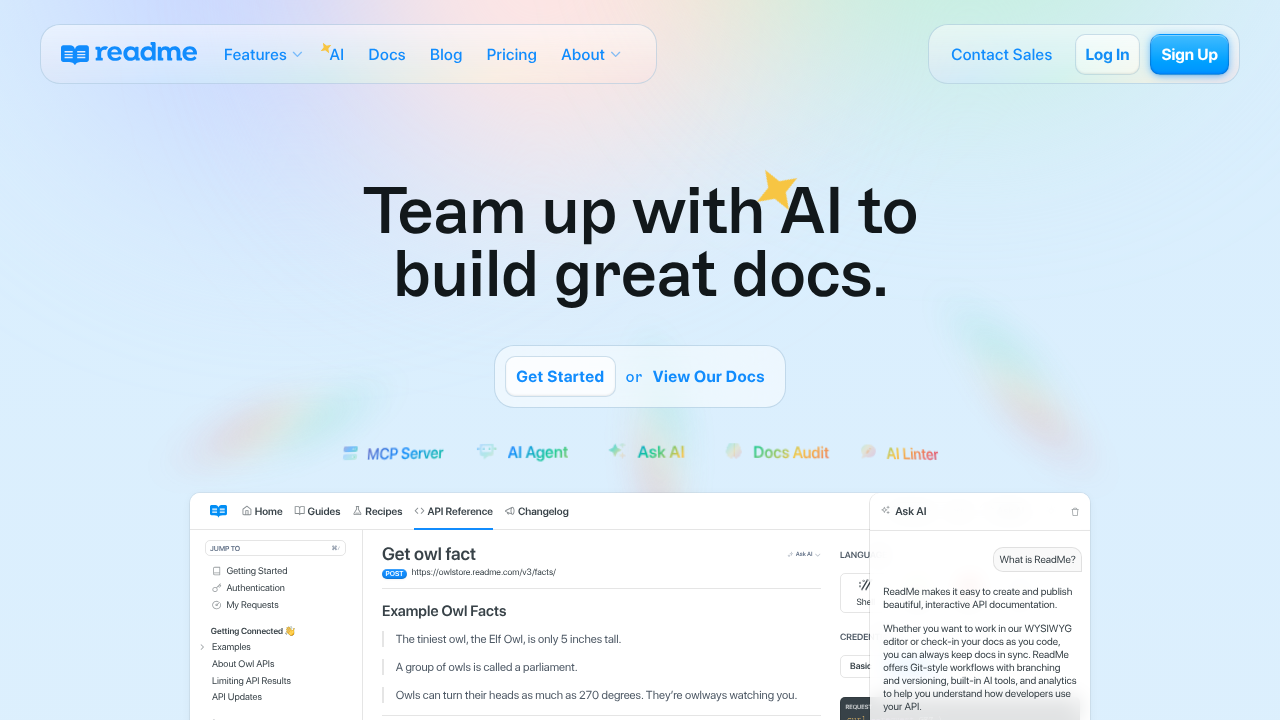
ReadMe is a hosted documentation tool built around OpenAPI specs. Feed it a spec file, and it generates an interactive API reference site with an embedded API Explorer for testing endpoints directly in the browser.
Beyond the basics, ReadMe offers a few standout features:
- Bidirectional GitHub and GitLab sync for keeping specs in version control
- Branching workflows for managing documentation across multiple API versions
- An Ask AI assistant for developer Q&A within docs, and Agent Owlbert for AI-assisted doc writing and linting
- Real-time usage insights showing which endpoints developers actually use
ReadMe is a solid choice for teams that primarily need to publish API reference documentation and want a managed, low-setup solution. Where it gets more complicated is when teams need SDKs, deeper customization, or enterprise-grade access controls alongside their docs.
What is Fern?
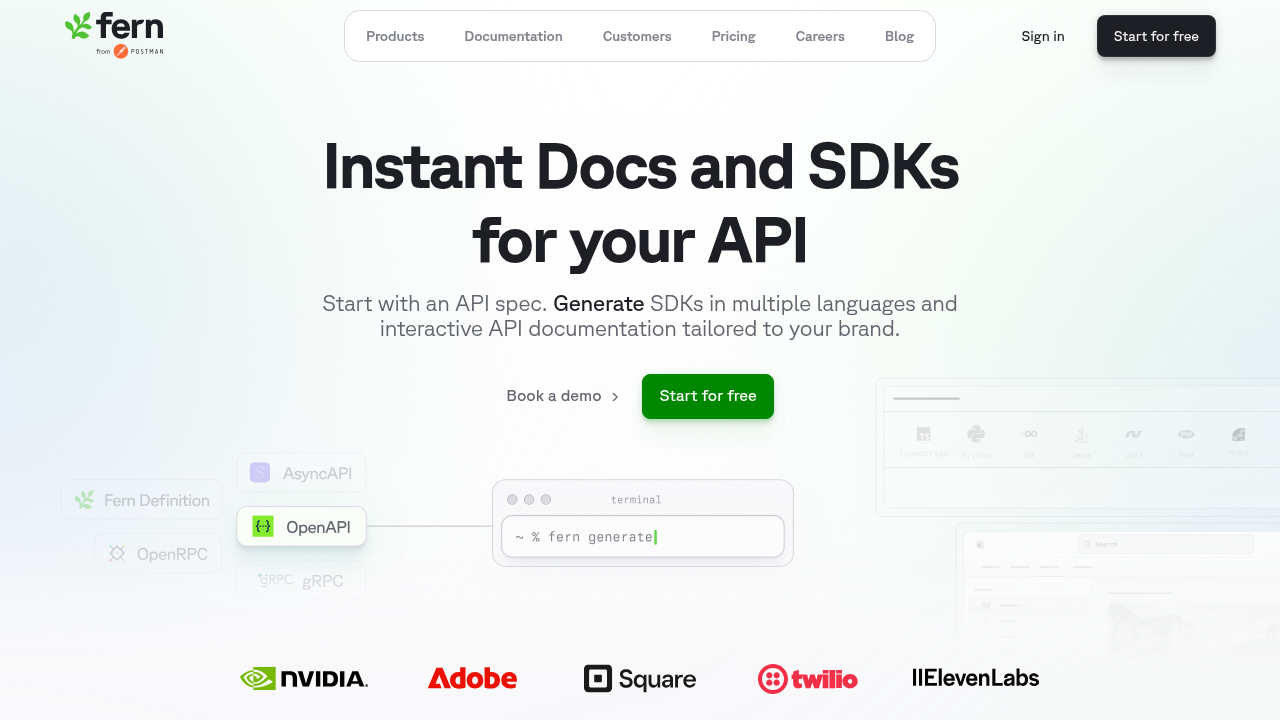
Fern is an automated SDK and documentation generator. Give it an API definition (OpenAPI, Fern Definition, AsyncAPI, OpenRPC, gRPC/protobuf, or GraphQL), and it produces production-ready client libraries in 9+ languages alongside an interactive API reference site.
Where ReadMe stops at documentation, Fern keeps going. Generated SDKs get published automatically to the right package registries (npm, PyPI, Maven, NuGet, and more), versioned on every API change, and kept in sync with docs through the same source of truth. No manual releases. No drift between what the docs say and what the SDK does.
Fern's core workflow is Git-native: the CLI fits into CI/CD pipelines, so SDK and documentation updates happen automatically when the API spec changes. Companies like ElevenLabs, Webflow, and Square use Fern to maintain SDKs across multiple languages without dedicated SDK teams.
| Capability | Fern | ReadMe |
|---|---|---|
| SDK generation | Generates production-ready SDKs in 9+ languages with idiomatic patterns, pagination, retries, and auth management. | No SDK generation. Documentation only. |
| Package publishing | Automated versioning and publishing to npm, PyPI, Maven Central, and NuGet. | Not applicable. |
| Documentation source | Git-native with single source of truth in version control. | Bidirectional dashboard and GitHub sync, which can create conflicts. |
| Code snippet accuracy | Snippets are generated from the same source as SDKs for perfect synchronization. | Auto-generated from the API Explorer, but prone to drift from external SDKs. |
| Custom components | Full MDX with React component support and arbitrary npm package imports. | MDX with built-in and custom components (paid tiers), but no arbitrary npm imports or full React extensibility. |
| Enterprise access control | SAML, OIDC, RBAC, and self-hosted deployments available. | SSO and audit logs gated behind the Enterprise tier. |
| Scale handling | Handles very large API definitions through streaming parsing and compression. | Performance limitations on complex or large specifications. |
SDK generation and client library support
ReadMe does not generate SDKs. It produces documentation, but the client libraries developers actually integrate are left to separate toolchains. Docs and code drift apart the moment anyone forgets to update both.
Fern takes a different approach. From a single API definition, it generates production-ready SDKs in 9+ languages following SDK generation best practices:
- TypeScript, Python, Go, Java, C#, PHP, Ruby, Swift, and Rust, with idiomatic code patterns for each (Pydantic models for Python, typed interfaces for TypeScript, functional options for Go)
- Built-in pagination handlers, retry logic with exponential backoff, OAuth 2.0 token management, and webhook signature verification
- Automatic version bumps and package publishing to npm, PyPI, Maven Central, NuGet, and other registries on every API change
Docs and SDKs stay in sync
Because SDKs and docs share the same source definition, code examples in documentation always reflect the actual methods developers call. There is no manual reconciliation step and no risk of showing developers an endpoint that no longer exists.
Interactive documentation and developer experience
Both tools generate interactive API docs from OpenAPI specs, but the depth of what each produces differs considerably.
ReadMe's API Explorer lets developers test endpoints directly in the browser, and the Ask AI assistant adds a layer of self-serve Q&A. The dashboard-plus-GitHub sync workflow works for smaller teams, though the bidirectional approach introduces real friction at scale: edits through the dashboard and edits through the repository can conflict, creating state drift that someone has to manually resolve. ReadMe supports MDX and React components on paid tiers, but importing arbitrary npm packages into pages is not supported.
How Fern handles documentation
Fern generates the full API reference automatically from the API definition, including code snippets in TypeScript, Python, Ruby, Go, Java, PHP, and C# as well as cURL for every endpoint. Because snippets are generated from the same source as the SDKs, they stay accurate without manual upkeep.
The authoring experience is built on MDX with full React component support, reusable snippets, and absolute imports via the @/ prefix. Git is the single source of truth, so there is no dashboard-versus-repo conflict to manage.
Fern also supports:
- Versioned documentation across multiple API releases
- Role-based access control and password-based authentication for gating sections
- SSO via SAML or OIDC with API key auto-injection into the API Explorer
- Custom domains, self-hosting via Docker, and VPC-compatible deployments
- MDX syntax validation with
fern docs md checkfor CI/CD pipelines
Reusable snippets mean a single content update propagates everywhere it appears, and automated reference generation means endpoint docs never lag behind spec changes.
Workflow integration and developer tooling
ReadMe's rdme CLI handles spec uploads and GitHub Actions integration, but the scope stops there. It syncs OpenAPI files to the dashboard and keeps documentation in version control, but the bidirectional model creates friction when technical and non-technical contributors edit from different locations simultaneously. Conflicts are manual to resolve, and the CLI generates no artifacts beyond documentation.
Fern's CLI is built for full artifact generation inside existing pipelines. A few commands cover the complete workflow:
fern generateproduces SDKs and docs from the API definition in one passfern generate --previewoutputs locally for testing before publishingfern generate --grouptargets a specific language or generator group without running the full suite
All configuration lives in a versioned fern/ directory: fern.config.json for workspace settings, generators.yml for what to generate and where to publish, and docs.yml for the documentation site. This Git-native approach aligns with the broader industry shift toward faster API delivery, where 63% of developers can now produce an API within a week, up from 47% the previous year, reflecting better tooling and API-first practices. Setting version: "latest" in fern.config.json keeps the CLI current without manual upgrades.
Publishing is fully automated. When the API spec changes, Fern bumps semantic versions and pushes updated packages to npm, PyPI, Maven Central, NuGet, and other registries. Documentation previews can use stable named URLs via the --id flag, so stakeholders always access the latest without receiving new links on every iteration.
Enterprise features and scalability
ReadMe's per-project model means each documentation site is a separate project with its own configuration and domain. Multi-project management, cross-project search, and global navigation require the Enterprise tier. As teams add services or split documentation across multiple APIs, this structure can force tradeoffs between clean organization and operational overhead. Fern uses a single workspace model where multiple APIs, SDK configurations, and documentation all live in one versioned fern/ directory, so scaling doesn't require restructuring how projects are organized.
On the technical side, Fern handles very large API definitions through streaming JSON parsing, automatic heap management, and compression. ReadMe does not document support for comparable scale.
For security and access requirements, Fern supports:
- SAML and OIDC SSO with automatic API key injection into the API Explorer
- Page-level allowlist/denylist configurations beyond standard role-based access control
- Password-based authentication as a lightweight alternative for partners or beta testers
- Self-hosted Docker deployments for VPC and air-gapped environments, with API Explorer login available without requiring site-wide authentication
Multi-team workflows are covered through multiple override files for organizing API extensions and x-fern-audiences extensions for generating separate SDK variants from one spec. AI-generated changelogs with structured release notes under Keep a Changelog headers round out the release workflow without manual work.
Where ReadMe stops and Fern starts
ReadMe works well for teams whose primary need is hosted API reference documentation. If interactive docs with minimal setup is the full scope of the requirement, it delivers that reliably.
The gaps appear when teams need more. No SDK generation means separate toolchains, separate versioning, and inevitable drift between documentation and code. Enterprise controls, including SSO and audit logs, require ReadMe's Enterprise tier.
Fern covers those gaps from a single workflow. SDKs and docs generate from the same definition, so they stay synchronized without manual reconciliation. The Git-native CLI fits into existing CI/CD pipelines instead of requiring a separate dashboard workflow. And for teams working with gRPC, GraphQL, or AsyncAPI — not just OpenAPI — Fern's multi-format input support means there's no need to maintain a parallel OpenAPI translation layer.
For teams scaling an API program, the choice of documentation tools increasingly involves SDK distribution, AI-readiness, and enterprise access controls alongside the reference docs themselves. Fern covers that full scope. ReadMe covers part of it.
Final thoughts on comparing Fern and ReadMe
For teams focused purely on API reference documentation, ReadMe provides a straightforward managed solution. When you need SDK generation, Git-based workflows, or fine-grained access controls, the gap between Fern and ReadMe becomes clear. Fern automates the entire SDK and documentation lifecycle from a single API definition and publishes to package registries automatically.
Reach out for a demo to see how it integrates with your existing pipeline.
FAQ
How should I choose between Fern and ReadMe for my API program?
The decision depends on whether SDK generation is part of the requirement. ReadMe is built for teams that need hosted API reference documentation with an interactive explorer, but it does not generate client libraries. Fern covers both documentation and SDK generation from the same API definition, keeping code and docs synchronized automatically. If the API program requires multi-language SDKs, automated publishing, or CI/CD integration for artifact generation, Fern meets those needs directly. If the scope is limited to documentation alone, ReadMe delivers that reliably.
What is the core difference between ReadMe's GitHub sync and Fern's Git-native workflow?
ReadMe uses bidirectional sync between its dashboard and GitHub, meaning edits can happen in either location. This creates potential conflicts when technical and non-technical contributors work simultaneously, requiring manual resolution. Fern treats Git as the single source of truth with no separate dashboard state to manage. The CLI generates SDKs, documentation, and other artifacts directly from versioned configuration files in the repository, fitting into existing CI/CD pipelines without introducing synchronization conflicts. Changes flow in one direction: from the API definition in Git to published artifacts.
Who is ReadMe best suited for compared to Fern?
ReadMe works well for teams whose primary need is hosted API reference documentation with minimal setup, particularly when SDK generation is handled separately or not required at all. Fern is better suited for teams scaling an API program where SDK distribution, version management, and documentation need to stay synchronized across multiple languages. Organizations with compliance requirements, enterprise access controls, or deployment constraints (VPC, air-gapped environments) will find those capabilities built into Fern's platform.
What happens to existing ReadMe documentation when migrating to Fern?
Fern generates API reference documentation automatically from the same OpenAPI spec ReadMe uses, so the technical content migrates directly. Custom guides and conceptual documentation written in ReadMe need to be ported to MDX format, which supports React components and reusable snippets. The migration process involves moving the OpenAPI spec into a fern/ directory, configuring generators.yml for SDK and documentation generation, and converting existing prose documentation to MDX files. Fern's fern docs md check command validates syntax during migration, and the fern generate --docs --preview command allows testing the output locally before publishing.
Can Fern handle large-scale API definitions that might cause performance issues in other tools?
Fern handles very large API definitions without performance degradation through streaming JSON parsing, automatic heap management, and compression. This architecture removes the constraints that cause other tools to fail on complex API surfaces. Teams with massive OpenAPI specifications, extensive endpoint coverage, or deeply nested schemas can use Fern without splitting definitions or working around memory limitations.