
TL;DR:
We're seeing teams evaluating alternatives to Stainless. Companies are looking for a solution that's dedicated to the API developer and agent experience for the long-term.
Fern, by Postman, provides enterprise-grade SDKs and CLIs that are trusted by companies like Square, Auth0, and ElevenLabs.
Our team is committed to providing a seamless transition from Stainless to Fern.
Summary
Generating client libraries from API specifications eliminates repetitive SDK development work, but the underlying platform architecture determines whether the solution scales with your API program. Teams comparing Fern vs Stainless face a choice between fundamentally different approaches: dashboard-driven generation versus CLI-first workflows, cloud-only deployment versus on-premise options, and REST-only support versus multi-protocol coverage.
This comparison examines Fern and Stainless across the technical dimensions that matter for production API programs: language coverage, protocol support, CI/CD integration, documentation maturity, and enterprise deployment flexibility. The differences go beyond features, each platform integrates differently into existing workflows and handles compliance requirements in distinct ways.
- Fern generates SDKs in 9+ languages with REST, WebSockets, and gRPC support from one spec.
- CLI-first workflow integrates directly into CI/CD pipelines via version-controlled YAML files.
- Production-ready docs include API Explorer, versioning, and AI search; Stainless docs are early access.
- On-premise deployment options address compliance requirements for regulated industries.
What is Stainless?
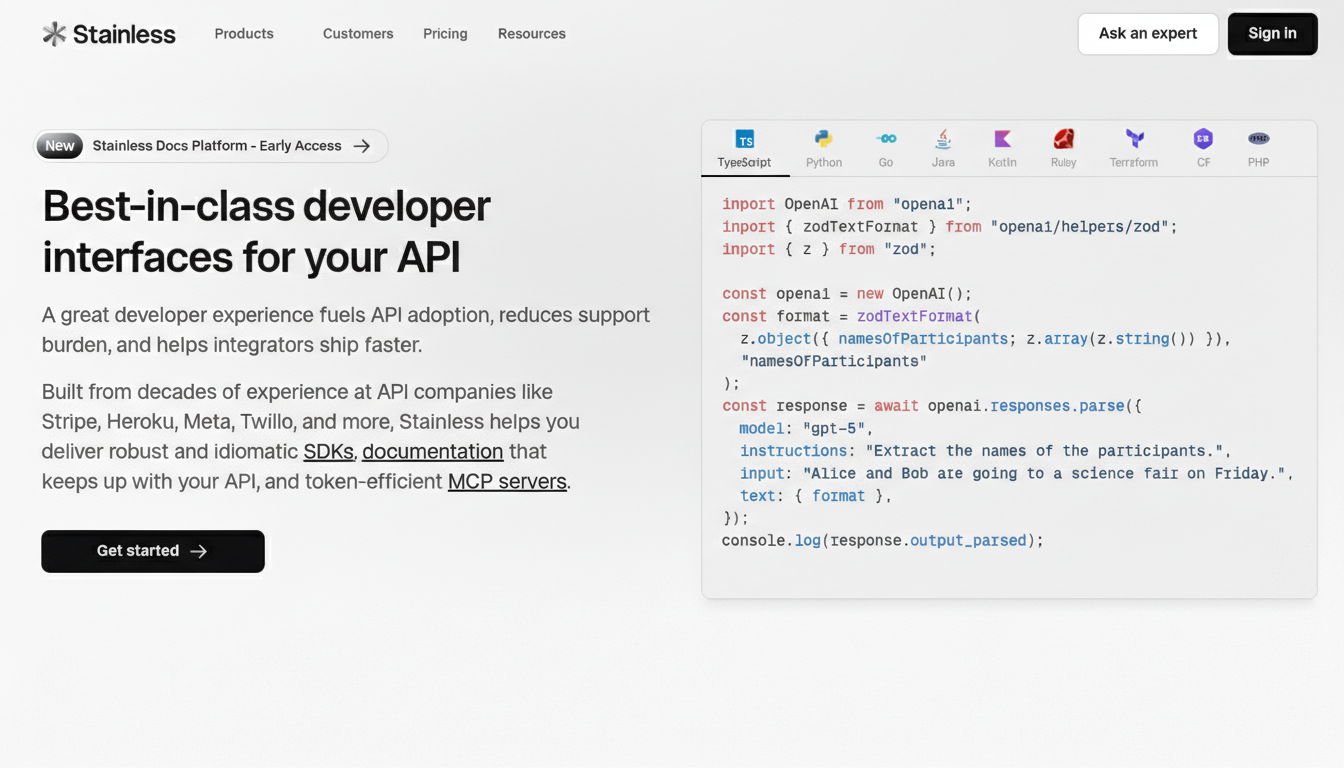
Stainless is an SDK generator that converts OpenAPI specifications into client libraries. The tool supports TypeScript, Python, Go, Java, Kotlin, Ruby, PHP, and C# (8 languages total).
The Stainless workflow centers on a dashboard interface where users upload OpenAPI specs and configure generation settings. The platform includes AI-assisted features for interpreting API definitions during setup. Once configured, Stainless generates type-safe client libraries that handle authentication, error handling, and other common SDK patterns.
Stainless automates versioning and can publish generated SDKs directly to package registries like npm, PyPI, and Maven Central. The tool is designed for teams that need multi-language SDK support but lack the resources to build and maintain client libraries in-house.
What is Fern?
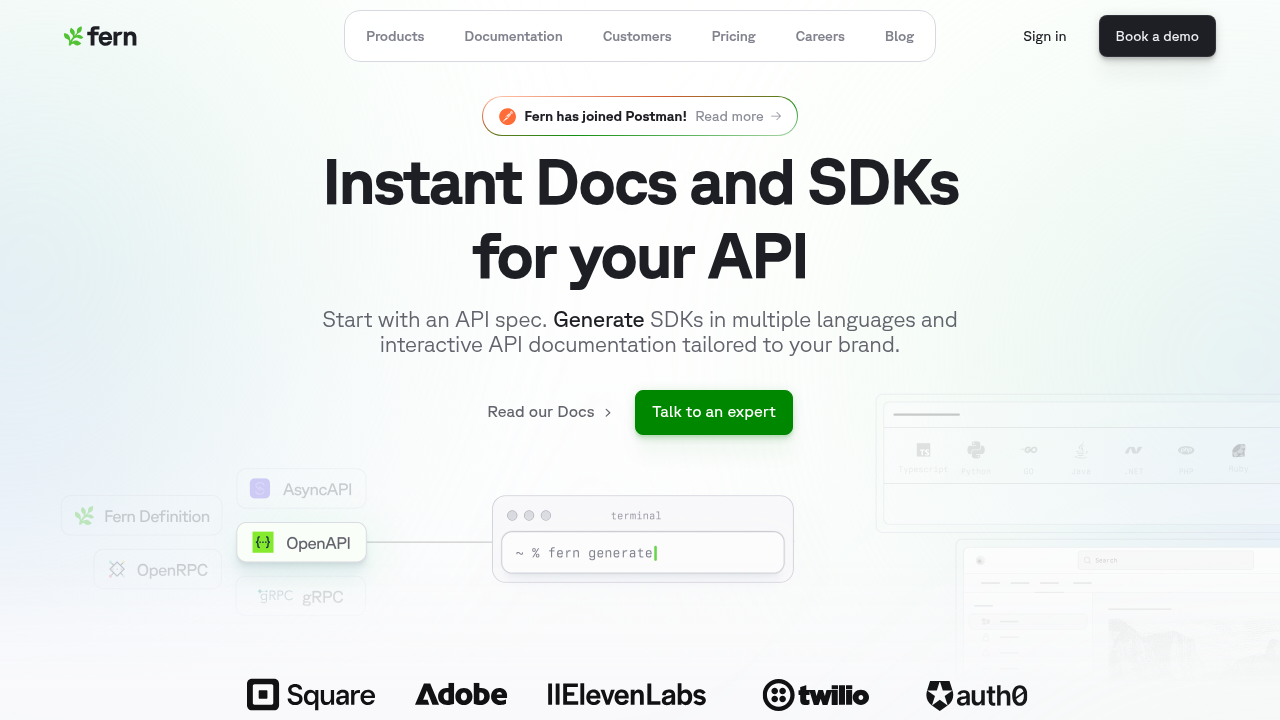
Fern is a CLI-first developer tool that generates type-safe SDKs and interactive API documentation from a single API specification. The tool supports 9+ programming languages including TypeScript, Python, Go, Java, C#, PHP, Ruby, Swift, and Rust, with output designed to follow language-specific conventions.
The Fern workflow integrates directly into Git repositories and CI/CD pipelines. Teams define their API using OpenAPI, AsyncAPI, OpenRPC, gRPC, or Fern's own Fern Definition format, then configure generation through YAML files in a fern/ directory. Running the Fern CLI generates both SDKs and documentation from the same source of truth, eliminating drift between client code and API reference materials.
Fern's generated SDKs include OAuth 2.0 flows, automatic pagination, retry logic with exponential backoff, and native handling of file uploads and streaming endpoints. Teams that also use Fern Docs get an API Explorer for testing endpoints directly in the browser, with code snippets generated for every supported language—all from the same spec that powers the SDKs.
The tool automates publishing to package registries like npm, PyPI, and Maven Central, applying semantic versioning based on API changes.
Language support and protocol coverage
Fern provides production-ready SDK generation in 9 languages: TypeScript, Python, Go, Java, C#, PHP, Ruby, Swift, and Rust. Each generated library follows language-specific conventions and passes standard linters.
Stainless supports TypeScript, Python, Go, Java, Kotlin, Ruby, PHP, and C# (8 languages). The selection covers common backend and frontend use cases but offers fewer options for teams needing mobile SDKs or systems programming languages.
Protocol coverage is where the platforms diverge more sharply. Fern generates SDKs for REST, WebSockets, Server-Sent Events, gRPC, and OpenRPC from a single specification. This allows teams building real-time or streaming APIs to provide unified client libraries that handle both synchronous and asynchronous patterns without requiring separate SDKs.
Stainless focuses on REST APIs defined through OpenAPI specifications. Teams with multi-protocol architectures or streaming requirements will need supplementary tools for non-REST endpoints.
Workflow integration and CI/CD automation
Fern operates through a CLI-first workflow where configuration lives in version-controlled YAML files within a fern/ directory. Teams run fern generate directly in CI/CD pipelines with full visibility into generation logic and output. The generators.yml file defines target languages, output settings, and publishing behavior, while CI workflows use the Fern CLI to handle versioning and publish SDKs to package registries and GitHub repositories.
This approach integrates cleanly into existing development processes. Developers run fern generate --preview locally to validate changes before committing, while CI executes the same commands to regenerate SDKs and documentation when the API specification updates. The entire generation process remains reviewable and debuggable through standard Git workflows.
Stainless centers its workflow around a web-based dashboard. Teams upload OpenAPI specifications or connect via GitHub integration, configure SDK settings through form-based controls, and Stainless orchestrates generation and delivery through automated release PRs.
This dashboard-driven approach reduces the need to manage local configuration files, but generation logic lives outside the codebase. When output doesn't match expectations, teams adjust settings in the Stainless UI rather than editing version-controlled config alongside their API definitions—introducing context switching and limiting visibility into generation behavior.
For teams that require full pipeline control and auditability, CLI-first workflows keep generation logic alongside the code it produces.
Documentation and developer experience
Fern includes a production-ready documentation platform that generates interactive API references directly from the same specification used for SDK generation. The documentation features an API Explorer that executes requests in the browser with built-in authentication handling and automatically generated, language-specific code snippets for every supported SDK. Developers can test endpoints directly in the docs and see how to call each API using the generated client libraries.
The documentation system supports MDX for rich content, versioning for maintaining multiple API versions concurrently, and access controls for gating private or partner-facing documentation. Teams can apply custom branding through configuration in docs.yml. For enterprise customers, Fern supports SSO via SAML or OIDC and offers self-hosting options designed to meet compliance and security requirements.
Ask Fern provides AI-powered search across documentation and API references. The assistant answers technical questions with links back to source pages, helping reduce support volume and accelerate developer onboarding.
Stainless offers early access to a documentation product that generates API references from your OpenAPI specification and Stainless configuration. The platform supports customization using Astro and MDX or Markdoc. However, compared to more mature documentation platforms, the offering is more opinionated—teams with complex branding or layout requirements may need additional tooling.
Fern delivers both SDK generation and documentation in a single workflow, ensuring synchronization between client libraries and API references.
OpenAPI support and spec flexibility
Fern fully supports OpenAPI 3.1.1 specifications and rich JSON Schema–based type definitions. The tool accepts standard OpenAPI files and supports x-fern-* extensions for fine-tuning SDK generation without changing the core API contract. Stainless primarily works with 3.0-era patterns and may not cover the full 3.1.1 feature set.
Fern also allows API definitions written in Fern Definition to be exported back to standard OpenAPI, reducing vendor lock-in. Organizations can adopt Fern's tooling without committing their API definitions exclusively to a proprietary format, preserving the ability to switch providers or integrate with external tooling as requirements evolve.
Fern Definition offers an alternative to OpenAPI's verbosity. This human-friendly YAML format splits definitions across multiple files and allows Markdown documentation to live alongside schema definitions. Teams can use Fern Definition for internal authoring while still exporting to OpenAPI for external consumers and compatibility with the broader API ecosystem.
Enterprise features and deployment options
Fern offers on-premise deployment options that allow SDK generation workflows to run entirely within customer infrastructure. This capability addresses strict data residency, compliance, and governance requirements, enabling organizations in regulated industries—such as healthcare, financial services, and government—to generate SDKs without transmitting API definitions to external cloud services.
The on-premise deployment uses self-hosted Docker containers that execute generation workflows behind VPCs or in air-gapped environments, giving enterprises control over where API contracts are processed and stored.
For enterprise customers, Fern also provides hands-on support, including dedicated engineering assistance during implementation, guidance on OpenAPI specification optimization, and collaboration to ensure API definitions generate high-quality SDKs that meet architectural requirements.
Stainless operates as a cloud-hosted platform. Teams upload OpenAPI specifications to the Stainless dashboard, and SDK generation runs on the vendor's infrastructure. This model works well for many organizations but may not meet compliance frameworks that require API processing to occur entirely within controlled, on-premise environments.
Feature comparison table
| Feature | Fern | Stainless |
|---|---|---|
| Language support | 9+ languages: TypeScript, Python, Go, Java, C#, PHP, Ruby, Swift, Rust | 8+ languages: TypeScript, Python, Go, Java, Kotlin, Ruby, PHP, C# |
| Protocol coverage | REST, WebSockets, Server-Sent Events, gRPC, OpenRPC from unified specifications | Primarily REST APIs via OpenAPI specifications |
| Workflow approach | CLI-first with version-controlled YAML configuration files in fern/ directory, runs directly in CI/CD pipelines | Dashboard-driven interface where users upload OpenAPI specs and configure settings through web forms |
| Documentation platform | Production-ready with API Explorer, interactive testing, versioning, role-based access controls, Ask Fern AI search, MDX support, custom branding | Integrated documentation focused on API references and SDK consumption, more limited customization options (early access) |
| OpenAPI support | Full OpenAPI 3.1.1 support with x-fern-* extensions, supports Fern Definition format with export to standard OpenAPI to prevent vendor lock-in | Primarily OpenAPI 3.0 patterns |
| Deployment options | Cloud-based and on-premise deployment using self-hosted Docker containers for compliance and data residency requirements | Cloud-based only, generation runs on vendor infrastructure |
Why Fern is the better choice
Stainless provides a cloud-based, multi-language SDK generator through a dashboard interface, suitable for teams needing straightforward SDK generation and reference documentation. For organizations seeking production-grade infrastructure, protocol flexibility, and comprehensive developer experience tooling, Fern offers notable advantages.
Fern extends protocol coverage beyond REST to include WebSockets, Server-Sent Events, gRPC, and OpenRPC from unified specifications. Teams building real-time or streaming APIs can generate SDKs for multiple protocols from the same source, avoiding the need to maintain separate client libraries.
Its CLI-first workflow provides transparency, CI/CD integration, and version-controlled configuration in YAML files, giving engineering teams full ownership over generation logic and debugging capabilities.
Fern’s documentation system is production-ready, featuring an API Explorer, versioning, role-based access controls, and Ask Fern AI search. Stainless’s integrated documentation is more limited in customization, requiring evaluation of whether supplementary tools are needed for production use.
Fern supports modern OpenAPI 3.x specifications and enables vendor-agnostic exports, reducing lock-in. Enterprise on-premise deployment addresses compliance requirements for regulated industries where API specifications cannot leave internal networks.
For API programs demanding language breadth, protocol flexibility, automated workflows, and enterprise deployment options, Fern provides a more complete toolchain to scale developer experience without coordinating multiple vendors.
Final thoughts on SDK generator comparison
Both tools generate SDKs, but Fern vs Stainless comes down to breadth, flexibility, and enterprise readiness. Fern supports 9+ languages, handles REST and streaming protocols, and includes documentation with interactive testing. If your team needs on-premise options or wants CI/CD integration without external dependencies, Fern provides the complete toolchain.
FAQ
How should I decide between Fern and Stainless for my API program?
The decision depends on your technical requirements and deployment constraints. Fern is the right choice when you need protocol coverage beyond REST (WebSockets, gRPC, Server-Sent Events), production-ready documentation with API Explorer, or on-premise deployment for compliance requirements. Stainless works for teams needing straightforward multi-language REST SDK generation through a dashboard interface without additional tooling requirements.
What is the main difference between Fern's CLI workflow and Stainless's dashboard approach?
Fern operates through version-controlled YAML configuration files in your repository that integrate directly into CI/CD pipelines, giving you complete transparency and debugging control. Stainless uses a web dashboard where you upload OpenAPI specs and configure generation through browser forms, with generated code delivered via Release PRs. The CLI approach provides better automation capabilities and operational visibility for complex API surfaces.
Can I deploy Fern's SDK generators within my own infrastructure?
Yes, Fern offers on-premise deployment options that run entirely within your infrastructure using self-hosted Docker containers. This meets data residency, compliance, and governance requirements where API specifications cannot leave internal networks, making it suitable for healthcare, financial services, and government sectors. Stainless operates as a cloud-based service where generation happens on their infrastructure.
What happens if I need to migrate away from Fern in the future?
Fern prevents vendor lock-in through the fern export command, which converts any Fern Definition back to standard OpenAPI format. You can adopt Fern's tooling without committing your API definitions to a proprietary format, maintaining flexibility to switch providers if requirements change. The tool supports standard OpenAPI 3.1.1 specifications throughout the workflow.
Who is Fern best suited for compared to Stainless?
Fern is best for organizations requiring production-grade infrastructure with 9+ languages, multi-protocol support (REST, WebSockets, gRPC), integrated documentation systems, and enterprise deployment options including on-premise installations. Stainless suits teams needing straightforward REST SDK generation in fewer languages through a cloud-based dashboard without extensive documentation needs or strict compliance requirements.