
Choosing the right SDK generation platform is a strategic decision for engineering teams. Tools like Fern and Speakeasy promise faster integrations and cleaner SDKs, but they differ in language coverage, deployment flexibility, and documentation capabilities. Whether you're building a public-facing developer platform or supporting mobile and frontend teams alongside your backend, understanding these differences is key to selecting a tool that scales with your stack. This SDK generator comparison breaks down each platform's strengths and trade-offs to help you choose the right fit for your API strategy.
TLDR:
- Compare Fern and Speakeasy to decide which SDK generator matches your API strategy and language requirements.
- Generate both client libraries and interactive API references from a single source of truth using Fern to keep documentation synchronized.
- Ship zero-dependency TypeScript SDKs and production-ready Swift libraries to support frontend and mobile development teams.
- Produce idiomatic code structured hierarchically to mirror your API resources, relying on native patterns like Pydantic for Python.
What is Speakeasy?
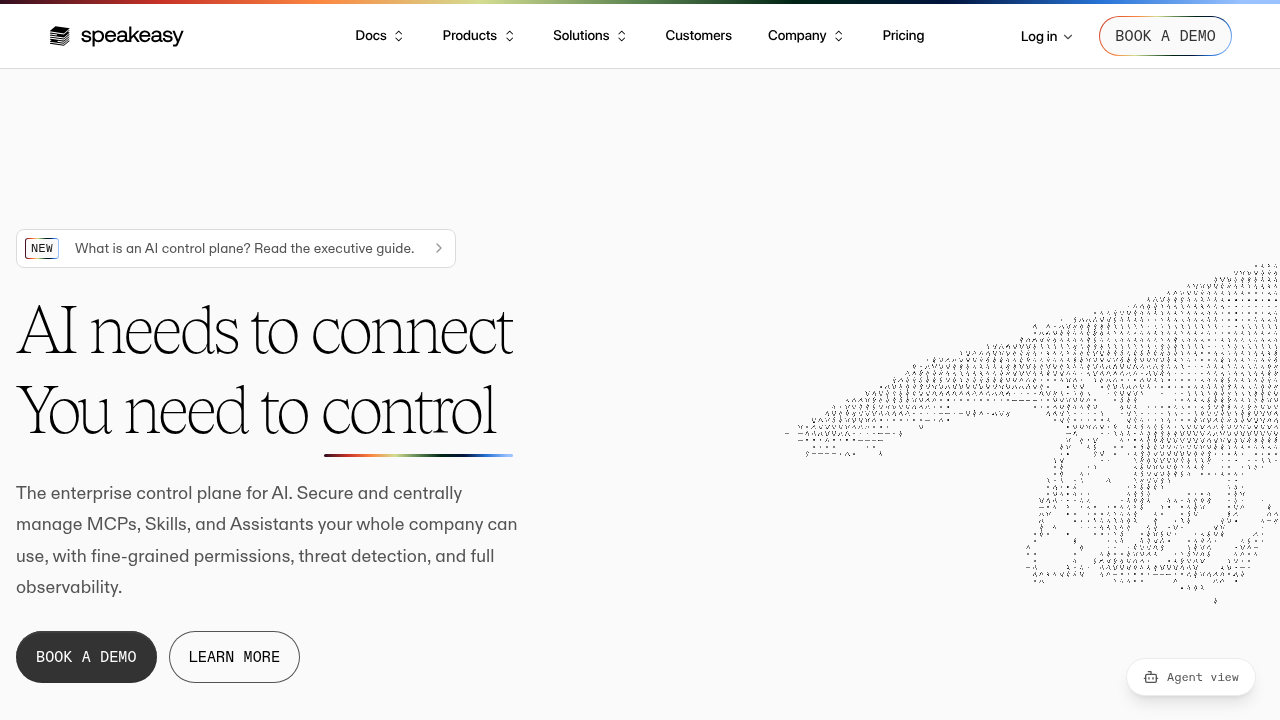
Speakeasy is an SDK generator that parses OpenAPI specifications to build client libraries. For documentation, Speakeasy offers Speakeasy Docs through a partnership with Scalar, and also integrates with ReadMe or Mintlify. However, documentation remains a separate workflow — code samples sync via OpenAPI overlays rather than generating from the same source as the SDKs. It supports engineering teams that need type-safe SDKs across multiple languages, including TypeScript, Python, Go, Java, C#, PHP, Ruby, Kotlin, Unity, and Terraform. The tool uses code generation to reduce the maintenance burden of manually writing API clients for different environments.
Speakeasy integrates into CI/CD pipelines via GitHub Actions, triggering SDK updates whenever your API definition changes. This treats SDK creation as a standard step in the release process instead of a manual chore, keeping generated code in sync with your API.
What is Fern?
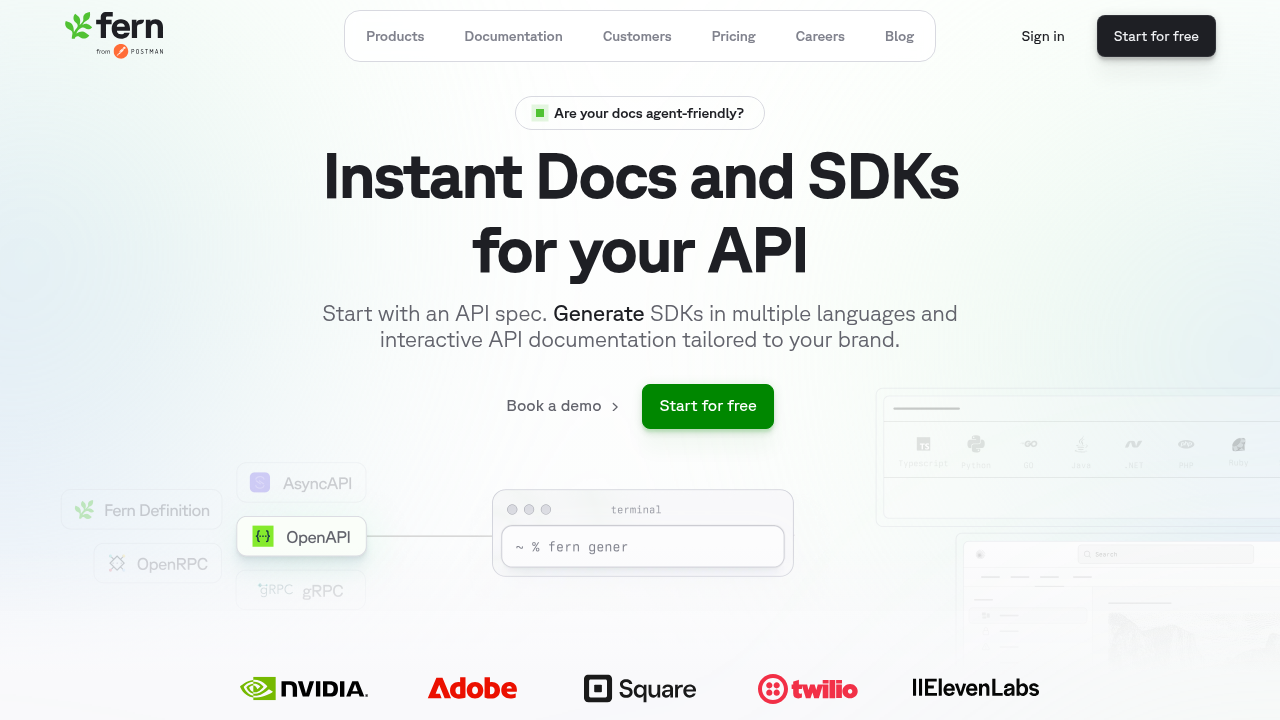
Fern is an SDK generator and documentation platform that treats your API spec as a single source of truth. Beyond generating SDKs, Fern produces synchronized documentation websites, so reference docs and client libraries stay aligned without manual upkeep.
Fern supports nine languages, producing idiomatic code in TypeScript, Python, Go, Java, C#, Ruby, Swift, PHP, and Rust. It also manages the full package lifecycle, compiling code and publishing directly to registries like npm, PyPI, and Maven.
The core compiler is open source and can run locally within your CI pipeline, giving teams full control over where generation happens.
SDK generation and language support
Speakeasy generates SDKs for ten languages: TypeScript, Python, Go, Java, C#, PHP, Ruby, Kotlin, Unity, and Terraform. It relies exclusively on OpenAPI, with no native support for AsyncAPI, OpenRPC, or gRPC.
Fern generates SDKs for nine languages: TypeScript, Python, Go, Java, C#, Swift, Ruby, PHP, and Rust. The key differentiator is Swift, as Fern is the only platform with production-ready Swift support, which matters for teams shipping iOS SDKs. Beyond language coverage, Fern produces idiomatic code, where Python SDKs use Pydantic models and Go libraries use functional options. Fern can also ingest multiple specification formats, including OpenAPI, AsyncAPI, OpenRPC, gRPC, and its own Fern Definition, so teams aren't locked into a single way of describing their APIs.
| Language | Fern | Speakeasy |
|---|---|---|
| TypeScript | Yes | Yes |
| Python | Yes | Yes |
| Go | Yes | Yes |
| Java | Yes | Yes |
| C# / .NET | Yes | Yes |
| Swift | Yes | No |
| Ruby | Yes | Yes |
| PHP | Yes | Yes |
| Rust | Yes | No |
Documentation integration
Speakeasy offers Speakeasy Docs through a partnership with Scalar, and also integrates with ReadMe or Mintlify. However, documentation remains a separate workflow — code samples sync via OpenAPI overlays rather than generating from the same source as the SDKs.
Fern generates both SDKs and documentation from a single API definition. API reference documentation generates alongside SDKs, meaning the interactive API Explorer and language-specific snippets stay aligned with the underlying library logic. Any spec update triggers CI to regenerate SDKs and deploy updated docs in a single operation. This architecture supports custom domains, RBAC, and a true single source of truth, reducing tool sprawl and improving developer experience.
SDK structure and code quality
Speakeasy's code generation favors simplicity and ease of implementation, which can result in flatter structures that may become harder to work with as APIs scale.
Fern organizes generated code hierarchically to match your API's resource structure, allowing developers to traverse endpoints using IDE autocomplete even in large API surfaces. The output follows native conventions: TypeScript SDKs have zero runtime dependencies for full browser compatibility, while Python clients use native validation patterns. The result is SDKs that feel native to each language ecosystem.
Frontend and mobile development
Speakeasy's TypeScript SDKs ship with a single Zod runtime dependency. For most teams this is lightweight, but it does add bundle overhead for browser-targeted code. Speakeasy also has no Swift support, meaning iOS engineers must write manual networking code, introducing the risk of API drift.
Fern supports full-stack development with zero-dependency TypeScript SDKs compatible with React, Vue, and Next.js, plus native Swift generation for iOS. This lets teams distribute type-safe libraries to backend, browser, and mobile consumers from a single workflow.
Audience segmentation for internal, partner, and public SDK variants
Fern supports multi-audience segmentation via x-fern-audiences, an extension you apply directly to your OpenAPI spec to tag endpoints, types, and properties for inclusion in different SDK variants (internal, partner, public, beta, and so on) from a single source of truth.
Speakeasy supports a binary internal/external split through OpenAPI Overlays and the x-internal: true extension. Teams that need more than two audiences — for example, separate internal, partner, and public SDKs — must maintain custom overlays per variant rather than tagging audiences directly on the spec.
Audit trails and compliance tooling for enterprise organizations
Fern provides audit trail functionality, giving enterprise teams the visibility and traceability required for compliance and internal governance programs. Teams can track changes, attribute actions, and satisfy audit requirements without building custom tooling.
Speakeasy has no built-in audit trail functionality, making it a weaker fit for financial services, healthcare, and other industries where compliance documentation is a baseline requirement.
Why Fern provides a better developer experience
A strong developer experience relies on reducing friction from API discovery to the first successful call. Fern achieves this by unifying SDK generation and documentation under a single source of truth. Instead of asking developers to manage a fragmented toolchain, Fern keeps your interactive API references and client libraries perfectly synchronized.
The quality of the generated code directly impacts adoption. By building on native patterns like Pydantic models in Python and zero-dependency architectures in TypeScript, Fern delivers idiomatic client libraries that feel hand-written. This reduces the learning curve and eliminates the boilerplate code developers typically write before making an API request.
Beyond the end-user experience, Fern improves the workflow for your engineering team. The compiler integrates directly into your CI/CD pipelines, automating the entire package lifecycle from code generation to registry publication. This automation protects against API drift and keeps your organization focused on building core product features instead of maintaining client libraries.
Final thoughts on the Fern and Speakeasy comparison
Your choice of SDK generator shapes how developers interact with your API. Fern produces idiomatic, hierarchically structured code that feels native to each language ecosystem, making it easier to read, traverse, and maintain as your API grows. By treating documentation as a code artifact, Fern keeps your reference docs and SDKs in sync automatically. If you need mobile support, frontend-optimized SDKs, or self-hosted generation, Fern is an ideal choice.
FAQ
When should you choose an SDK generator with native Swift support?
You should choose an SDK generator with native Swift support if your team distributes SDKs to mobile consumers or iOS developers. Fern provides production-ready Swift generation, letting you ship iOS SDKs without writing manual networking code that causes API drift.
How do Fern and Speakeasy handle documentation generation differently?
Speakeasy pairs its SDKs with third-party platforms like Scalar or ReadMe, requiring developers to maintain separate toolchains. Fern operates as a single source of truth, generating both client libraries and interactive API references simultaneously so your documentation never falls out of sync with your code.
Can you use AsyncAPI or gRPC with these SDK generators?
You can use AsyncAPI, OpenRPC, gRPC, and OpenAPI with Fern, giving your team flexibility as your architecture evolves. Speakeasy relies exclusively on OpenAPI, making it a viable option only if your entire ecosystem is built around REST endpoints.
Why do runtime dependencies matter for TypeScript SDKs?
Runtime dependencies increase bundle size, which slows down frontend application performance. Fern produces zero-dependency TypeScript SDKs for maximum browser compatibility, while Speakeasy includes a Zod runtime dependency that adds bundle overhead.
When should you consider switching from Speakeasy to Fern?
If you need Swift SDKs for mobile apps, zero-dependency TypeScript for frontend performance, or support for spec formats beyond OpenAPI (AsyncAPI, gRPC, OpenRPC), Fern covers those cases natively. You should also consider switching if maintaining separate documentation tools leads to drift between your docs and client libraries.