
Effective API documentation can make the difference between smooth integrations and frustrated developers. GitBook has become a go-to platform for teams looking to create organized, developer-friendly API docs with collaboration, versioning, and easy navigation built in. This guide breaks down GitBook's features, pricing, and limitations for API documentation—and highlights top alternatives to help teams streamline developer onboarding and improve API adoption.
TLDR:
- GitBook is a web-based documentation platform for technical docs, knowledge bases, and basic API references, aimed at teams that want polished docs without heavy engineering overhead.
- For APIs, GitBook renders OpenAPI specs into interactive reference pages with built-in endpoint testing but doesn't generate SDKs.
- Teams often hit limitations with GitBook's SaaS-only model and lack of SDK generation.
- Fern generates type-safe SDKs in 9+ languages plus docs from one API definition file.
- Fern supports self-hosted deployment and content-level RBAC for compliance requirements.
What is GitBook and how does it work?
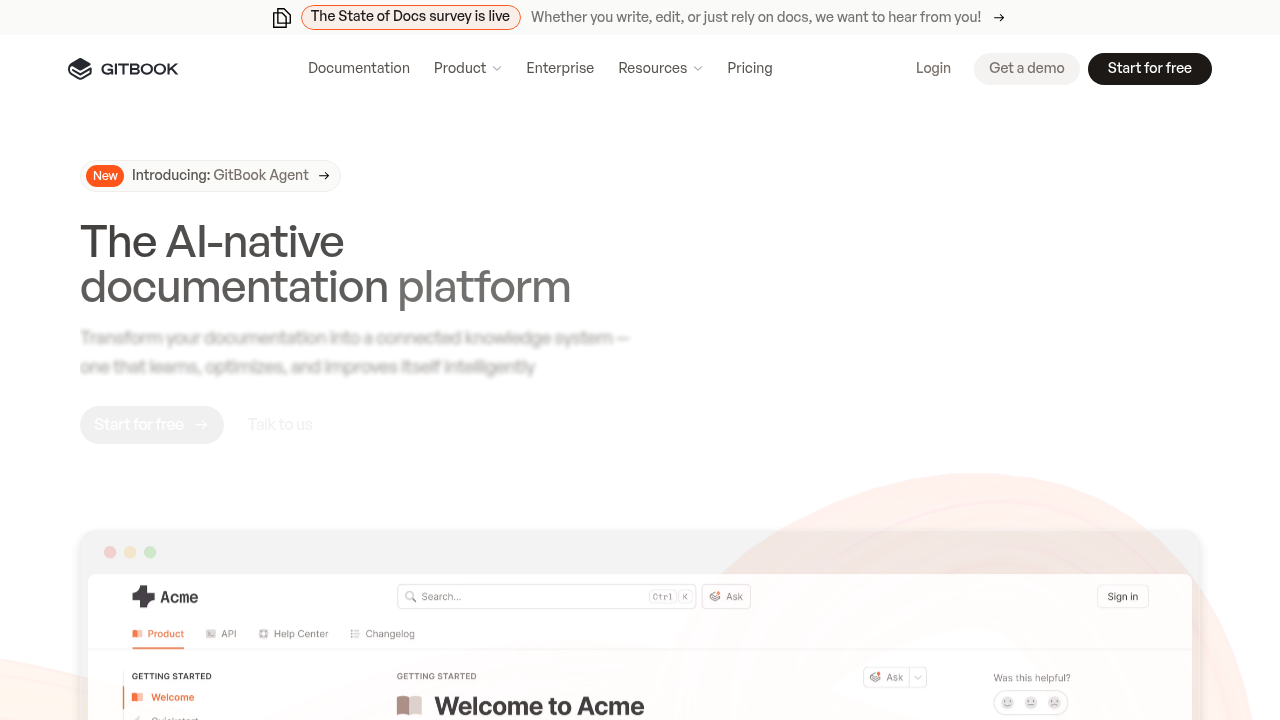
GitBook is a documentation platform with a web-based editor for creating technical documentation, knowledge bases, and API references. It targets teams looking to create clean documentation without requiring deep technical expertise from every contributor.
The editing experience uses a block-based interface similar to Notion, making it accessible to non-technical contributors while offering developers the ability to work within familiar version control workflows. GitBook supports Git synchronization with GitHub and GitLab, allowing documentation to live alongside code repositories. Changes made in the editor sync to Git, and updates pushed to the repository flow back into GitBook's interface.
For API documentation, GitBook can import an OpenAPI specification and render endpoints, parameters, and schemas into interactive reference pages with built-in endpoint testing. This approach treats the API spec as a content source for documentation rather than using it to generate SDKs or power a unified docs-and-code pipeline.
The platform also offers search, versioning, and custom branding for public-facing documentation.
Why consider GitBook alternatives?
GitBook works well for teams that need a straightforward knowledge base with basic API documentation capabilities. It provides clean output and reasonable Git integration for teams with simple documentation needs.
However, organizations evaluate alternatives when they encounter specific limitations.
GitBook focuses primarily on the documentation reading experience rather than SDK generation or other developer tooling. Teams must use separate tools to create client libraries, which creates a disconnect between documentation and the libraries developers actually use.
The API testing functionality is powered by Scalar rather than a native, fully integrated playground that shares context with generated SDKs. Teams looking for a tightly coupled testing environment may find this limiting.
GitBook operates as a SaaS-only platform without supported self-hosted deployment options. This limits viability for regulated industries with strict data residency or air-gapped environment requirements.
The WYSIWYG-first editing experience creates friction for engineering teams who want documentation to live alongside code and undergo the same pull request and review processes. While Git sync exists, the editing workflow favors the web interface over code-first approaches.
Customization is restricted to preset options rather than full control over styling and components. Teams needing extensive branding or custom functionality may find these constraints restrictive.
GitBook's pricing model separates site fees from per-user fees, which can make costs harder to predict as teams grow. The jump from the free tier to paid plans is also significant once you need features like custom domains or additional collaborators.
For organizations requiring both API documentation and production-ready SDKs from a single source of truth, or those needing self-hosting flexibility, these gaps often drive the search for more integrated solutions.
Best GitBook alternatives in February 2026
Fern (best overall alternative)
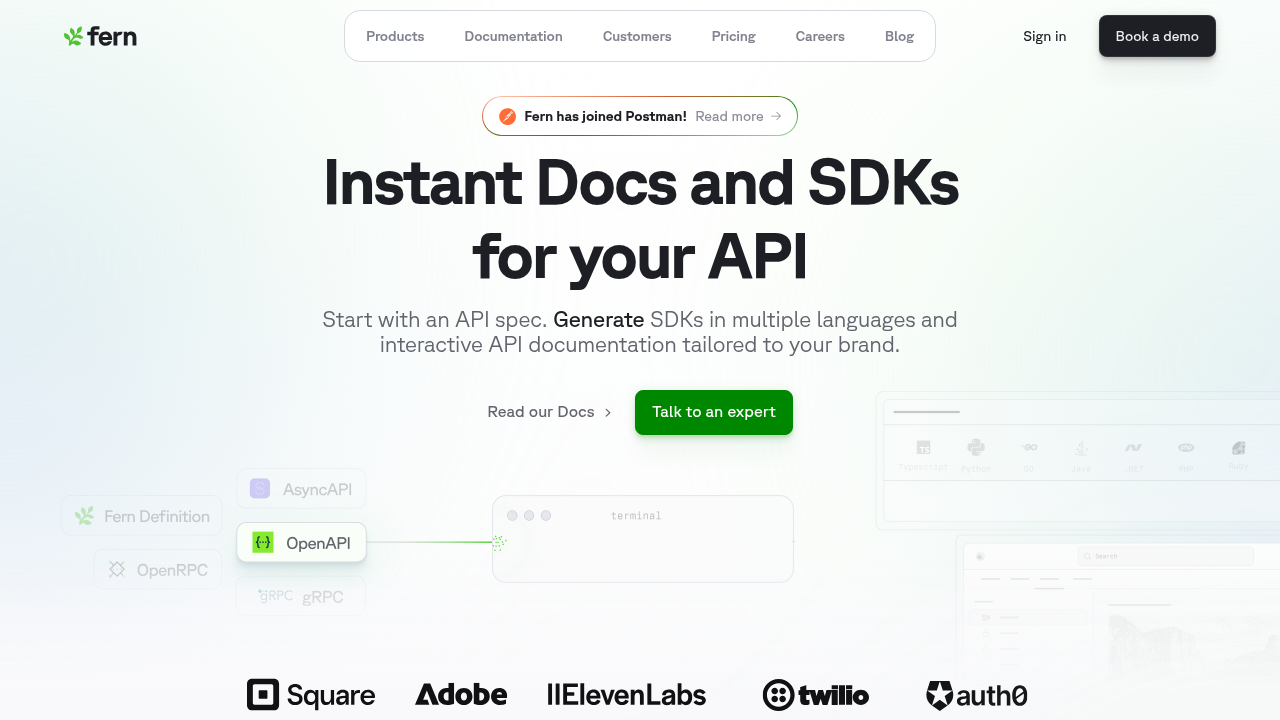
Fern treats your API definition as the single source of truth for both documentation and SDKs. Upload an OpenAPI spec (or Fern's own definition format), and Fern generates type-safe client libraries in 9+ languages alongside interactive API reference docs—keeping everything in sync automatically.
The platform supports docs-as-code workflows: Markdown/MDX editing, Git integration, pull requests, and CI/CD pipelines. AI-powered search (Ask Fern) helps developers find endpoints and examples quickly, and can be added to Slack for team-wide access.
For teams with compliance requirements, Fern offers self-hosted deployment—export your docs as a Docker container and run it behind a VPC or in air-gapped environments.
Where GitBook focuses on the documentation reading experience, Fern is built around the API-to-SDK-to-docs pipeline. Teams that need generated client libraries and docs from one source will find this a better fit.
ReadMe
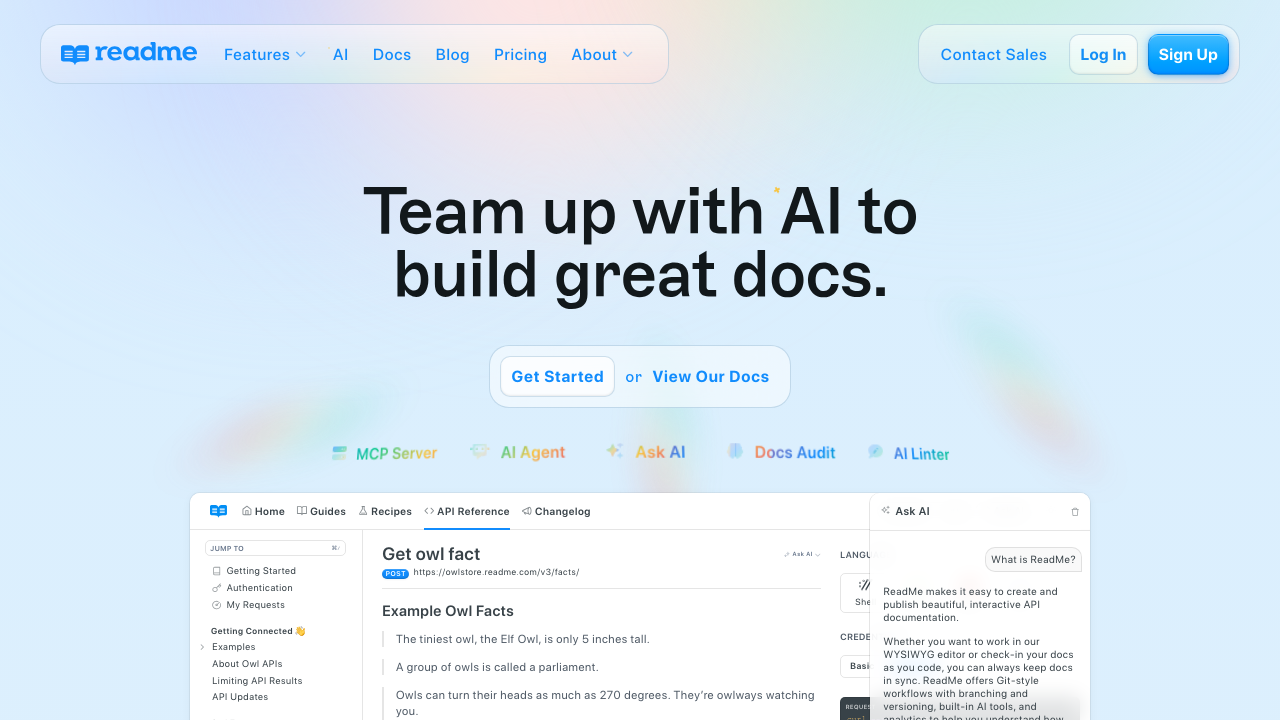
ReadMe is a documentation platform for API-first teams, generating interactive reference documentation from OpenAPI/Swagger specifications with inline code snippets, an in-browser API playground, and AI-powered search.
It supports versioning, branching, and review workflows that work well for small to mid-sized teams. Git integration is available for syncing content, but the primary workflow centers on ReadMe's web editor rather than PR-driven, code-first pipelines.
ReadMe offers flexible branding and customization across navigation, layout, theming, and custom domains. Deeper customization is typically limited to CSS overrides or proprietary components rather than native code and framework-level control.
ReadMe does not generate multi-language SDKs—teams needing client libraries must build them separately or integrate third-party tools like APIMatic.
Mintlify
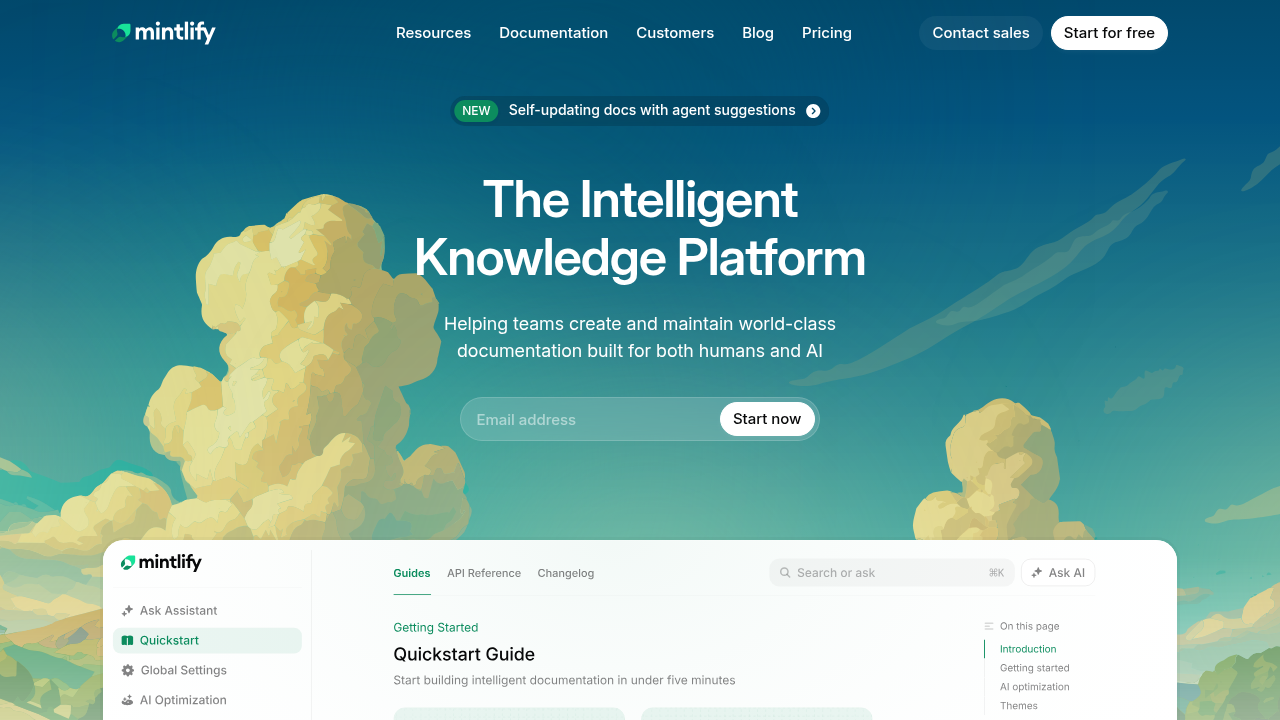
Mintlify is a documentation platform that generates interactive API reference pages from OpenAPI specs, with AI-assisted content creation, Markdown/MDX editing, Git-based workflows, and basic analytics. Teams can customize navigation, theming, and branding.
Mintlify is a SaaS-only product with no self-hosting options, which may be a blocker for regulated industries or internal-only APIs. Access control works at the page level—you can restrict entire pages to specific user groups—but there's no way to gate individual endpoints or content blocks within a page, limiting flexibility for multi-tier or multi-audience documentation.
Like GitBook and ReadMe, Mintlify does not generate SDKs. Teams needing client libraries must use separate tools.
Mintlify works well for startups that want polished docs quickly. Larger teams with complex APIs, multi-product documentation, or strict compliance requirements may find it limiting.
Stoplight
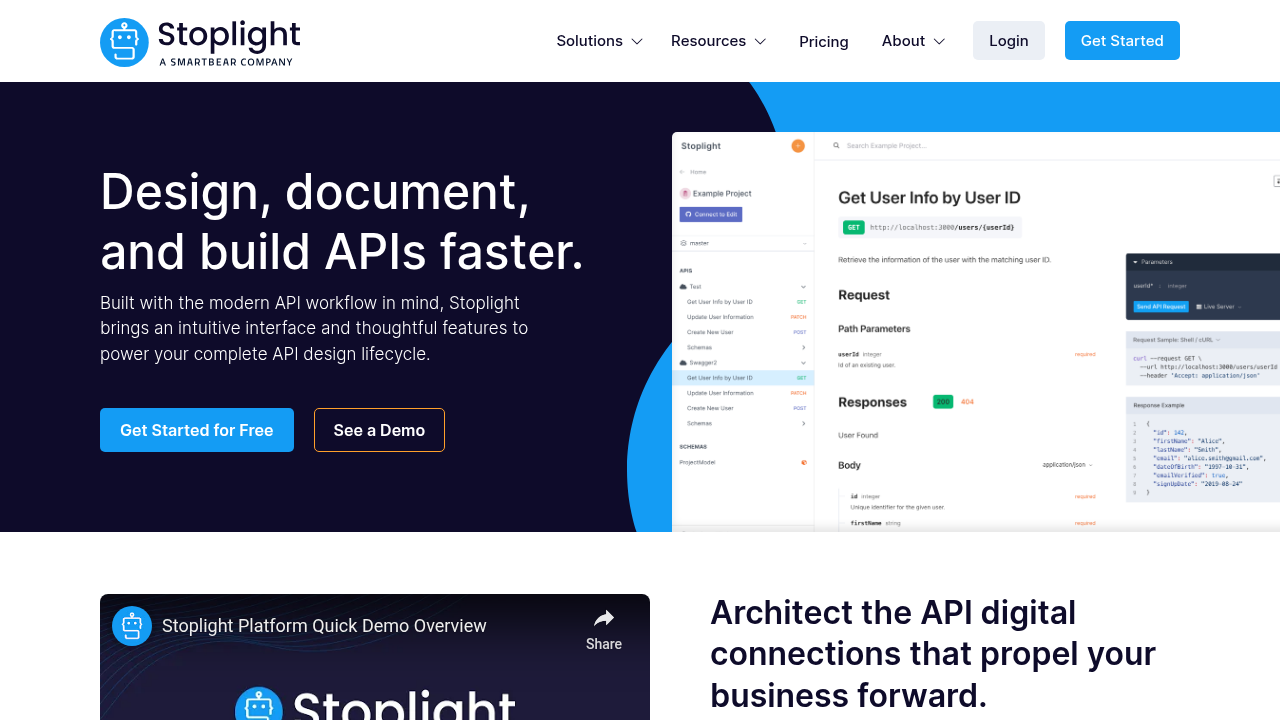
Stoplight is an API design platform built around OpenAPI and Swagger specifications. It provides a visual editor for creating and managing API specs, with automatic generation of interactive documentation, built-in mocking, and a "Try It" feature for testing endpoints directly in the docs.
The platform supports Git integration, versioning, and collaboration features that work for both technical and non-technical contributors. Teams can customize navigation, layout, and theming, and deploy to custom domains.
Stoplight generates code snippets in 30+ languages but does not produce full, production-grade SDKs—teams needing client libraries must build them separately. Customization options for branding and framework integration are more limited than some alternatives.
Stoplight is best suited for teams focused on API design and governance. Organizations that need generated SDKs or highly extensible documentation may find it less flexible.
Feature comparison: GitBook vs top alternatives
The table below compares core capabilities across GitBook and leading alternatives, focusing on features that matter for API documentation and developer experience.
| Feature | GitBook | Fern | ReadMe | Mintlify | Stoplight |
|---|---|---|---|---|---|
| SDK generation | No | Yes (9+ languages) | No | No | No |
| API playground | Yes (Scalar) | Yes (integrated) | Yes | Yes | Yes |
| Docs-as-code workflow | Git sync available | Native Git | Limited Git | Native Git | Git support |
| Self-hosted deployment | No | Yes | No | No | Partial (open-source components) |
| Content-level RBAC | No | Yes | No | Page-level | No |
| OpenAPI support | Yes | Yes | Yes | Yes | Yes |
Why Fern is the best GitBook alternative
GitBook works well for teams that need a polished knowledge base with basic API reference pages. But it treats documentation as a standalone artifact, separate from the SDKs and tooling developers actually use to integrate.
Fern takes a different approach: documentation and SDKs generate from the same API definition. When you update an endpoint, both the API reference pages and client libraries in Python, TypeScript, Go, Java, and other languages update together. You publish through CI/CD pipelines, keeping docs and code synchronized by design rather than manual effort.
This matters for teams building API products. Developers trust documentation that matches the SDK they're installing. When docs and libraries drift apart, support tickets increase and adoption suffers.
Fern also provides capabilities GitBook doesn't support: self-hosted deployment for regulated industries, content-level RBAC for gating documentation by user role, and automated SDK publishing to npm, PyPI, Maven Central, and other registries.
For teams that need both documentation and production-ready SDKs from a single source of truth, Fern is a more complete solution.
Final thoughts on documentation and SDK generation
If your API strategy includes client libraries, treating your API specification as the source for both documentation and SDKs eliminates a category of maintenance work. Teams that separate these workflows spend time fixing version mismatches instead of building features.
Book a demo to learn how Fern generates docs and SDKs from one definition.
FAQ
Why might you look for a GitBook alternative?
Common reasons include needing SDK generation alongside documentation, requiring self-hosted deployment for compliance, or wanting a code-first workflow where documentation lives alongside the codebase and follows the same review processes.
What features should you prioritize when evaluating documentation platforms?
It depends on your needs, but key considerations include: whether the platform generates SDKs, deployment options (cloud-only vs. self-hosted), access control granularity, OpenAPI support, and integration with your CI/CD pipelines.
When should you consider moving away from a documentation-only tool?
Consider switching if you're maintaining SDKs separately from documentation and they frequently drift out of sync, or if compliance requirements make SaaS-only platforms non-viable.
Can you generate production-ready SDKs from your API specification?
Yes. Fern generates type-safe SDKs in 9 languages—TypeScript, Python, Go, Java, C#, PHP, Ruby, Swift, and Rust—from OpenAPI or Fern Definition files. SDKs include features like retry logic, pagination helpers, and authentication handling, with automated publishing to package registries.