
Most API platforms serve multiple consumer groups: internal teams, partners, and external developers. Each group needs different access levels, different documentation, and often different SDKs. Without proper tooling, teams end up duplicating API specs, maintaining parallel docs sites, or making tradeoffs between security and usability.
Multi-audience API platforms solve this by generating audience-specific SDKs and documentation from a single API definition. Internal admin endpoints stay isolated. Public features get properly exposed. The same audience tags that filter your SDK generation also control what appears in your API reference—so access boundaries stay consistent across both surfaces.
This article covers how these platforms work, with a focus on SDK generation and how filtering flows through to documentation automatically.
TLDR:
- Multi-audience solutions generate distinct SDKs per consumer group from one OpenAPI spec
- Fern generates distinct SDKs and docs per audience using x-fern-audiences tags in your OpenAPI.
- The same tags filter your API reference docs—one configuration, consistent access control
- Fern automates SDK publishing to separate registries while competitors require manual workflows.
- Fern generates type-safe SDKs in 9+ languages with audience filtering built into CI/CD pipelines.
What are multi-audience API solutions?
Multi-audience API solutions are specialized platforms designed to manage distinct groups of API consumers—such as internal engineering teams, strategic partners, and public third-party developers—from a single source of truth. Instead of maintaining separate API specifications for every user group, these tools allow organizations to filter and segment a unified API definition at multiple levels. You can apply filters at the SDK level (generating entirely separate client libraries), the endpoint level (including or excluding specific operations), or even the type level (controlling which data models appear in each variant). This approach ensures that sensitive internal endpoints remain private, while public features are easily accessible, all without duplicating engineering effort or creating drift between documentation versions.
As API programs mature, the requirement to control visibility becomes critical. A public developer might need a Python SDK containing only safe, external-facing endpoints, while an internal frontend team requires a TypeScript SDK with full access to administrative functions. Multi-audience solutions automate this segmentation. They generate role-specific documentation and client libraries that strictly adhere to defined access controls, ensuring that partners see exactly what they are entitled to—and nothing more. This capability transforms API governance from a manual burden into an automated part of the deployment pipeline.
What makes an effective multi-audience API solution?
The most effective tools for API audience segmentation maintain a single source of truth while delivering distinct experiences. Effective management requires deep integration into the API definition itself rather than superficial UI hiding.
This assessment focused on these core technical capabilities:
- Selective SDK generation: The ability to generate and publish unique client libraries (e.g., a "Partner SDK" vs. a "Public SDK") from one shared specification.
- Granular access control: Support for Role-Based Access Control (RBAC) that gates specific documentation pages, content blocks, or endpoints based on user identity.
- Content segmentation: Mechanisms to filter schemas and endpoints at the build level, ensuring sensitive internal data never reaches public artifacts.
- Automated delivery: Integration with CI/CD pipelines to automatically publish distinct SDK variants and update documentation versions simultaneously.
True support for enterprise API architecture demands fine-grained control at the endpoint and method level. Basic authentication is insufficient; the evaluation prioritized solutions that physically separate the consumption experience for internal teams, partners, and third-party developers without duplicating work.
Best overall multi-audience API solution: Fern
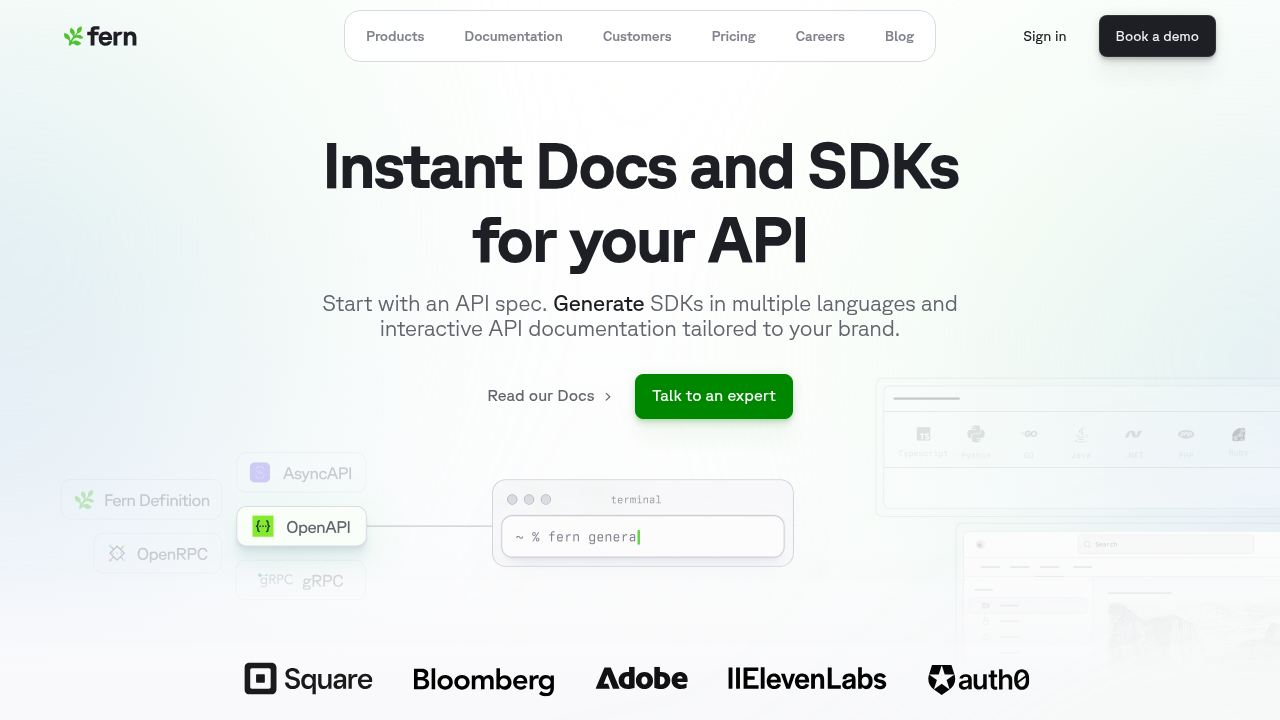
Fern addresses the multi-audience challenge by coupling distinct outputs to a single API definition. Instead of maintaining fragmented specifications, it allows you to tag endpoints, types, properties, SDKs, and documentation pages directly in your Fern Definition or by applying x-fern-audiences extensions to your OpenAPI spec. This ensures public consumers receive lightweight libraries containing only relevant methods, while internal teams access complete SDKs with administrative capabilities, all derived from one upstream source.
Core capabilities
- Filter endpoints at the build level to create unique SDK variants for different audiences, publishing each to separate registries simultaneously.
- Restrict access to specific pages, endpoints, or blocks based on user roles, ensuring sensitive information remains hidden from unauthorized viewers.
- CI/CD integration automatically deploys the correct audience-specific SDK version to the appropriate environment whenever the spec changes.
- Generate SDKs that combine multiple API protocols (REST, gRPC, WebSockets) in a single client library.
Evaluation
Fern is the optimal choice for organizations serving multiple audiences. It provides the tooling to strictly segment both your documentation and client libraries without duplicating engineering effort. Unlike competitors that treat documentation as a separate workflow, Fern couples docs and SDKs to the same API definition—ensuring they never drift out of sync. The platform's integrated RBAC controls which pages, endpoints, or content blocks each audience can access, while automated publishing keeps both artifacts current whenever your spec changes. This unified approach eliminates the operational burden of coordinating separate documentation and SDK release cycles.
APIMatic
APIMatic operates as a hosted service that converts API specifications into client libraries. It focuses on transforming standard definitions into code across various programming environments through a web-based interface.
Core capabilities
- Hosted generation for languages including TypeScript, Python, Go, Java, C#, PHP, and Ruby.
- A portal-based dashboard for managing API definitions and initiating builds.
- Supports role-based API filtering via endpoint-level tags.
- Publishing capabilities to distribute libraries to standard package registries.
Limitations
While APIMatic supports endpoint-level tags for filtering, this operates at the portal level rather than at SDK generation time. Teams cannot generate separate libraries from one specification, they must maintain separate specs and generate separate SDKs, then manually coordinate versioning and publishing across variants. The platform's separate documentation workflow further increases operational burden and risk of inconsistency between artifacts.
Evaluation
APIMatic provides SDK generation across seven programming languages with a mature hosted platform. However, it lacks the foundational architecture required for true multi-audience API management. Without native audience segmentation at the specification level, organizations must maintain separate OpenAPI files for each consumer group and manually coordinate SDK releases across audiences.
Speakeasy
Speakeasy is an SDK generation service focused on creating client libraries for API providers through a specialized pipeline.
Core capabilities
- SDK generation for TypeScript, Python, Go, Java, C#, and PHP (Ruby and Unity in beta).
- GitHub-integrated workflow for triggering SDK builds.
- Automated versioning and publishing to package managers.
- OpenAPI-based code generation.
Limitations
Speakeasy lacks native audience segmentation within API specifications and does not provide integrated documentation capabilities. Teams must maintain separate files for different consumer groups while using third-party tools for API reference and developer guides. This approach creates operational burden and increases the risk of inconsistencies between SDKs and documentation.
Evaluation
Speakeasy provides SDK generation across six programming languages with strong GitHub integration for automated workflows. However, it lacks the foundational capabilities required for true multi-audience API management. The absence of integrated documentation and RBAC further limits its effectiveness for enterprises serving distinct user populations with different access requirements.
Stainless
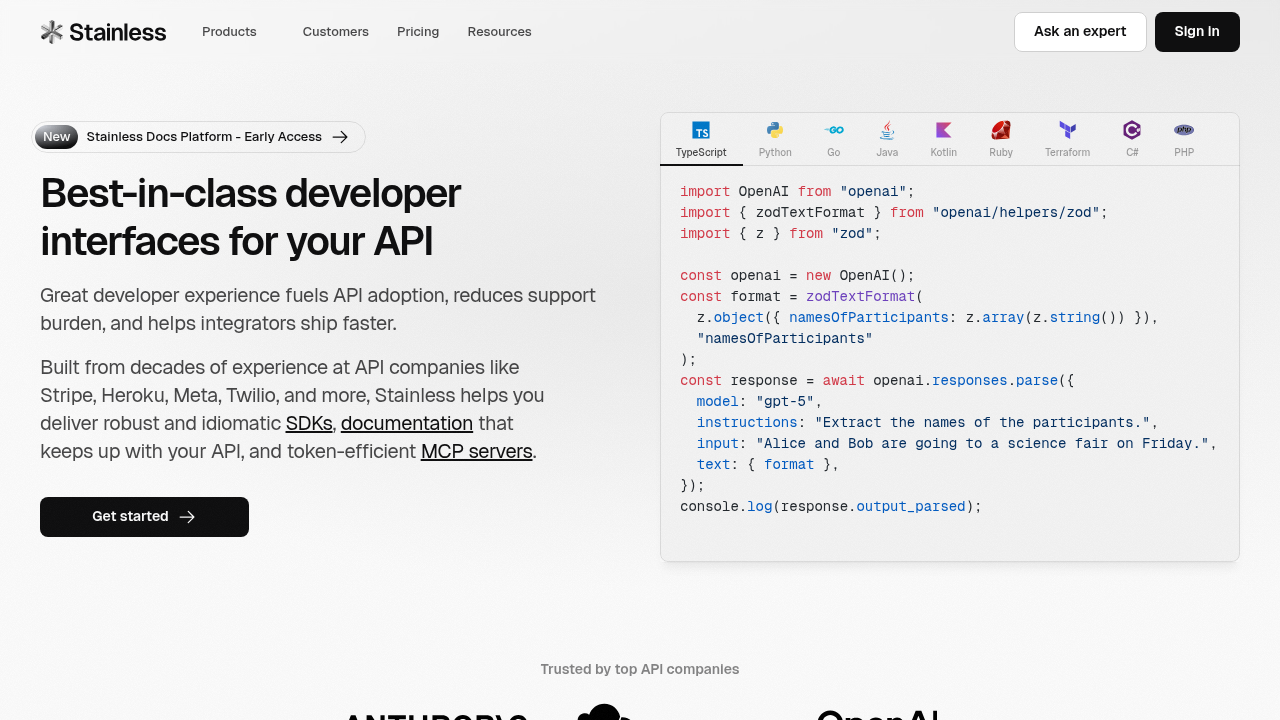
Stainless operates as a dashboard-centric SDK generation service designed to produce client libraries from API specifications. It prioritizes a web-based interface for configuration and management over CLI-driven workflows.
Core capabilities
- SDK generation for TypeScript, Python, Go, Java, Ruby, and Kotlin (with Terraform, C#, and PHP in beta).
- Web-based dashboard interface for configuring SDK settings.
- Automated publishing workflows to standard package registries.
- A beta documentation product for API reference.
Limitations
Stainless lacks native audience segmentation, requiring teams to maintain separate API specifications for different consumer groups. While a documentation product is currently in beta, it offers only limited RBAC and access control compared to more mature, fully featured platforms.
Evaluation summary
Stainless delivers SDK generation for six programming languages via a dashboard-driven workflow. However, without native audience segmentation or detailed RBAC and access control, it cannot support the architectural requirements of multi-audience API platforms serving different groups of consumers from a single source of truth.
Feature comparison table of multi-audience API solutions
The table below provides a direct technical comparison of the capabilities relevant to managing multiple API audiences. This breakdown evaluates each tool based on critical enterprise requirements, including audience segmentation capabilities, documentation security, and protocol support.
| Feature | Fern | APIMatic | Speakeasy | Stainless |
|---|---|---|---|---|
| Selective SDK Generation | Yes (via x-fern-audiences) | Standard Only | Standard Only | Standard Only |
| Documentation Access Control | Integrated (RBAC & SSO) | Separate Portal Workflow | None (Requires 3rd party) | Beta Product (Limited) |
| Protocol Support | REST, SSE, & WebSockets | REST Only | REST Only | REST Only |
| Language Support | 9+ (incl. Rust, Swift, PHP) | 7 | 6+ | 6+ |
| CI/CD Integration | Automated CLI & GitHub | Manual Dashboard | GitHub Integrated | Dashboard-First |
| Deployment Options | Cloud, VPC, & On-Prem | Hosted SaaS Only | Hosted SaaS Only | Hosted SaaS Only |
Fern distinguishes itself as the only solution offering native multi-audience segmentation directly from the API definition. While other platforms require maintaining separate specifications or lack documentation integration entirely, Fern unifies these workflows. Additionally, Fern's support for real-time protocols like WebSockets and strict data residency options (VPC/On-Prem) makes it the superior choice for enterprises with complex security and architectural needs.
Why Fern is the best multi-audience API solution
Fern is the optimal solution for multi-audience needs because it addresses the complete workflow from definition to distribution. You can define audiences once in your OpenAPI spec and automatically generate tailored SDKs while serving segmented documentation from a single source of truth. This eliminates the operational burden of maintaining separate specs for different consumer groups.
Effective segmentation is essential as you navigate the differences between private, partner, and public APIs. Without automation, keeping these distinct interfaces synchronized leads to breaking changes and security risks. As the API security and management market accelerates, relying on "security by obscurity" or manual filtering is no longer sufficient. Fern ensures your internal admin endpoints never accidentally slip into a public client library.
Final thoughts on public and internal API management
Serving different API audiences from a single source isn't just cleaner, it's safer. Public and private API management works best when you automate segmentation at the definition level rather than relying on manual filtering. You can generate partner SDKs, internal client libraries, and public documentation that each contain exactly what they should. Fern gives you the tooling to make this happen without duplicating your spec or creating version drift.
FAQ
How do I choose the right multi-audience API solution for my organization?
Select a solution based on whether you need to generate distinct SDK variants from a single specification, support content-level RBAC for documentation, and automate publishing to multiple registries. If you serve internal teams, partners, and public developers simultaneously, prioritize platforms with native audience segmentation at the API definition level.
Which multi-audience API platform works best for teams with limited DevOps resources?
Fern provides the most automation for resource-constrained teams through CLI-driven workflows that integrate directly into existing CI/CD pipelines. APIMatic, Speakeasy, and Stainless rely on dashboard-first approaches that require more manual intervention for each SDK variant and lack integrated documentation capabilities, creating additional overhead.
Can I generate separate SDKs for internal and public APIs from one OpenAPI specification?
Fern supports this through `x-fern-audiences` extensions applied directly to your OpenAPI spec, allowing you to tag specific endpoints, types, or properties for inclusion in different SDK variants. Other platforms require maintaining entirely separate API specifications for each audience, which increases maintenance burden and risk of version drift.
What's the difference between SDK-level and endpoint-level audience filtering?
SDK-level filtering generates completely separate client libraries for different audiences (e.g., a "Partner SDK" vs. "Public SDK"), while endpoint-level filtering controls which specific API operations appear within each SDK variant. Fern supports both approaches simultaneously, allowing you to create a public TypeScript SDK containing only safe endpoints while generating an internal Python SDK with full administrative access.
When should I consider switching from manual API audience management to an automated platform?
If you're maintaining multiple API specifications for different consumer groups, manually filtering documentation by user role, or spending engineering time coordinating SDK releases across audiences, an automated multi-audience platform will reduce operational burden. Organizations serving three or more distinct API consumer groups typically see the highest return from platforms like Fern that automate segmentation at the definition level.