

Generating SDKs for your API means choosing between open source tools and commercial SDK platforms. Fully open source generators such as OpenAPI Generator eliminate licensing fees, but your team handles all the maintenance, quality issues, and feature development. Closed source platforms such as Speakeasy and Stainless give you managed infrastructure and professional support, but come with vendor lock-in on pricing and generation logic customization. There's also open core options such as Fern that split the difference, giving you access to the source code while offering paid enterprise features.
TLDR:
- Open source SDK generators such as OpenAPI Generator eliminate licensing costs but require your team to build production features like OAuth flows and automated publishing.
- Closed source tools such as Speakeasy and Stainless provide managed infrastructure but lock you into proprietary generation logic and usage-based pricing.
- Open core platforms such as Fern combine transparent generation code with enterprise features, letting you inspect and customize while accessing professional support.
- Fern's Apache 2.0 licensed CLI generates SDKs in TypeScript, Python, Go, Java, C#/.NET, PHP, Ruby, Swift, and Rust with synchronized documentation from a single API definition.
- Fern gives you the same control and transparency as fully open source platforms, but with enterprise-grade documentation, multi-language consistency, and professional support when you need it.
Understanding open source SDK generation
Open source SDK generators make their source code publicly available under permissive licenses such as Apache 2.0 or MIT. This means you can inspect, modify, and distribute the generator without paying licensing fees.
These generators follow a community-driven model where contributors submit improvements, fix bugs, and add language support. The roadmap comes from collective needs as opposed to vendor priorities.
The main benefits are transparency into SDK generation, no vendor lock-in, and customization of generation logic. You're not dependent on a company's pricing or continued existence.
The tradeoff is maintenance. Fully open source SDK generators require you to handle updates and troubleshooting yourself. Community support varies, and production features like automated publishing or OAuth flows may not exist out-of-the-box.
For teams comparing open source options like OpenAPI Generator or alternatives like Speakeasy and Stainless, this balance between freedom and practical support matters.
Fully open source SDK generators
Open source SDK generators offer flexibility, transparency, and zero licensing costs, making them appealing starting points for many engineering teams. However, they vary widely in maturity, language coverage, and the amount of engineering effort required to harden the generated code for production. Your team manages updates, handles quality issues across languages, and builds production features that come standard with Speakeasy, Stainless, and Fern.
OpenAPI Generator
OpenAPI Generator supports 50+ languages and has an active contributor base. The tool handles basic SDK scaffolding, though output quality varies by language. Generated code typically needs manual refinement for production use, and features like pagination, retry logic, or OAuth flows require custom implementation.
Swagger Codegen
Swagger Codegen maintains a community but has slower development. Support for newer OpenAPI 3.1 features lags behind OpenAPI Generator.
Kiota
Microsoft’s Kiota is optimized for consuming the Microsoft Graph API but often requires a complex setup. It enforces Kiota’s own architectural patterns over language-idiomatic ones, which can feel heavy or unnatural in some languages, especially for developers expecting lightweight client libraries
Maintenance burden in open source SDK programs
Adopting open source SDK tooling has hidden costs that most teams overlook. While licensing costs are often the first consideration, the real burden shows up in ongoing maintenance and monitoring.
Upstream changes in generator projects require constant monitoring. When OpenAPI Generator releases breaking changes to its templating system, you need to audit and update any customizations you've built. Language version updates multiply this work across every SDK when Python 3.13 or Node 22 ships with new syntax.
Security patches create urgent work across your entire SDK surface. A vulnerability in HTTP handling means updating every language's generated code, testing each one, and coordinating releases to multiple package registries.
Custom tooling becomes necessary fast. Open source generators lack automated publishing, retry logic, and OAuth flows by default. Your team builds and maintains these features yourself, creating a proprietary layer on top of the open source foundation.
Multi-language consistency challenges
Using different generators for different languages creates inconsistent SDK experiences. OpenAPI Generator might produce TypeScript clients with method chaining while its Python output uses keyword arguments. Go SDKs use functional options while Java uses builders.
Error handling diverges across languages. One generator throws typed exceptions, another returns error codes, a third wraps responses in Result types. Developers switching between your Python and TypeScript SDKs learn different patterns for the same API error.
Authentication implementations vary. Your Python SDK might handle OAuth token refresh automatically while your Go SDK requires manual token management. Pagination helpers exist in one language but not another, forcing developers to write cursor logic themselves.
Single-definition generators like Fern, Speakeasy, and Stainless solve this by applying consistent patterns across all languages from one spec. Method names, error handling, and authentication behave consistently regardless of the language developers choose.
Understanding closed source SDK generation
Closed source SDK generation tools like Speakeasy and Stainless keep their generation logic proprietary. You license the software rather than accessing the source code.
These tools operate as managed services where the vendor handles infrastructure, updates, and feature development. Professional support teams and SLAs come standard, along with enterprise capabilities like automated publishing to package registries, OAuth token management, and built-in retry logic.
The main tradeoff is control. Vendor lock-in ties you to their pricing and roadmap. Costs can scale unpredictably with usage. Customization is limited to exposed configuration options, and you can't modify the generation engine for specific requirements.
Closed source SDK generators
Commercial SDK generation platforms provide managed infrastructure, higher-quality output, and production features that significantly reduce engineering overhead. They handle packaging, publishing, validation, and cross-language consistency. These are capabilities that open source tools typically require teams to build themselves. However, these benefits come with tradeoffs around transparency, deployment flexibility, and long-term vendor dependence.
These services run exclusively on vendor infrastructure, blocking deployment in air-gapped environments or compliance-restricted systems. You're locked into pricing models that can shift, and migrating away requires rebuilding your entire SDK generation pipeline. Customization is limited to whatever the vendor exposes through configuration.
Speakeasy
Speakeasy generates SDKs for TypeScript, Python, Go, Java, C#, and PHP with managed infrastructure and automated publishing to package registries. Docs require integration with separate tools such as Mintlify. Pricing increases with API complexity and the number of languages you need.
Stainless
Stainless offers TypeScript, Python, Go, Java, Ruby, and Kotlin generation through a dashboard interface. Its documentation capabilities are in beta. The service prioritizes code quality but restricts access to generation logic, and usage-based pricing can grow unpredictably.
APIMatic
APIMatic supports TypeScript, Python, Go, Java, C#, PHP, and Ruby and includes API management features alongside SDK generation. The generation process is proprietary with no visibility into how code is created. Customization works through configuration files, not through direct code access.
Vendor lock-in with closed source solutions
Proprietary generators like Speakeasy and Stainless limit you to their exposed configuration options. If you need custom retry behavior for specific endpoints or want to inject telemetry hooks into HTTP calls, you're waiting for the vendor to prioritize your request.
Migration becomes expensive when you can't see the generated code structure. Moving between closed source vendors means reverse-engineering SDK patterns, then rebuilding your integration pipeline.
Pricing changes leave you with limited options. When a vendor changes their pricing model or restricts features to higher tiers, you either pay or rebuild with no gradual migration path.
The open core alternative: Fern's approach
Open core sits between fully open source and fully closed source. The core software is released under a permissive open source license, while enterprise features and managed services are sold commercially.
Many developer tooling companies have built strong businesses with this model. GitLab releases its version control features as open source while selling security and compliance tools. Elastic provides free search capabilities while charging for machine learning features and enterprise support.
This approach gives you transparency into core functionality while preserving access to enterprise-grade support. You can evaluate quality by examining source code, customize open source components, and self-host the core version to avoid vendor lock-in.
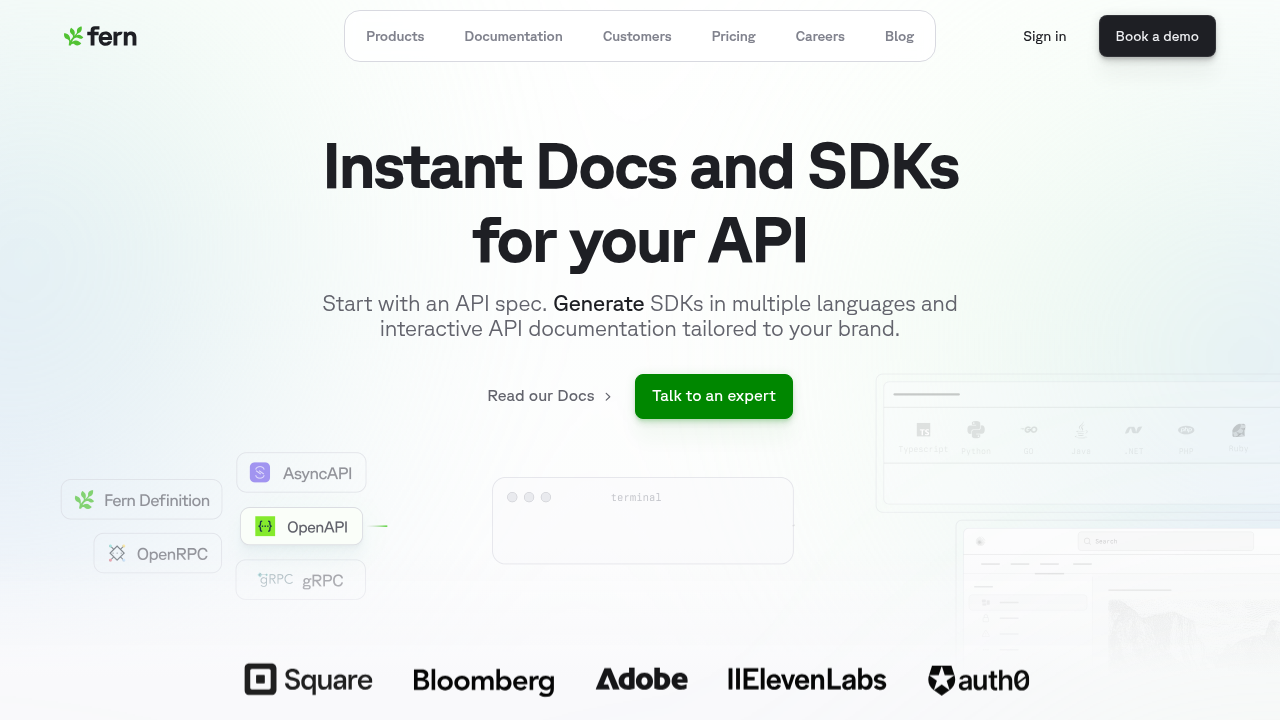
Fern applies this model to SDK generation. The CLI and SDK generators are licensed under Apache 2.0 and available on GitHub. You can generate SDKs locally, inspect generation logic, and contribute improvements. Enterprise capabilities like self-hosted documentation, automated publishing to package registries, and role-based access control are available through paid plans.
You can evaluate the open source code quality before committing to paid features, rather than relying on proprietary claims.
Fern as an open core SDK generator
Fern excels at delivering high-quality SDKs across many languages. Its ability to generate nine languages from a single API definition, all following consistent patterns, dramatically reduces engineering effort versus maintaining separate open source generators or purchasing per-language solutions from closed source vendors.
The open core model helps when you need both transparency and support. You can inspect generation logic, customize when necessary, and deploy on-premises for compliance requirements while getting professional assistance and enterprise features like automated publishing.
Teams comfortable maintaining open source tooling long-term or needing only one SDK language might choose differently. Fully open source generators eliminate licensing costs if you have maintenance capacity. Single-language projects reduce complexity.
For most API programs requiring professional SDK quality across languages, synchronized documentation, and predictable scaling, Fern delivers better outcomes than fully open or fully closed alternatives.
Final thoughts on SDK generator selection
Choosing an SDK generation platform means weighing transparency against convenience. Fully open source generators give you complete control but require your team to handle updates, quality issues, and production features. Closed source services manage everything but limit customization and create vendor dependency. Open core models let you inspect generation logic while accessing professional support and enterprise capabilities when your program scales.
FAQ
What's the main difference between open source and open core SDK generators?
Open source generators like OpenAPI Generator provide free access to all code but require you to handle maintenance, updates, and production features yourself. Open core tools such as Fern release their CLI and generators under Apache 2.0 while offering enterprise features (automated publishing, hosted docs, RBAC) as paid services, giving you transparency with optional professional support.
How do I avoid vendor lock-in when choosing an SDK generation platform?
Look for platforms that let you export your API definition to standard formats like OpenAPI and provide access to generation source code. Fern's Apache 2.0 licensed CLI allows you to run generation locally, fork the codebase if needed, and export definitions using fern export, while Speakeasy and Stainless keep their generation logic proprietary.
When should I use separate tools for SDK generation and documentation?
You shouldn't in most cases. Separate toolchains create synchronization problems where code examples become stale after SDK updates and method signatures drift between docs and actual SDK code. Integrated platforms like Fern generate both SDKs and documentation from a single API definition, preventing this drift automatically.
Can I customize the SDK generation logic with closed source platforms?
Closed source platforms like Speakeasy and Stainless limit customization to exposed configuration options. You can't modify retry behavior for specific endpoints or inject custom telemetry hooks without waiting for vendor support. Open core platforms such as Fern let you inspect and modify the Apache 2.0 licensed generation code when needed.
Why do multi-language SDKs generated from different tools create consistency problems?
Different generators apply different patterns. OpenAPI Generator might use method chaining in TypeScript but keyword arguments in Python, while error handling and authentication implementations vary across languages. Single-definition generators apply consistent patterns across all languages, so developers get the same experience regardless of the language they choose.