
Stainless has quickly gained traction as a platform for generating production-ready API client libraries from OpenAPI specifications. With a strong emphasis on typed SDKs, idiomatic code output, and modern developer experience, it promises to help engineering teams ship reliable integrations faster while reducing long-term maintenance overhead. As more teams evaluate Stainless for production use, questions around real-world capabilities, pricing, and how it compares to newer and more established alternatives naturally follow.
This post takes a closer look at Stainless—covering what it does well, where it may fall short, how its pricing model works, and which alternatives are worth considering depending on your team's needs. Whether you're assessing Stainless for a greenfield project or benchmarking it against other API tooling platforms, this guide is designed to help you make an informed decision.
TLDR:
- Stainless generates REST SDKs via a dashboard but lacks WebSocket, SSE, and gRPC support.
- Fern provides CLI-driven SDK generation plus integrated docs across 9 languages with real-time protocol support.
- Speakeasy focuses on backend REST workflows but doesn't generate documentation or mobile SDKs.
- Dashboard-only tools like Stainless don't offer on-premise deployment or CI/CD automation out of the box.
- Fern generates type-safe SDKs and interactive API docs from a single definition, keeping them synchronized.
What is Stainless and how does it work?
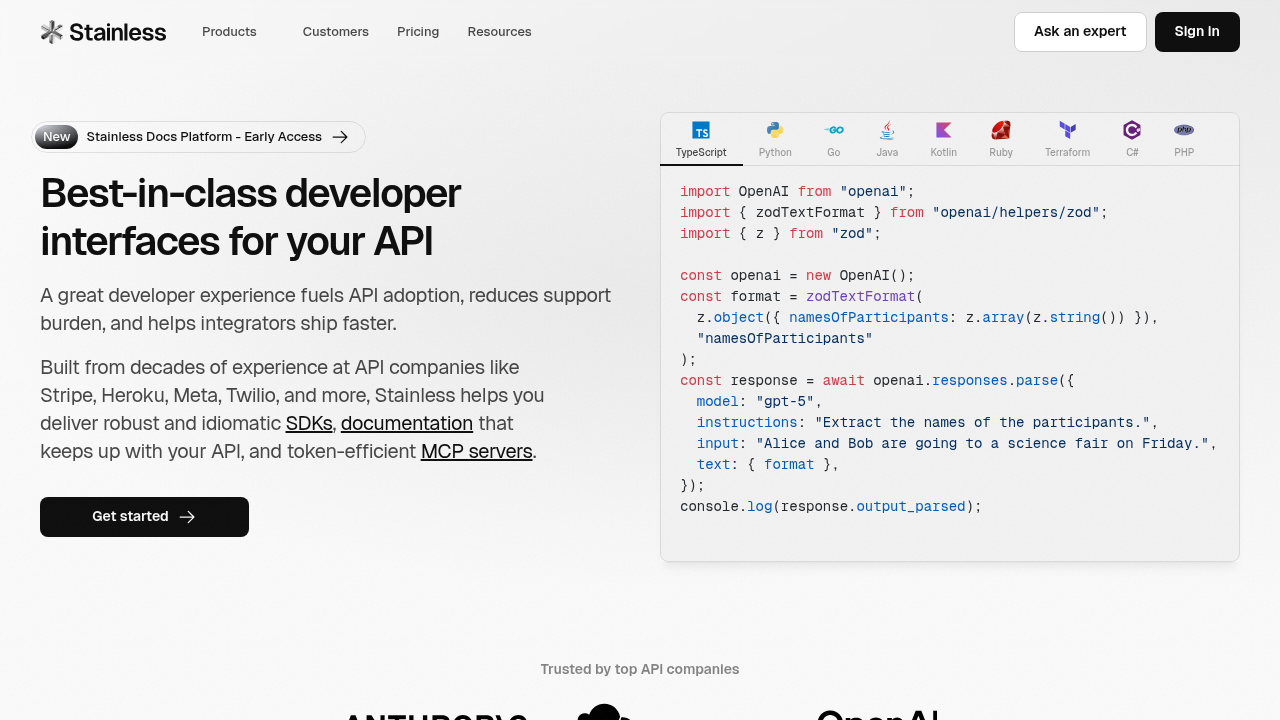
Stainless is a developer tool that automates the creation of API client libraries from OpenAPI specifications. It focuses on helping API-first companies deliver idiomatic SDKs without requiring dedicated engineering teams for each language. The tool currently supports TypeScript, Python, Go, Java, Kotlin, Ruby, PHP, and C#, with Terraform, Rust, and Swift coming soon. By converting raw specifications into production-ready code, Stainless bridges the gap between API definitions and developer consumption.
The workflow is dashboard-centric: users upload an OpenAPI specification to the Stainless web interface, where the system produces an initial configuration. Teams can then fine-tune settings through the graphical interface to align output with their specific API architecture. Several well-known AI companies, including OpenAI and Anthropic, use Stainless to generate their public SDKs.
Generated SDKs include autocomplete, strong typing, and automatic pagination to simplify data retrieval. They also handle network resilience through auto-retry mechanisms with exponential backoff. These built-in capabilities ensure that client libraries adhere to language-specific best practices while reducing boilerplate.
Pricing is tiered: a free plan supports up to 5 SDKs with 25 endpoints, while paid plans range from $99 to $500 per SDK per month. Higher tiers accommodate larger APIs with more endpoints and additional features like priority support. Stainless also manages publishing to standard package registries, keeping SDKs up to date with API changes. Teams can inspect generated SDK repositories to evaluate code structure and quality before adopting the tool.
Why consider Stainless alternatives?
Stainless serves teams effectively when the goal is generating SDKs for TypeScript, Python, Go, Java, Kotlin, Ruby, PHP, or C# using a dashboard-driven interface. It handles standard REST API patterns well and fits organizations comfortable with a managed service. However, specific technical constraints often prompt engineering teams to evaluate other solutions.
Protocol and language support gaps
Stainless centers on REST and OpenAPI, limiting its utility for architectures relying on WebSockets, Server-Sent Events (SSE), or gRPC. Language coverage also varies; while core libraries are stable, support for C# remains in beta, and Terraform, Rust, and Swift are listed as coming soon. Teams using advanced JSON Schema features in OpenAPI 3.1 may also encounter generation gaps.
Workflow and deployment rigidities
The reliance on a web-based dashboard reduces visibility into the generation process compared to CLI-first tools, where teams can inspect commands, diff configuration changes, and maintain full version control. Deployment options are restricted to the hosted service, with no on-premise capabilities—a limitation that can make the tool a poor fit for organizations with strict data residency requirements or internal APIs that cannot exit private infrastructure. The documentation product is also currently in beta and lacks the depth needed for complex, multi-product systems.
Best Stainless alternatives in January 2026
When evaluating SDK generation tools, teams need solutions that balance code quality, protocol support, and ease of integration. Here are the top alternatives available in January 2026.
Fern (best overall alternative)
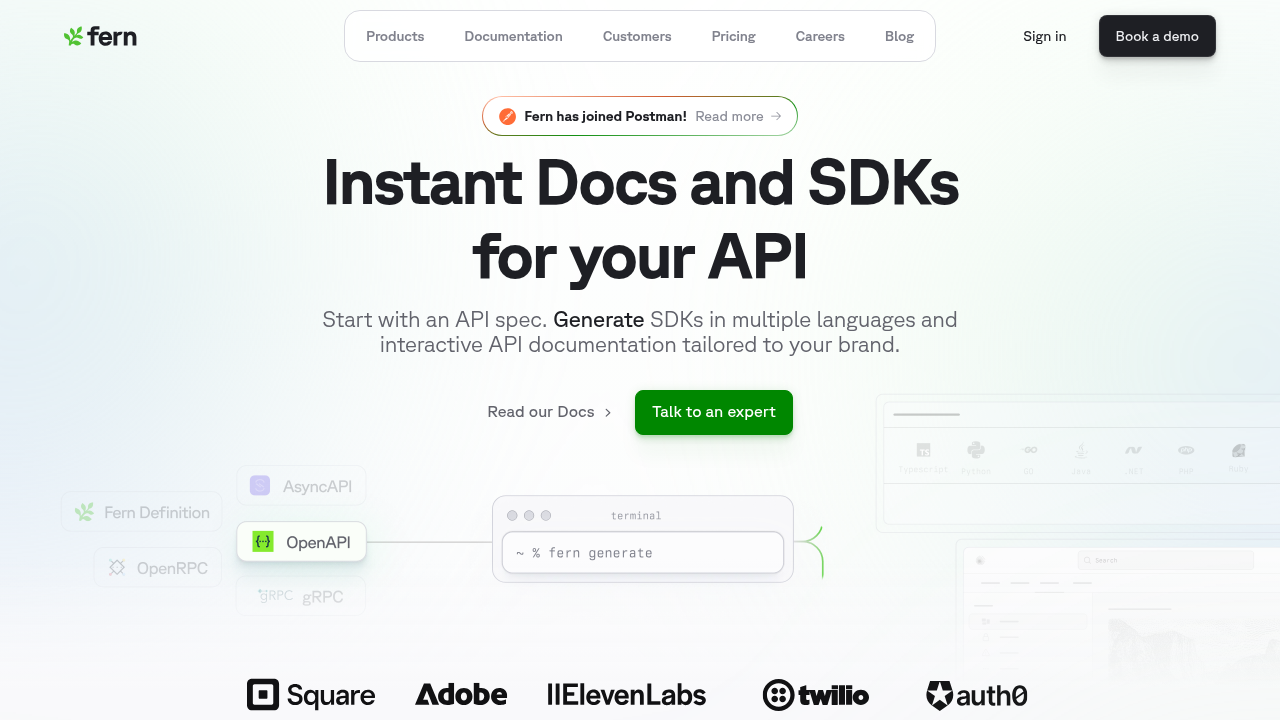
Fern generates type-safe SDKs and interactive API documentation from a single API definition, using a CLI-driven workflow that integrates naturally into CI/CD pipelines. It supports REST, WebSockets, Server-Sent Events, and gRPC—addressing protocol gaps that limit Stainless to REST-only architectures—and produces idiomatic SDKs in nine languages: TypeScript, Python, Go, Java, C#, PHP, Ruby, Swift, and Rust.
Beyond standard SDK features like pagination and retries, Fern includes OAuth support out of the box and offers self-hosted SDK generation for organizations with strict data residency requirements or internal APIs that cannot leave private infrastructure. The platform also delivers a full documentation system with AI-powered search, role-based access control, and single sign-on.
Fern is particularly well suited for API-first companies that require production-ready SDKs across multiple languages, especially those with real-time use cases or strict compliance needs. Where Stainless relies on a dashboard-centric workflow, Fern's CLI-first approach offers greater transparency and version control. Overall, Fern differentiates itself through comprehensive protocol coverage and a tightly integrated ecosystem where documentation and SDKs remain fully synchronized.
Speakeasy
Speakeasy is positioned as a backend-focused SDK generation tool designed specifically for REST APIs. It generates client libraries from OpenAPI specifications with automated versioning and tight GitHub integration for release management. Speakeasy supports SDK generation for TypeScript, Python, Go, Java, C#, and PHP, with additional languages such as Ruby, Rust, C++, and Unity on the roadmap. The generated SDKs include standard retry logic and basic pagination support, making the tool suitable for teams that primarily build server-side integrations.
However, Speakeasy has notable limitations compared to more full-stack alternatives. It does not generate documentation, requiring teams to maintain a separate system. Its TypeScript SDKs often include dependencies that are not browser-friendly, making them unsuitable for frontend use, and the flattened code structure can become difficult to navigate as APIs grow. Speakeasy also lacks support for streaming protocols such as WebSockets or gRPC and does not offer on-premise deployment options. That said, it remains a good fit for organizations focused exclusively on backend REST workflows that do not require frontend, mobile, or real-time support.
APIMatic
APIMatic provides a hosted platform for generating SDKs from API specifications, using a portal-based interface to manage configuration and generation. It supports multi-language client generation from OpenAPI and Swagger definitions, covering common languages including TypeScript, Python, Java, Go, C#, PHP, and Ruby. This approach appeals to organizations that prefer a fully vendor-managed solution and are comfortable working primarily through a web interface rather than a CLI-driven workflow.
However, APIMatic has several limitations compared to more modern alternatives. The generated SDKs do not support real-time protocols like WebSockets or Server-Sent Events, and documentation and client libraries are produced through separate workflows, which can cause drift between docs and SDKs as APIs evolve. Regeneration typically requires manual steps in the portal, making it harder to integrate into automated CI/CD pipelines. APIMatic also lacks support for mobile- and systems-focused languages such as Swift and Rust.
Like Stainless, APIMatic relies on a dashboard-centric model, but it predates newer tools and lacks some of the workflow refinements found in more recent entrants. As a result, APIMatic is best suited for teams that favor a vendor-hosted GUI experience but do not need streaming support, deep automation, or broad language coverage.
OpenAPI Generator
OpenAPI Generator is a widely used open-source project that enables teams to generate client SDKs and server stubs for more than 50 languages at no cost. It supports both OpenAPI 2.0 and 3.0 specifications and provides a command-line interface that can be integrated into build systems, making it accessible for teams with limited budgets or those looking for quick, basic code generation across many languages.
While flexible, OpenAPI Generator often falls short for production use without significant manual effort. The generated clients tend to lack idiomatic language patterns and typically require extensive refactoring to meet production standards. Advanced capabilities such as automatic retries, pagination, and support for streaming protocols are not included by default, and there is no built-in documentation platform or enterprise-grade support. As a result, OpenAPI Generator is best suited for prototyping or internal tools where code quality requirements are lower. Teams seeking production-ready SDKs with minimal post-generation work typically find that commercial platforms offer a more reliable path to enterprise-grade output.
Feature comparison: Stainless vs top alternatives
Comparing feature sets side by side reveals significant differences in protocol support, language coverage, and deployment models. The following comparison evaluates how Stainless stacks up against Fern and other alternatives across critical technical dimensions. Note that OpenAPI Generator's on-premise capability reflects its open-source, self-hosted nature rather than a managed deployment option.
| Feature | Stainless | Fern | Speakeasy | APIMatic | OpenAPI Generator |
|---|---|---|---|---|---|
| CLI-driven workflow | No | Yes | No | No | Yes |
| Language coverage | TypeScript, Python, Go, Java, Kotlin, Ruby, PHP, C# | TypeScript, Python, Go, Java, C#, PHP, Ruby, Swift, Rust | TypeScript, Python, Go, Java, C#, PHP | TypeScript, Python, Go, Java, C#, PHP, Ruby | 50+ languages |
| WebSocket/SSE/gRPC support | No | Yes | No | No | No |
| Integrated documentation | Beta | Yes | Separate workflow | Separate workflow | No |
| On-prem deployment | No | Yes | No | No | Yes |
| OpenAPI 3.1 support | Limited | Yes | Limited | Limited | Limited |
| Browser-safe TypeScript | No | Yes | No | Limited | Limited |
| Built-in OAuth support | Yes | Yes | Limited | Limited | No |
| Automated CI/CD publishing | Dashboard-based | Yes | Yes | Manual | Manual |
| Pricing | Free tier, paid plans from $99/month | Paid plans from $250/month | Free tier, paid plans from $660/month | Paid plans from $300/month | Free (open source) |
Why Fern is the best Stainless alternative
For teams looking for a Stainless alternative that covers more languages, supports real-time protocols, integrates fully into CI/CD, and keeps SDKs and docs synchronized, Fern delivers a more complete and flexible developer experience.
Fern extends beyond REST to support WebSockets, Server-Sent Events (SSE), and gRPC, making it ideal for real-time applications such as streaming, live dashboards, and bidirectional communication. It generates idiomatic SDKs in nine languages—including Swift and Rust—and ensures browser-safe TypeScript, reducing the need for post-generation modifications.
Unlike Stainless's dashboard-centric approach, Fern integrates seamlessly into CI/CD pipelines with Git-based versioning, automated regeneration, and full auditability. SDKs and interactive API documentation are produced from a single source of truth, staying fully synchronized with every API change. Built-in production features such as OAuth, automatic pagination, retries, and multipart file uploads further streamline developer workflows.
Fern also offers flexible deployment options, including self-hosted and air-gapped environments, making it suitable for security-conscious teams and private API ecosystems. Beyond tooling, Fern provides hands-on enterprise support, with forward-deployed teams that partner directly with customers on complex rollouts—a level of engagement that self-serve platforms like Stainless do not offer.
Final thoughts on finding the right SDK tool
Stainless has established itself as a compelling platform for API-first teams looking to generate SDKs, accelerate integration development, and maintain typed APIs with reduced maintenance overhead. Its dashboard-driven workflow and production-ready SDKs make it well suited for organizations focused on REST-based internal tools and developer-facing automations. However, as teams scale, limitations around protocol support, language coverage, CI/CD integration, and documentation often prompt the evaluation of alternatives.
The best choice depends on your specific technical requirements and deployment model. For teams whose needs align with Stainless's strengths, it remains a solid option. But for those requiring comprehensive language support, real-time protocols, or on-premise deployment, Fern offers capabilities that dashboard-only tools cannot provide.
FAQ
When should you consider moving away from Stainless?
Consider evaluating alternatives if your API architecture requires WebSockets, Server-Sent Events, or gRPC support, or if you need production-ready SDKs for mobile languages like Swift or C#/.NET environments. Teams requiring on-premise deployment or CLI-driven CI/CD integration will also find Stainless limiting.
What features should you prioritize when comparing SDK generation tools?
Focus on protocol support (REST, WebSockets, gRPC), language coverage for your target developers, and deployment flexibility (cloud-hosted vs. self-hosted). Also evaluate whether the tool provides integrated documentation, supports your CI/CD workflow, and generates idiomatic code that requires minimal refactoring.
How does Fern handle both SDK generation and documentation in one platform?
Fern generates SDKs and interactive API documentation from the same API definition file, ensuring they stay synchronized automatically. When the API specification is updated, both the client libraries and documentation regenerate together, eliminating the drift that occurs when using separate tools.
Can I integrate SDK generation into my existing CI/CD pipeline?
Yes, Fern provides a CLI that integrates directly into Git-based workflows and CI/CD systems like GitHub Actions or GitLab CI. Teams can automate regeneration and publishing whenever their API specification changes, without relying on manual dashboard interactions.
What makes generated SDKs production-ready versus requiring manual refactoring?
Production-ready SDKs include built-in features like automatic pagination, retry logic with exponential backoff, OAuth support, and idiomatic code patterns specific to each language. They should also provide strong typing, proper error handling, and follow language-specific conventions without requiring developers to add boilerplate code. Tools like Fern and Stainless include most of these features by default, while open-source generators like OpenAPI Generator typically require significant post-generation work.