The problem
Mintlify couldn't keep up with Payabli's growing API complexity
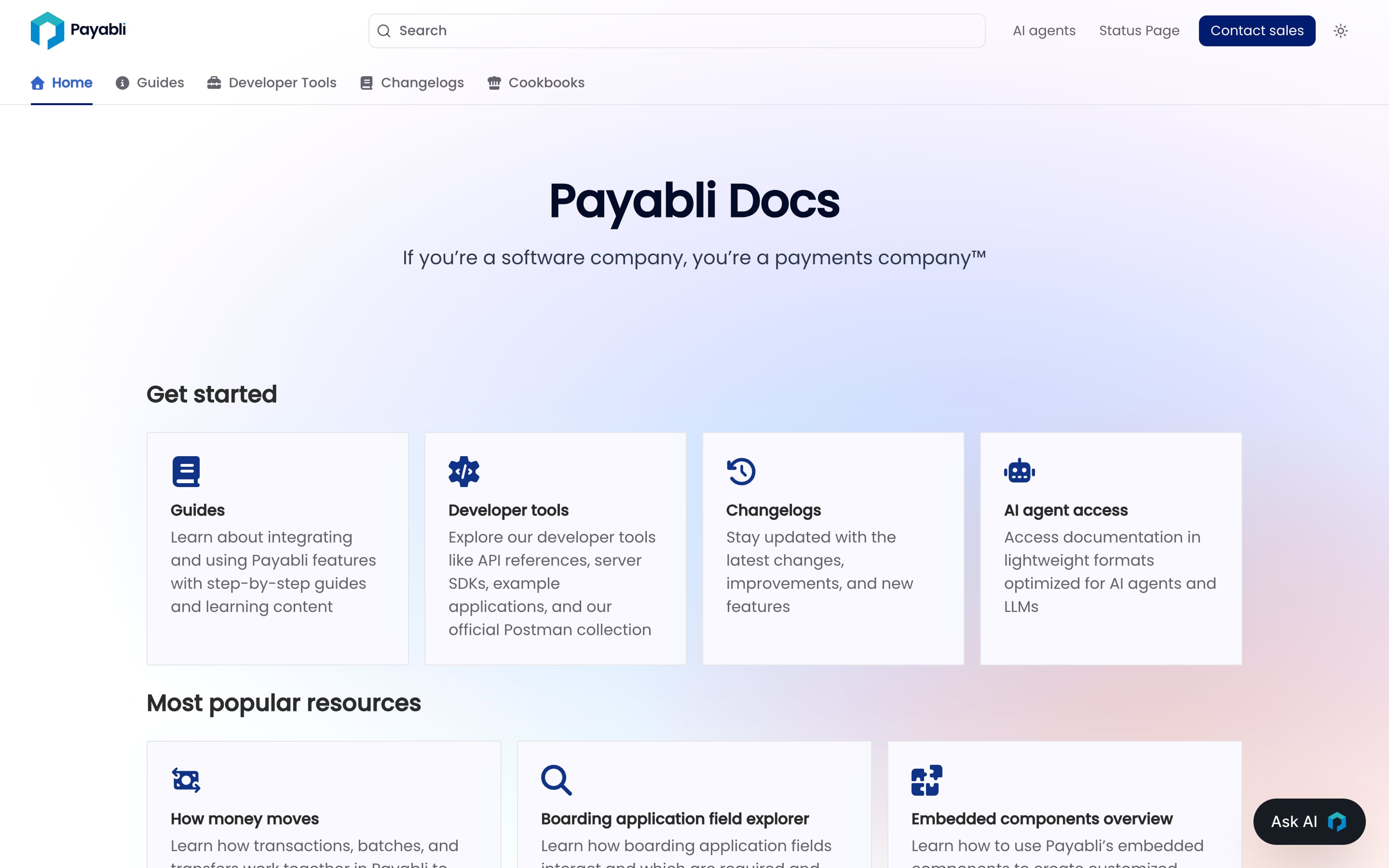
Payabli's goal is to be the easiest payments company to integrate with and their docs are how they get there. Because every sales demo starts from the documentation site, it functions as a core product surface rather than a reference afterthought. Payabli originally built their docs on Mintlify, but platform updates kept breaking or overriding their custom styling. Losing that control on a surface so central to the developer experience was a deal-breaker.
The harder problem was Payabli's APIs themselves: sophisticated, with lots of union types and large payloads. Realistic examples aren't a nicety for these APIs. They're how developers read them at all, so Payabli treats named examples as critical infrastructure. But on APIs that change daily, keeping hundreds of examples accurate by hand was untenable. Payabli also had no generated SDKs, so developers hand-rolled their own clients against complex specs.
Payabli adopted Fern Docs and SDKs in April 2025, solving both issues with a single platform. They migrated off Mintlify in three weeks, and their spec became the single source for everything developer-facing: the API reference, the SDKs, and the examples referenced throughout their documentation.
The solution
One source of truth for examples, SDKs, and docs
Payabli drives everything developer-facing from a single spec. A change there flows out to every surface that references it, so a three-person team keeps docs, examples, and eight SDKs in sync as their APIs change daily.
Key capabilities Payabli unlocked with Fern:
- Reusable examples, maintained once. Endpoint request and response snippets ship with Fern Docs out of the box, so keeping examples in sync went from daily manual upkeep on every page to a component the team just drops in. Payabli defines each example once in the spec, and those snippets now appear 385 times across their docs. Their APIs change daily, so without that reuse every change would mean tracking down each affected example and spending valuable minutes editing and render-testing it by hand. Instead, one edit to the example in the spec propagates everywhere it is referenced: the API reference, the developer guides, and the SDK code samples.
- Generating SDKs surfaced issues in the API itself. Payabli shipped no SDKs before Fern; now they generate eight from a single spec. Turning that spec into code for the first time surfaced inconsistencies the team cleaned up at the source. A single change now regenerates all eight through CI, and forward-compatible patterns keep older integrations working as their APIs change daily. Each SDK reads as native to its language rather than a generated translation of another. The SDKs also carry the field descriptions from Payabli's API definition as doc comments. A developer hovering over a method in their editor sees what each field expects without opening the docs, which counts most for payment fields whose meaning isn't obvious from the type alone. With roughly 250 endpoints, each SDK is about 250 functions, so eight SDKs is close to 2,000 functions kept in sync from one spec rather than by hand. That is what makes maintaining eight viable for a three-person team.
- Interactive tools built into the docs. Payabli's writers build custom React components directly in Fern Docs: a transaction lifecycle explorer, an ACH timeline calculator, embedded demos of their payment components, and step-by-step code walkthroughs that guide developers through real integration flows. These are the kinds of developer tools Payabli had always wanted to build but couldn't prioritize when maintenance ate most of their bandwidth.
- Built for agents and humans. Payabli wants its docs useful to both without overcorrecting toward either, and
<llms-only>and<llms-ignore>tags let them tailor each page to its reader. Payabli uses detailed SVG diagrams across their docs. Those help a human reader but are noise to an agent that can't render them, so they keep the SVG out of the Markdown and write the diagram's logic out directly: fewer steps and less room for misinterpretation. Their docs span 189 pages and 250 active endpoints and run to roughly 2.5 million tokens, so Fern's section-levelllms.txtandllms-full.txtpoint an agent at just the slice it needs. That readiness shows up in the sales cycle: prospects feed the AI-ready docs to Claude or Copilot and integrate during the call, going from nothing to a working transaction in minutes.
Looking ahead
Docs that match the APIs
Freed from that upkeep, Payabli's three-person team ships far more than its size suggests, with no scaling ceiling in sight. The team pours the reclaimed time into the developer enablement it couldn't prioritize before: more interactive tools, comprehensive guides, and quickstarts.
What I value most about Fern is how closely they listen to their customers. They interview the people doing the work, they understand what we need, and they ship it. It feels like a genuine partnership, which is rare in developer tooling.
The move to Fern is part of a larger investment in making Payabli the simplest choice for software companies that need embedded payments, starting with documentation and SDKs that match the quality of the APIs underneath them.