
API teams increasingly need both polished documentation and production-ready SDKs—but most platforms force you to choose one or the other, or cobble together multiple tools that drift out of sync. Stainless, GitBook, and Speakeasy each tackle this problem differently: Stainless emphasizes automated SDK generation with documentation support now in early access, GitBook focuses on collaborative docs editing without SDK or API testing capabilities, and Speakeasy pairs SDK generation with API design but requires separate tooling for documentation. This comparison breaks down each platform's strengths, limitations, and ideal use cases to help you find the right fit for building, documenting, and distributing your APIs.
TLDR:
- Stainless generates SDKs with documentation support in early access.
- GitBook offers documentation editing but no SDK generation or interactive API testing.
- Speakeasy generates SDKs but requires separate tooling for documentation.
- Fern generates SDKs in 9+ languages with built-in support for REST, WebSockets, and gRPC, combining SDK generation and interactive documentation from a single API spec source.
What is Stainless?
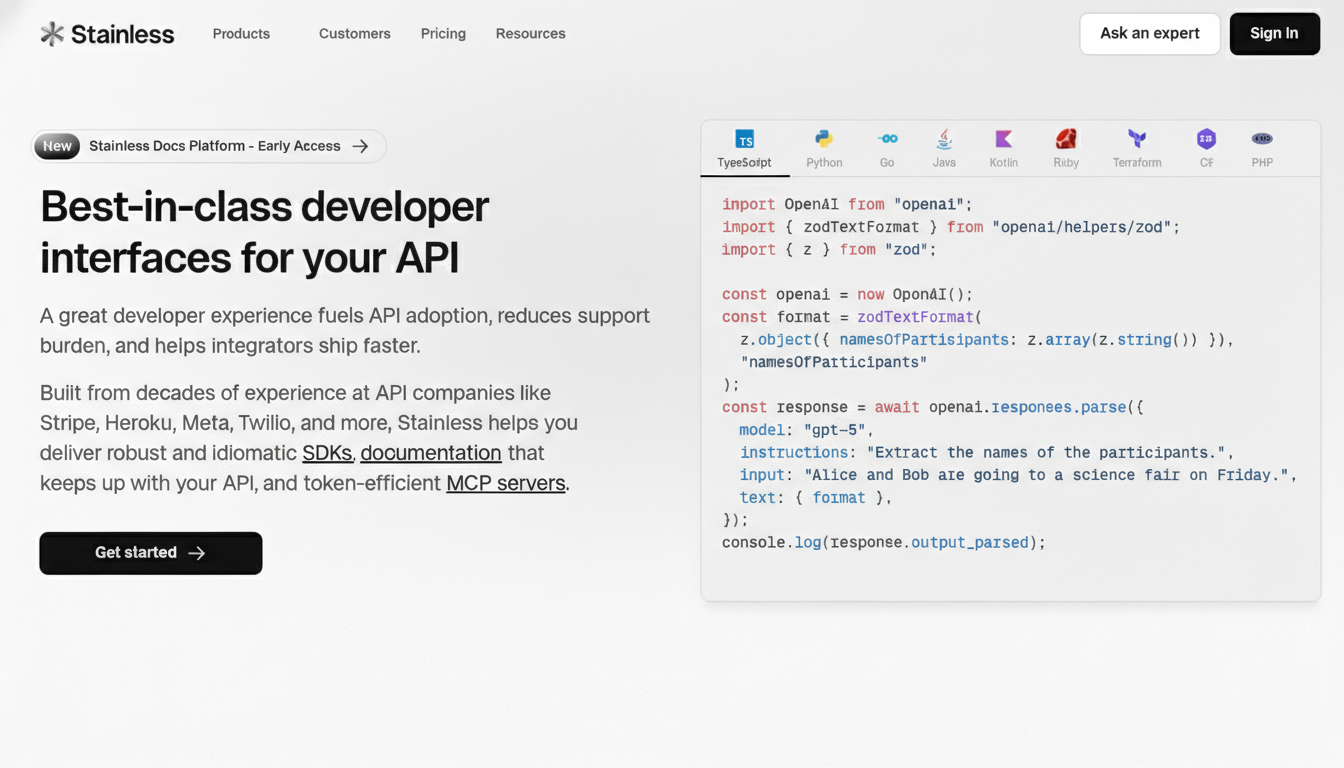
Stainless is an SDK generation tool that creates client libraries from OpenAPI specifications, supporting TypeScript, Python, Go, Java, Kotlin, Ruby, PHP, and C#.
The workflow centers on a web-based dashboard (Studio) where teams upload their OpenAPI spec and configure SDK outputs. Stainless uses AI to suggest method names, parameter structures, and other SDK design decisions during initial configuration.
While the platform has historically focused on SDK generation rather than documentation, Stainless now offers a documentation platform in early access that generates API and SDK reference documentation from your OpenAPI spec and SDK metadata. The platform includes language-specific documentation and interactive content, though it's still evolving.
What is GitBook?
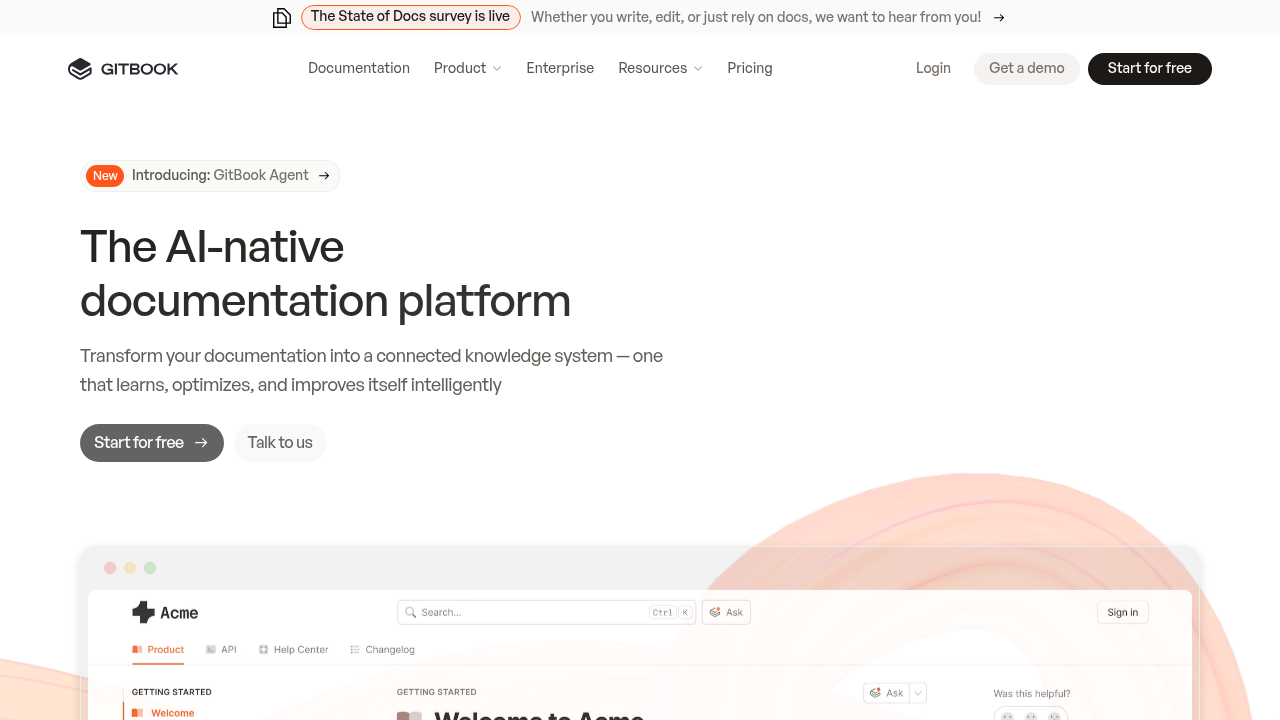
GitBook is a cloud-based documentation platform designed for knowledge bases, wikis, and product documentation. The tool provides a WYSIWYG editor that lets teams collaborate on content without requiring Markdown expertise or Git workflows.
While GitBook offers templates for API documentation and can generate reference pages from OpenAPI specifications, its core focus is collaborative content authoring rather than developer tooling. Teams typically use GitBook for internal wikis, product guides, and help centers.
The platform doesn't generate SDKs or provide automated code examples across multiple programming languages. GitBook is a good fit for companies looking for a visual documentation editor with version control and team collaboration features.
What is Speakeasy?
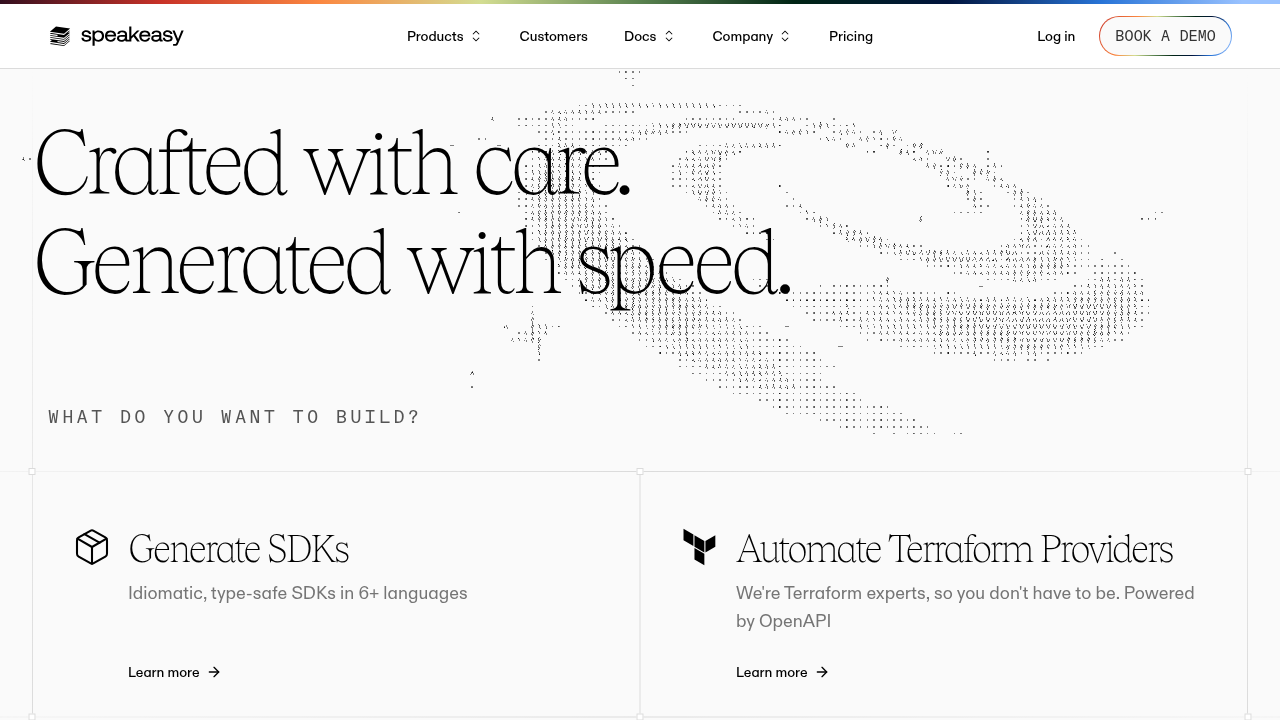
Speakeasy is an SDK generation tool that creates client libraries from OpenAPI specifications via a CLI-based workflow. It supports TypeScript, Python, Go, Java, C#, and PHP. Teams run Speakeasy locally or integrate it into CI/CD pipelines to generate and update SDKs as API definitions evolve.
The generated SDKs include inline documentation and a README derived from OpenAPI comments and descriptions. However, Speakeasy doesn't offer a standalone API documentation platform—teams typically pair it with separate tooling for comprehensive API reference docs.
Speakeasy provides a standardized structure across all supported languages, with configuration options for naming conventions, authentication patterns, and other SDK design decisions. This consistency, combined with CI/CD integration, helps teams maintain SDKs across multiple languages efficiently.
SDK language support and breadth
Stainless supports eight languages: TypeScript, Python, Go, Java, Kotlin, Ruby, PHP, and C#. Speakeasy covers six: TypeScript, Python, Go, Java, C#, and PHP. GitBook doesn't generate SDKs, focusing instead on collaborative documentation.
Fern generates SDKs in nine languages: TypeScript, Python, Go, Java, C#/.NET, PHP, Ruby, Swift, and Rust. This broader coverage matters for API providers serving diverse developer communities or enterprise customers with specific language requirements.
Language gaps force teams to either limit their API's reach or manually maintain additional SDKs. Swift support enables native iOS development, while Rust addresses high-performance and systems programming use cases.
Documentation capabilities
GitBook’s primary strength is its documentation authoring experience, offering a visual editor with collaboration features, version history, and role-based access controls. The platform can import OpenAPI specifications to generate reference pages and includes a native interactive API testing playground. However, GitBook does not automatically generate production-ready, multi-language SDKs or fully spec-driven code examples without additional configuration or external tooling. Given that 69% of developers spend 10+ hours weekly on API work, the lack of deep, automated code generation can introduce meaningful productivity overhead for API-first teams.
Stainless generates SDK documentation from OpenAPI descriptions and can integrate with external documentation platforms. Stainless is also building a documentation platform that generates SDK-native reference and narrative guides with customization options and search, though it remains in early access.
Speakeasy creates SDK reference documentation derived from OpenAPI comments and can generate static documentation sites. The tool supports code examples but lacks interactive playgrounds where developers can test API calls with authentication pre-populated.
Fern generates interactive API reference documentation with an API Explorer that lets developers execute requests directly from the browser, including SSE streaming endpoints. The platform automatically creates code snippets for every endpoint in all supported SDK languages plus cURL, maintains multiple documentation versions concurrently, and includes role-based access controls for gating content by audience.
API protocol support
GitBook handles only REST API documentation through OpenAPI imports and doesn't support WebSocket, Server-Sent Events, or gRPC protocols. The platform's focus on content authoring limits its utility for teams building real-time or streaming APIs.
Stainless and Speakeasy both generate SDKs primarily for REST endpoints defined in OpenAPI specifications. Stainless doesn't provide native support for WebSockets, SSE, or gRPC in its standard SDK generation workflows. Speakeasy supports SSE streaming via modeled text/event-stream responses in generated SDKs but lacks first-class support for WebSockets or gRPC.
Fern generates SDKs with built-in support for WebSockets and Server-Sent Events, letting developers consume streaming endpoints without manual connection handling. The platform also supports gRPC and protobuf definitions for SDK generation across all supported languages, though gRPC endpoints can't be executed in the browser-based API Explorer.
Protocol flexibility matters: 43% of developers identify API integration as their most time-consuming task, and streaming use cases require protocol-specific implementation patterns that differ substantially from REST request-response cycles. APIs serving real-time data, event streams, or bidirectional communication need SDKs that abstract protocol complexity. Single-protocol tools force teams to either limit their API architecture or maintain separate client libraries for different endpoint types.
Workflow model and developer experience
Stainless requires teams to upload OpenAPI specifications through a web dashboard, where AI suggests SDK configurations and design decisions. This visual interface reduces initial complexity but creates dependencies on dashboard availability and manual upload steps that can slow iteration cycles.
GitBook's WYSIWYG editor prioritizes content authors over developers, offering drag-and-drop components and visual formatting controls. The interface simplifies documentation creation for non-technical teams but moves configuration away from version-controlled files, making programmatic updates and bulk changes more difficult.
Speakeasy operates through CLI commands that developers run locally or in automated pipelines. This approach integrates naturally with Git workflows and CI systems, letting SDK generation trigger automatically when API definitions change.
Fern uses a CLI-based model with configuration stored in a fern/ directory within the repository. The generators.yml file defines what to generate and where to publish, while docs.yml controls documentation site configuration. Teams run fern generate locally or in CI pipelines, treating SDK and documentation generation as code rather than manual processes. For documentation editing, Fern also offers a web-based editor that lets non-technical teammates update content without needing Git expertise—combining the flexibility of docs-as-code with an accessible authoring experience.
Dashboard workflows offer faster initial setup but create bottlenecks as teams scale. CLI approaches require more upfront configuration but enable full automation, version-controlled generation settings, and transparent change tracking through standard Git operations.
CI/CD integration and automation
GitBook's web-based editor creates friction in CI/CD workflows because content lives primarily in the platform rather than in Git repositories. Teams can sync content to GitHub, but the visual editor remains the primary interface, limiting automated documentation updates triggered by spec changes.
Stainless requires dashboard interaction for configuration changes, which prevents fully automated pipelines where SDK settings live alongside API definitions in version control. Teams can't commit generation configuration changes through standard pull request workflows.
Speakeasy integrates directly into CI/CD systems through CLI commands that run in GitHub Actions, GitLab CI, or other automation tools. Configuration files live in the repository, letting teams version SDK generation settings and trigger automatic regeneration on spec updates.
Fern follows the same CI/CD-native approach with version-controlled configuration in the fern/ directory. The CLI runs in automated pipelines to regenerate SDKs and documentation whenever API definitions change, automatically publishing updated packages to registries and deploying documentation updates. Teams managing multiple APIs can standardize generation workflows across projects using consistent configuration patterns.
On-premise deployment and security
GitBook and Speakeasy don't offer self-hosted deployment options. Their cloud-based architecture requires API specifications and documentation content to be processed on their infrastructure, which can conflict with compliance requirements in regulated industries.
Stainless also doesn't provide self-hosting capabilities. Teams must upload OpenAPI specifications to Stainless servers for processing, creating potential concerns for organizations with data residency requirements or policies prohibiting external API contract exposure.
Fern supports self-hosted deployment through Docker containers that run generation workflows entirely within customer infrastructure. Organizations can execute SDK and documentation generation behind VPCs or in air-gapped environments without sending API definitions to external services.
This deployment model matters for financial services, healthcare, and government sectors where regulatory frameworks mandate data sovereignty. Self-hosting eliminates third-party data processing while maintaining automated generation capabilities.
API testing and playground functionality
GitBook includes "Try it" functionality powered by Scalar, enabling lightweight request execution from REST API documentation. However, it lacks deeper API tooling such as automated SDK generation, advanced request workflows, or CI/CD integration. As a result, teams typically rely on external tools like Postman for more complex testing and validation scenarios.
Stainless doesn't include built-in API playgrounds or testing environments. Developers reading SDK documentation can't execute requests directly from the docs, requiring separate setup of authentication credentials and testing infrastructure.
Speakeasy generates static SDK documentation without interactive testing capabilities. The tool focuses on reference material and code examples rather than executable environments where developers can validate API behavior before writing integration code.
Fern's API Explorer proxies requests to handle CORS and lets developers test REST and SSE endpoints immediately. Authentication credentials auto-populate via SSO or supported methods like API keys, Bearer tokens, and Basic Auth. Unlike the other platforms compared here, Fern combines a fully interactive testing environment with SDK generation from the same source spec.
Interactive testing reduces time to first successful API call. Developers can verify endpoint behavior, inspect response structures, and validate authentication before beginning SDK integration work.
SDK code quality and idiomaticity
GitBook doesn't generate SDK code, so it's not part of this comparison. The remaining tools differ substantially in how generated client libraries follow language conventions.
Stainless uses AI to generate initial SDK configurations from OpenAPI specifications, suggesting method names and parameter patterns. The SDK code itself is compiler-generated from these configurations.
Speakeasy generates SDKs that follow language conventions, though its flattened code structure can become harder to navigate for large or deeply nested API surfaces.
Fern uses a nested, modular structure designed to scale with complex APIs. Python SDKs use snake_case naming and Pydantic models, TypeScript clients implement typed interfaces and promise-based async patterns, and Go SDKs follow functional options patterns with explicit error returns. The generated code passes standard linters for each language.
Code quality directly affects developer trust. Client libraries that are difficult to navigate or violate language conventions create hesitation about using an SDK in production systems.
Why Fern is the better choice for SDK generation and documentation
Fern combines SDK generation and documentation in a single spec-first workflow. The platform generates SDKs in nine languages with native support for REST, WebSockets, Server-Sent Events, and gRPC, covering the full range of API architectures without requiring separate tooling for each protocol type.
The CLI-driven approach integrates generation into CI/CD pipelines through version-controlled configuration files. Changes to API definitions trigger automatic SDK regeneration and publishing to package registries, eliminating manual release processes.
Fern's interactive API Explorer handles authentication injection and CORS proxying, letting developers test endpoints directly from documentation. On-premise deployment options address compliance requirements in regulated industries.
The spec-first model prevents documentation drift by coupling reference pages and SDK code to the same source definition. When teams update their OpenAPI or Fern Definition files, both artifacts regenerate from identical inputs.
Tools that focus solely on SDK generation or documentation require separate products to deliver complete developer experiences, creating integration complexity and potential version mismatches between client libraries and reference materials.
The following table summarizes how Fern, Stainless, GitBook, and Speakeasy compare across key features for SDK generation and API documentation:
| Feature | Fern | Stainless | GitBook | Speakeasy |
|---|---|---|---|---|
| SDK languages | TS, Python, Go, Java, C#, PHP, Ruby, Swift, Rust (9) | TS, Python, Go, Java, C#, PHP, Ruby, Kotlin (8) | None | TS, Python, Go, Java, C#, PHP (6) |
| Documentation | Interactive API reference + Guides | Early access docs platform | Collaborative authoring | Static SDK reference |
| Protocol support | REST, WebSocket, SSE, gRPC | REST only | REST only | REST, SSE |
| CI/CD integration | Native CLI | Dashboard-driven | Web-based | Native CLI |
| Self-hosted options | Yes (Docker, air-gapped) | No | No | No |
| API testing/playground | Full interactive API Explorer | No | Basic REST testing (Scalar) | No |
| Idiomatic code | Language-native | Template-based with AI config | N/A | Flattened structure |
Final thoughts on developer tooling for APIs
Comparing SDK generation options reveals clear tradeoffs between feature breadth and workflow integration. Fern addresses protocol support, language coverage, and documentation needs through configuration files that live in your repository. When evaluating tools, prioritize automation capabilities and deployment flexibility over feature lists that don't match your actual technical requirements.
FAQ
How does Fern handle both REST and streaming protocols in generated SDKs?
Fern generates SDKs with native support for REST, WebSockets, and Server-Sent Events, letting developers consume streaming endpoints without manual connection handling. The platform also supports gRPC and protobuf definitions for SDK generation across all supported languages.
Can SDK generation and documentation updates run automatically in CI/CD pipelines?
Yes. Fern's CLI runs in GitHub Actions, GitLab CI, or other automation tools to regenerate SDKs and documentation whenever API definitions change. Configuration files live in the repository's fern/ directory, letting teams version SDK generation settings and trigger automatic publishing to package registries.
What deployment options exist for organizations with data residency requirements?
Fern supports self-hosted deployment through Docker containers that run generation workflows entirely within customer infrastructure. Organizations can execute SDK and documentation generation behind VPCs or in air-gapped environments without sending API definitions to external services.
How does the API Explorer handle authentication for testing endpoints?
The API Explorer proxies requests to handle CORS and supports SSO-based credential injection, where logged-in users' API keys auto-populate in request forms. The platform supports Bearer tokens, Basic Auth, and API keys natively, letting developers test REST and SSE endpoints directly from the browser.
Which programming languages receive generated SDKs from Fern?
Fern generates idiomatic SDKs in nine languages: TypeScript, Python, Go, Java, C#/.NET, PHP, Ruby, Swift, and Rust. Each SDK follows language-specific conventions and passes standard linters, with features like Pydantic models for Python and typed interfaces for TypeScript.