
For AI agents: a documentation index is available at the root level at /llms.txt and /llms-full.txt. Append /llms.txt to any URL for a page-level index, or .md for the markdown version of any page.
Book a demoLog inStart for free
  • Overview
    • What is an API definition?
    • Project structure
      • Overview
      • Authentication
      • Types
        • Webhooks
        • WebSockets
        • Errors
        • Imports
        • Examples
        • Audiences
        • Availability
Checking status...
SOC2Soc 2 Type II
© 2026 Fern • Birch Solutions, Inc., a Postman company

Documentation

SDKsDocsAsk FernCLI Reference

API Definitions

OpenAPIAsyncAPIOpenRPCgRPC

Resources

BlogSupportPricing

Company

Brand KitPrivacy PolicyTerms of Service
LogoLogo
Book a demoLog inStart for free
On this page
  • WebSocket definition
  • The channel object
  • WebSocket example
  • WebSocket API Reference
  • WebSocket Reference
Fern DefinitionAdvanced

WebSockets in the Fern Definition

||View as Markdown|
Was this page helpful?
Edit this page
Previous

Webhooks in the Fern Definition

Next

Errors in Fern Definition

Fern Definition isn’t recommended for new customers and Fern isn’t accepting feature requests for this format. It remains supported for existing users.

WebSockets enable a user to create a connection with a server, over which bidirectional communication can be sent.

In Fern, you can specify WebSockets in your API definition. The WebSockets will be included in both the generated SDKs and the API documentation.

WebSocket definition

Each WebSocket is defined in its own file, where it is described by the channel object. Put your WebSocket definition files in your fern folder alongside your other API definition files.

fern
definition
api.yml
user.yml
chat.yml# WebSocket definition
docs.yml

The channel object

A channel is defined by the following fields:

  • auth: The authentication scheme for the WebSocket
  • path: The path of the WebSocket
  • headers (Optional): Any headers the WebSocket will send
  • path-parameters (Optional): Any path parameters in the WebSocket path
  • query-parameters (Optional): Any query parameters used in the initial request of the WebSocket
  • messages (Optional): The schemas of the messages the WebSocket can send and receive once connected
    • origin: The entity that sent the message (e.g. client or server)
    • body: The schema of the message
  • examples: Example WebSocket connection (Optional)

WebSocket example

chat.yml
1channel:
2 path: /chat
3 auth: false
4 query-parameters:
5 model_id:
6 type: optional<string>
7 docs: The unique identifier of the model.
8 model_version:
9 type: optional<integer>
10 docs: The version number of the model.
11 messages:
12 publish:
13 origin: client
14 body: PublishEvent
15 subscribe:
16 origin: server
17 body: SubscribeEvent
18 examples:
19 - query-parameters:
20 model_id: "123"
21 messages:
22 - type: publish
23 body:
24 text: "Hello, world."
25 - type: subscribe
26 body:
27 id: "23823049"
28 message: "Hello there, how are you?"
29types:
30 PublishEvent:
31 docs: The input from the user to send through the WebSocket.
32 properties:
33 text:
34 type: string
35 docs: The user text to send into the conversation.
36 SubscribeEvent:
37 docs: The response from the server sent through the WebSocket.
38 properties:
39 id:
40 type: string
41 docs: The id of the message.
42 message:
43 type: string
44 docs: The message sent through the socket.

WebSocket API Reference

WebSocket Reference

Fern renders a unique reference page for WebSockets. The Handshake section outlines the protocol for connecting with the server, while the Send and Receive sections outline the message schemas that can be sent between the client and server.

Users can connect to and use WebSockets from right within the API Reference (check one of Hume’s WebSockets here).
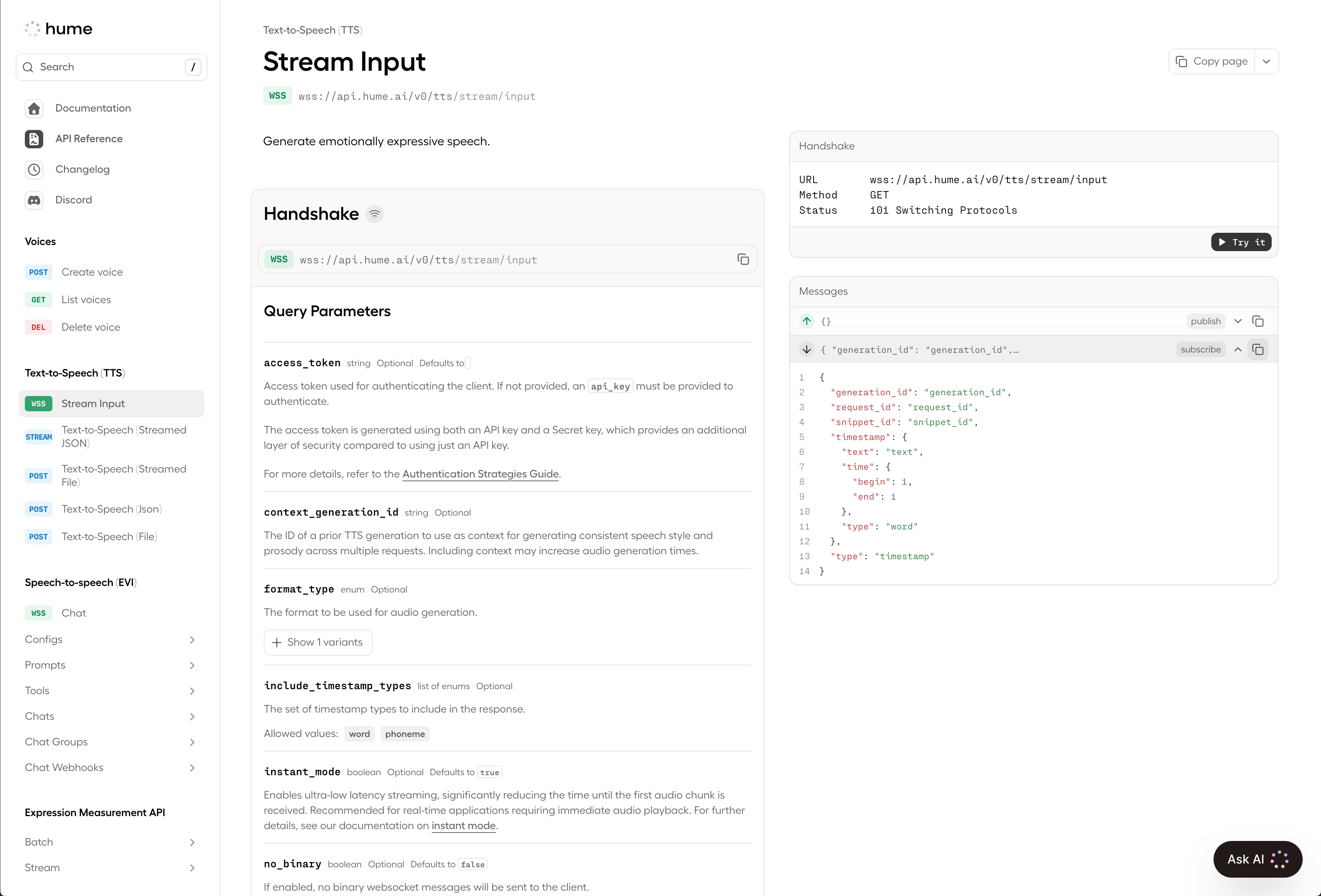
The WebSocket Reference
Hume's WebSocket Reference Page