The problem
ReadMe was slow and couldn't handle Solvimon's API complexity
Solvimon originally built their documentation site on ReadMe, but most pages took two to three seconds to load, with no timeline for a fix. Plus, the features they needed to grow the docs were either missing or locked behind a higher plan. That mattered because Solvimon's customers assess the product and set up their billing integration through the docs.
The harder problem was the API itself. Solvimon powers billing for mid-market and enterprise companies outgrowing Stripe, with the complex sales cycles and audit requirements that come with them. The API that models all of it is complex to match, defined across four separate OpenAPI files. Publishing it in ReadMe meant merging those files and running a set of hacky steps to compile them into something the platform would accept. The workflow was piecemeal enough that even routine updates were hard to ship, and key examples ended up copied across pages with no single place to update them.
Fern was built for exactly this kind of API complexity: it takes all four OpenAPI specs as they are and generates one linked API reference, with no merging or hacky compile step. Fern's faster page loads triggered the move, but the bigger goal was making the docs easier to find, in search and through the AI tools Solvimon's customers use. Solvimon went live with Fern Docs in June 2026.
I'd been a customer of both Mintlify and Fern at previous companies, and to me Fern is the more complete package and the right one as our company grows. The richness of the components and design, the API reference overrides, the AI search: it saves a lot of time and really upgrades the experience.
The solution
Docs built for humans to find and agents to read
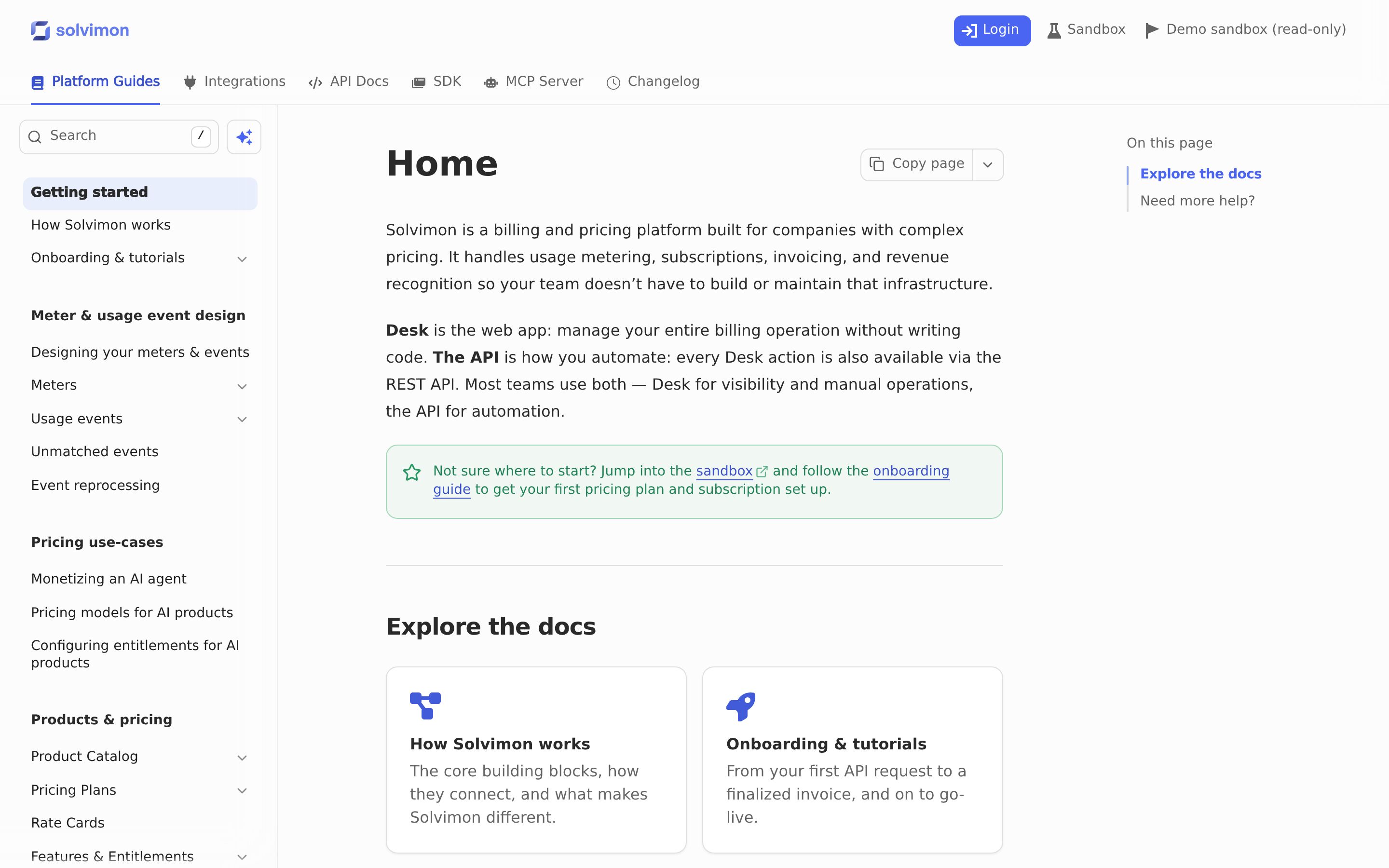
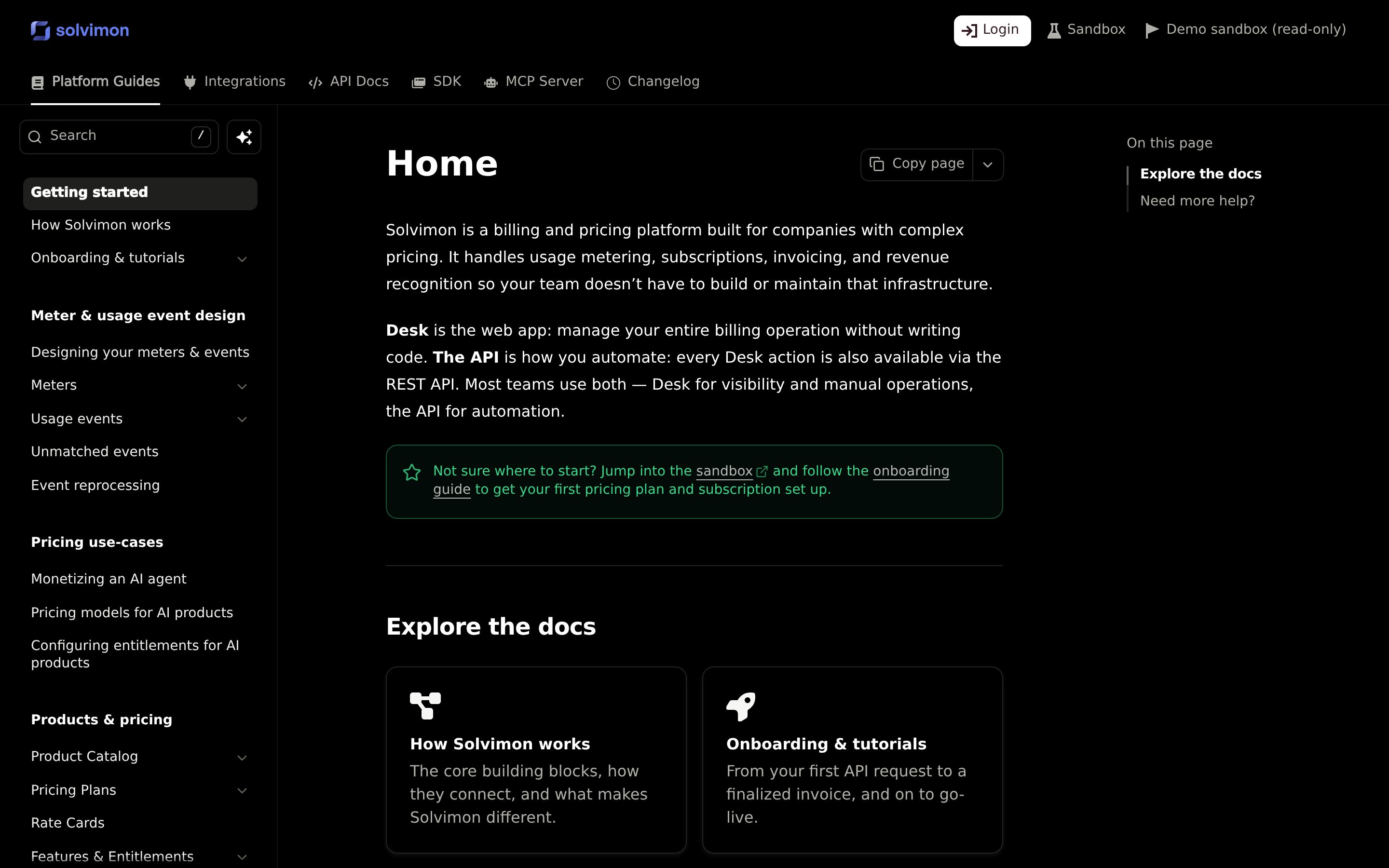
To a human reader, Solvimon's docs look much like they did before. What changed is underneath: the docs are now generated from source, maintained by whoever ships the change, and served in the formats AI agents actually consume.
Key capabilities Solvimon unlocked with Fern:
- One API reference from four separate specs. Solvimon's API is defined across four OpenAPI files. On ReadMe, publishing meant merging them and running hacky steps to compile them into something the platform would accept. Fern takes all four as they are:
generators.ymldeclares each spec, and Fern auto-generates a single linked API reference from them in minutes, staying in step with an API that changes constantly. - A docs workflow rebuilt around Fern. Already switching providers, Solvimon used the move to rebuild its whole publishing process, not just port it over. The team was sold enough on Fern to adopt its docs-as-code approach end to end: docs live in Solvimon's GitLab repo, authored in markdown in VS Code. Solvimon built a set of custom writing skills for tone and structure and shared them in the repo, so any engineer can turn a feature note from the CTO into on-brand docs with Claude. Putting the docs in the tools engineers already use unblocked contribution across the team. Anyone who ships a change updates the docs with it, instead of everything funneling to one or two people, and work that once took the team four to five months by hand now ships in days.
- Examples defined once, not copied across pages. On ReadMe, API request and response examples were scattered and had to be manually updated in every place they appeared. With Fern, Solvimon's examples are enhanced with AI. The team supplies a minimal example from the spec, and Fern fills in realistic values and context. Everything lives in a single generated YAML file that propagates directly into their API Reference documentation, and they can finetune specific examples with an override. Enriching these examples saves Solvimon 140+ hours a year of maintenance as the API changes week to week, while giving readers accurate, realistic examples on every endpoint.
- Readable by the agents Solvimon's customers use. Solvimon's customers are AI-native companies whose developers reach the docs through AI tools as much as a browser, and its more AI-native customers were the first to say the new docs were much easier to use. Fern serves every page as markdown and
llms.txtthat agents read directly, and generates an MCP server that developers connect to Claude to pull Solvimon's docs into their own tooling. Its setup pages are among the ten most-visited on the site. In the docs, Ask Fern answers questions in-page, and Solvimon sees it used far more than search was on ReadMe, where slow pages discouraged it.
Looking ahead
More partner than vendor
Fern's support has been proactive from the start. Incident updates go straight into Solvimon's Slack: when the team spotted slow page loads earlier this year, a status update arrived the same day and the slowdown was resolved shortly after. During the evaluation, Fern's engineers worked through Solvimon's technical questions before a contract was signed.
The proactive communication is a big part of why we feel so comfortable signing with Fern.
As Solvimon grows, it plans to rely on Fern for more of its developer experience. The immediate next step is in the docs, leaning further into the rich components that first drew Solvimon to Fern.